
AI Babies: Why Elon Musk Thinks Algorithms Will Save Humanity
AI, Love, and Babies: What Elon Musk Really Meant
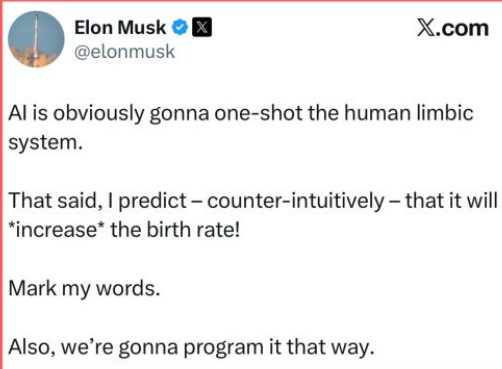
Elon Musk has a habit of dropping tweets that sound like riddles from the future. One of his recent posts is exactly that. He said AI is going to “one-shot the human limbic system.” Translation? AI is going to directly hit the emotional center of our brains—the part that controls love, desire, fear, and reward.
But then he added a twist: instead of making people more lonely or addicted, he predicts AI will actually increase the birth rate. And here’s the kicker—he says they will program it that way.
Why would Elon say this?
First, remember who’s talking. Elon Musk isn’t just building rockets and cars—he’s also obsessed with the survival of humanity. He has openly said that one of the biggest risks we face is population collapse. And to prove he’s serious, he himself has gone out of his way to have many kids. As of now, Elon Musk has 14 children with four different women. For him, it’s not just talk; he’s living his pro-natalist philosophy.
So when Elon says AI will boost birth rates, he’s imagining a future where AI is used not just to entertain us, but to connect us.
The limbic system hack
AI already controls your dopamine. Think about it: Instagram reels, YouTube shorts, and endless scrolling aren’t accidents—they’re carefully engineered dopamine machines. Every scroll, every like, every ping is designed to keep you hooked. That’s what Elon means by “one-shotting the limbic system.”
But what if instead of using that power to trap us in our phones, AI used it to push us toward real relationships, marriages, and children? That’s the radical angle Elon is pointing at.
How AI could actually increase connections
- Smarter matchmaking:
Dating apps today are just slot machines with faces. But AI can go further—matching people based on personality, values, lifestyle, and even subtle emotional compatibility. No more endless swiping. The system could simply say: “Here’s the person you’re most likely to build a family with.” - AI as a social coach:
For many people, fear and awkwardness stop them from approaching others. Imagine an AI assistant that doesn’t just help you text better but also coaches you for a date, suggests conversation starters, and pushes you to actually meet someone offline. - Reducing loneliness:
Right now, AI companions are already filling gaps for people who feel isolated. But if programmed the right way, they could act as bridges—helping people build confidence until they’re ready for human-to-human bonds. - Helping with infertility:
This is the dark truth: today 1 in 6 people suffer from infertility, and it’s not just stress—it’s also because of microplastics and microfibers that have invaded our bodies, even our blood, brains, and testicles. But AI is already being used in fertility clinics to improve IVF, rank embryos, and predict the best chances of conception. With more advances, AI could make fertility treatments cheaper, faster, and more successful—giving more couples a chance to have children. - Designing healthier environments:
AI could even help us fight the invisible enemies—like plastic particles in our water, clothes, and food—by mapping exposure, creating better filters, and designing low-shed fabrics. If our bodies are healthier, fertility has a better chance.
Why Elon ties this to Grok and X
Elon owns X (formerly Twitter) and has an AI project called Grok. He’s already hinted that he wants to turn X into a dating platform. If you connect the dots, his vision becomes clearer: Grok could analyze users, match them deeply, and nudge them to meet in real life. Instead of wasting hours doomscrolling, the app could actually push you into a coffee shop with someone compatible.
Imagine X not as a place where people fight online, but as a place where people meet their future partners. That’s what Elon means when he says: “We’re gonna program it that way.”
The name-and-shame reality
Here’s the uncomfortable truth: Big Tech today is killing real human connection.
- Meta (Facebook, Instagram) engineered infinite scroll to keep you chasing likes instead of real love.
- Google’s YouTube perfected the recommendation trap—you start with one video and lose three hours of your life.
- Tinder and Bumble make money when you keep swiping, not when you actually find someone and leave the app.
- Netflix proudly tells you to “watch next” instead of “go live your life.”
They’re not building families; they’re farming your attention. They’ve hijacked the same limbic system Elon is talking about, but they use it to keep you alone, glued, and addicted.
Musk, for all his chaos, is at least pointing in a different direction: use AI to give people real bonds, real partners, and real children. That’s why he says, “We’re gonna program it that way.”
A glimpse into 2050
Picture this: It’s the year 2050. Two-thirds of married couples around the world don’t say, “We met on Tinder.” They say, “We met through Grok.”
Instead of wasting years swiping left and right, AI simply pairs people with their most compatible matches. Divorce rates have fallen. Loneliness has declined. Birth rates are stabilizing. Kids born in 2050 are called the “Grok Generation.”
Now rewind to today: half of modern relationships are collapsing because dating apps profit more from breakups than from marriages. People are lonelier than ever despite being more “connected” online. Fertility is in crisis because our bodies are drowning in plastics, while Big Tech keeps pushing dopamine hits instead of real connections.
Elon is betting that AI can flip the script. That instead of being the tool that kills intimacy, AI becomes the tool that saves humanity’s future.
👉 The question is not whether AI can hack our brains—it already has. The question is: who programs it, and for what purpose? Will it be Big Tech squeezing our loneliness for ad dollars, or Elon Musk trying to turn dopamine into babies?
Comments

Hi, I’m Nishanth Muraleedharan (also known as Nishani)—an IT engineer turned internet entrepreneur with 25+ years in the textile industry. As the Founder & CEO of "DMZ International Imports & Exports" and President & Chairperson of the "Save Handloom Foundation", I’m committed to reviving India’s handloom heritage by empowering artisans through sustainable practices and advanced technologies like Blockchain, AI, AR & VR. I write what I love to read—thought-provoking, purposeful, and rooted in impact. nishani.in is not just a blog — it's a mark, a sign, a symbol, an impression of the naked truth. Like what you read? Buy me a chai and keep the ideas brewing. ☕💭 For advertising on any of our platforms, WhatsApp me on : +91-91-0950-0950 or email me @ support@dmzinternational.com