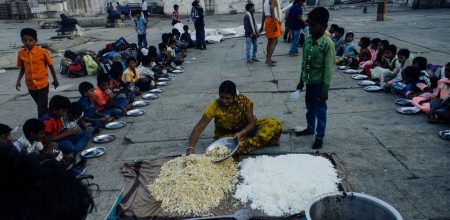
50 paise For a Child’s Vegetable: Welcome to India’s Nutrition Scam
Let’s drop the politeness and get straight to the gut punch.
In Ramanagara, Karnataka, an Anganwadi cooking meal for children below six gets 50 paise per child per day for vegetables.
Not ₹5. Not ₹50.
₹0.50 ( 50 paise )
That’s not a typo. That’s official government allocation.
At today’s prices, you can’t buy tomato skin, forget tomatoes. You won’t get a curry leaf, a green chilli, or even the smell of coriander with this amount. What exactly are we trying to feed these children—air, promise, or political blindness?
This is not poverty.
This is institutional neglect wrapped in paperwork.
Who Is Giving This Shameful Amount?
This money flows under the ICDS (Integrated Child Development Services) scheme.
On paper, it’s a joint responsibility of the Central and State Governments.
On the ground, this particular allocation comes from Karnataka’s state machinery, routed through the Department of Women and Child Development, and trickles down to Anganwadi centres via district and taluk offices.
By the time it reaches the kitchen, the child is left with 50 paise worth of “nutrition”.
This amount has been in force for years, silently adjusted, quietly accepted, never revised in line with inflation, and conveniently buried inside bureaucratic files.
What Can ₹0.50 Actually Buy?
Let’s do real-world math.
- Tomato – No
- Onion – No
- Drumstick – No
- Greens – No
- Curry leaves – No
- Salt & spices – Already assumed free, which they’re not
So what do Anganwadi workers do?
They pay from their own pocket, beg local vendors, dilute meals, or skip vegetables completely. The “hot cooked meal” becomes hot water with grains.
And remember—this is for children at the most critical stage of physical and cognitive development.
What About Other States? Are They Any Better?
Some states do slightly better. A few provide eggs, milk, or better take-home rations.
But let’s not fool ourselves—the majority of Indian states are cutting corners at the cost of children.
The difference is only in how loudly the ugliness shows.
Karnataka just got caught on camera. Others are hiding behind silence.
Now the Big Question: Why Is No One Screaming?
Because this system is designed to keep everyone quiet.
- Children don’t vote
- Anganwadi workers are underpaid and scared
- Parents are daily-wage survivors
- Files move, stomachs don’t matter
And most importantly:
There is no ribbon-cutting event in fixing nutrition.
No PR. No selfies. No viral reel.
So it’s ignored.
Money for Votes vs Money for Food
Let’s speak the truth politicians fear.
- Freebies during elections? Crores ready
- Advertising schemes? Unlimited budget
- Statue unveilings, road hoardings, party banners? Never short of funds
- Feeding a child vegetables? “No money, adjust”
This is not shortage.
This is choice.
When votes are at stake, wallets open.
When children are hungry, the system offers philosophy.
Who Is Responsible? Don’t Play Musical Chairs
Let’s name the guilty parties clearly:
- State Government – for approving and continuing this joke of an allocation
- Department of Women & Child Development – for executing it without conscience
- District & Taluk Officers – for playing blind clerks
- Policy Experts & Committees – for designing nutrition on paper, not in kitchens
- Society – for not being angry enough
And yes, silence is also responsibility.
The Red Tape That Keeps This Hidden
This system survives because of:
- Clubbed budgets that hide per-child cost
- Quarterly disbursals that blur daily realities
- Paper audits that look clean while plates stay empty
- No real-time public dashboard showing what a child actually eats
Transparency would kill this scam overnight.
So transparency is avoided.
Final Thought: This Is Not Governance, This Is Negligence
When a government decides that 50 paise is enough for a child’s vegetables, it sends a strong message:
“Your future is cheaper than our politics.”
No smart nation starves its children quietly.
No honest system lets toddlers pay the price for red tape.
This isn’t about Karnataka alone.
This is about how casually India treats its most vulnerable citizens.
If this doesn’t outrage us, nothing will.
Children don’t need speeches.
They need food. Real food.
And ₹0.50 is an insult—nothing else.
— Nishani
Comments

Hi, I’m Nishanth Muraleedharan (also known as Nishani)—an IT engineer turned internet entrepreneur with 25+ years in the textile industry. As the Founder & CEO of "DMZ International Imports & Exports" and President & Chairperson of the "Save Handloom Foundation", I’m committed to reviving India’s handloom heritage by empowering artisans through sustainable practices and advanced technologies like Blockchain, AI, AR & VR. I write what I love to read—thought-provoking, purposeful, and rooted in impact. nishani.in is not just a blog — it's a mark, a sign, a symbol, an impression of the naked truth. Like what you read? Buy me a chai and keep the ideas brewing. ☕💭 For advertising on any of our platforms, WhatsApp me on : +91-91-0950-0950 or email me @ support@dmzinternational.com