
From “Next China” to “A Bigger Nigeria”: How Did India Slip So Far?
For nearly two decades, India was sold a dream.
A dream where we would become the next China.
A manufacturing giant.
A disciplined economy.
A global power that didn’t just talk big — but delivered.
Today, that comparison has quietly changed.
Not to China.
Not to South Korea.
Not even to Vietnam.
But to Nigeria — only bigger, louder, and more chaotic.
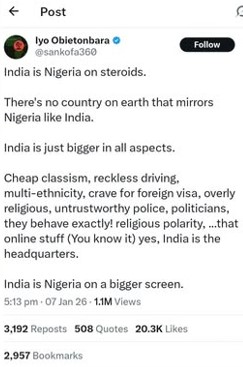
That comparison did not come from a troll or a random critic.
It came from Iyo Obitornbara, a Nigerian commentator known for brutally honest geopolitical takes. His words stung because they weren’t emotional — they were analytical.
And that’s why they hurt.
Let’s break down why this comparison exists, whether it is accurate, and who actually owns this mess.
1. Cheap Classism Everywhere — Money Without Manners
India today has money floating around, but dignity hasn’t scaled with income.
• Abuse of service staff
• Public humiliation videos
• Caste + wealth = new arrogance
• “I paid, so I own you” mindset
Nigeria struggles with elite entitlement too — but India amplified it with population scale.
Economic growth without social reform doesn’t create a middle class.
It creates bullies with smartphones.
2. Reckless Driving = Cultural Lawlessness
This isn’t about traffic.
It’s about respect for rules.
In both countries:
• Signals are suggestions
• Footpaths are optional
• Enforcement is selective
• Bribes replace fines
When citizens believe rules are for fools, development collapses silently.
China didn’t grow because of democracy.
It grew because rules were feared.
India? Rules are laughed at.
3. Crime, Hustle & Survival Economy
India’s informal economy feeds millions — but it also normalises:
• Scams
• Fraud
• Shortcut success
• “Adjust maadi” ethics
Nigeria has the same survival hustle culture.
Difference?
India has better branding, not better systems.
A country where survival beats integrity will never build trust — internally or globally.
4. Visa Obsession: Escape as a National Goal
When the best minds don’t dream of building the country — but leaving it — something is broken.
• Students aim for Canada before finishing college
• Professionals plan exits, not enterprises
• Citizenship abroad = status symbol
China sends talent abroad to learn.
India sends talent abroad to escape.
Nigeria suffers the same brain drain.
That’s not coincidence.
That’s systemic failure.
5. Religion as Identity, Not Faith
Religion in India has moved from belief to branding.
• Loudness over values
• Polarisation over peace
• Politics over spirituality
Nigeria has religious tension too — Christianity vs Islam.
India copied the playbook and added:
• Social media outrage
• Vote-bank algorithms
• Weaponised faith
When religion becomes political currency, society fractures fast.
6. Police Trust Deficit
In both countries:
• Police feared, not trusted
• Justice delayed or denied
• Power decides outcomes
A common citizen doesn’t expect protection — only negotiation.
No country becomes a global power when citizens don’t trust their own protectors.
So… Did India “Fall” to This Level?
India didn’t fall overnight.
It drifted.
The Current Government’s Role
Let’s be blunt.
• Strong narrative, weak execution
• Optics over institutions
• Centralised power, decentralised accountability
• Silence on ground-level governance rot
Infrastructure improved.
Branding improved.
But civic discipline, institutional independence, and social trust did not.
You can’t build a superpower on PR alone.
The Earlier Governments’ Role
They’re not innocent either.
Post-independence India suffered from:
• License Raj
• Corruption normalisation
• Vote-bank politics
• Delayed reforms
• Bureaucratic arrogance
They taught citizens:
“Rules don’t matter if you know the right people.”
Today’s chaos is just the interest on that old loan.
The Uncomfortable Truth
India didn’t become “Nigeria-like” because of poverty.
It did because of:
• Weak enforcement
• Cultural tolerance of disorder
• Politicisation of identity
• Celebration of jugaad over justice
Nigeria and India are mirrors — separated by geography, united by governance failures.
The Bigger Question
India is still young.
Still powerful.
Still capable of course correction.
But only if we stop lying to ourselves.
Superpowers are not built by shouting nationalism.
They are built by boring things:
• Rule of law
• Civic sense
• Honest policing
• Education with ethics
• Leaders who fix systems, not slogans
Until then, comparisons like these will keep coming.
And each time, they’ll sting a little more — because deep down, we know why.
Comments

Hi, I’m Nishanth Muraleedharan (also known as Nishani)—an IT engineer turned internet entrepreneur with 25+ years in the textile industry. As the Founder & CEO of "DMZ International Imports & Exports" and President & Chairperson of the "Save Handloom Foundation", I’m committed to reviving India’s handloom heritage by empowering artisans through sustainable practices and advanced technologies like Blockchain, AI, AR & VR. I write what I love to read—thought-provoking, purposeful, and rooted in impact. nishani.in is not just a blog — it's a mark, a sign, a symbol, an impression of the naked truth. Like what you read? Buy me a chai and keep the ideas brewing. ☕💭 For advertising on any of our platforms, WhatsApp me on : +91-91-0950-0950 or email me @ support@dmzinternational.com