Lahore Is Giving Back Its Hindu, Sikh, and Jain Names. Pakistan Just Did Something India Never Expected
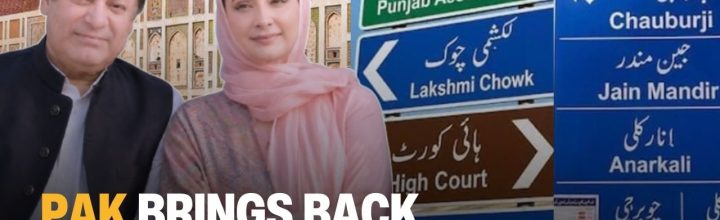
Pakistan is not supposed to do this.
That is the honest first reaction. The country that has spent seven decades scrubbing its pre-Partition identity clean — renaming streets, demolishing temples, burying the cosmopolitan Lahore that once existed — has just done something that will make many Indians do a double take.
Punjab’s provincial government has approved a plan to restore more than 15 pre-Partition street names across Lahore. Names that belonged to Hindu, Sikh, and Jain communities before 1947. Names that were quietly strangled after Partition and replaced with Islamic alternatives that erased any trace of what came before.
Islampura becomes Krishan Nagar again. Rehman Gali may return to Ram Gali. Babri Masjid Chowk — named, of all things, after the demolished mosque in Ayodhya — could once again be Jain Mandir Road. The symbolism in that last one alone is enough to make you sit down.
This is not a small administrative reshuffle. This is Pakistan’s establishment acknowledging, in writing, that Lahore’s identity was violently amputated in 1947, and that the amputation needs at least partial reversal.
Why Lahore Was Never Just A Muslim City
Before Partition, Lahore was one of the most culturally layered cities on the subcontinent. Hindus, Sikhs, Jains, and Muslims had built it together over centuries — its mohallas, its bazaars, its temples, its gurdwaras, its cricket grounds all carrying the fingerprints of communities that coexisted in tension and tolerance simultaneously. Anarkali Bazaar, the Walled City, the old cricket grounds at Minto Park — these were not Muslim spaces or Hindu spaces. They were Lahori spaces.
When Partition happened, roughly 500,000 non-Muslims fled or were killed in Lahore alone. And as they left, their names left with them — systematically, deliberately, ideologically. Streets were renamed. Neighbourhoods were rebranded. The physical city was remapped to tell a new story: that Lahore had always been Islamic, had always been Pakistani, had never belonged to anyone else.
The locals, to their credit, often refused. Many Lahori families continued using the old names in private for generations. Ram Gali stayed Ram Gali in conversation even when the official signs said otherwise. Memory is stubborn when the state is dishonest.
The Cricket Ground Is The Most Damning Detail
The heritage revival project includes something beyond street names: the restoration of historic cricket grounds at Minto Park, which were demolished in 2015 under then Chief Minister Shehbaz Sharif. These were grounds where legends like Lala Amarnath — India’s first Test centurion, a Lahori by birth — once played. Grounds that carried living cricket history connecting undivided Punjab to modern South Asian sport.
Shehbaz Sharif demolished them. Now the same political dynasty’s opponents in Punjab are promising to rebuild them.
The political irony is sharp. The current Punjab government’s move is partly administrative, partly ideological, and partly an exercise in discrediting the Sharif legacy on cultural heritage. But motives do not cancel outcomes. If the grounds come back, they come back regardless of why.
What Is Actually Driving This
Do not romanticise this as a sudden Pakistani spiritual awakening about pluralism. It is not that.
This move exists inside a specific political context. The push for heritage restoration has gained ground through civil society archaeologists, urban historians, and activists who have argued for years that Lahore’s official history is a fraud. It also exists in a moment where Pakistan’s government — battered economically, isolated diplomatically, desperate for soft power — sees heritage tourism as a rare untapped asset. A Lahore that acknowledges its Sikh and Hindu past is a Lahore that can attract diaspora tourism from India, Canada, the UK, and the US.
There is also the global minority rights optics calculation. Pakistan has been under sustained pressure over its treatment of religious minorities. A symbolic gesture on street names costs nothing and buys international goodwill cheaply.
What It Means For India
India should watch this without either dismissing it or over-celebrating it. Street names are not rights. A restored sign at Jain Mandir Road does not undo the demolition of temples, the forced conversions, or the continuing marginalisation of Pakistan’s Hindu minority.
But it does do one thing. It forces an official acknowledgement that Lahore’s pre-Partition identity was real, multi-faith, and legitimate. That is not nothing. Once a state puts that in writing, it is harder to officially deny later.
Lahore belonged to everyone who built it. Pakistan’s Punjab government just, quietly, admitted that.
That is shocking. And it is worth watching what happens next.
Comments

Hi, I’m Nishanth Muraleedharan (also known as Nishani)—an IT engineer turned internet entrepreneur with 25+ years in the textile industry. As the Founder & CEO of "DMZ International Imports & Exports" and President & Chairperson of the "Save Handloom Foundation", I’m committed to reviving India’s handloom heritage by empowering artisans through sustainable practices and advanced technologies like Blockchain, AI, AR & VR. I write what I love to read—thought-provoking, purposeful, and rooted in impact. nishani.in is not just a blog — it's a mark, a sign, a symbol, an impression of the naked truth. Like what you read? Buy me a chai and keep the ideas brewing. ☕💭 For advertising on any of our platforms, WhatsApp me on : +91-91-0950-0950 or email me @ support@dmzinternational.com