
Before You Build Your Own Online Store, Build Trust Where Customers Already Shop
When a new brand launches, the biggest challenge is not always creating a great product. It is getting people to trust the brand enough to buy it.
You may have a beautiful website, excellent products and a compelling story. But if nobody knows your brand, spending heavily on Meta or Google Ads can quickly become expensive. A customer sees a new website, asks, “Who are these people?”, and simply moves on.
This is where marketplaces such as Amazon can play a surprisingly important role for a young brand.
Our Experience: DesiFusions.com on Amazon Karigar
At Save Handloom Foundation, our brand DesiFusions.com is an example of this journey.
When we launched, we were a new brand with limited resources. We didn’t have a huge advertising budget, a large marketing team or an established customer base.
Instead of waiting for our own website to magically attract customers, we started selling on Amazon India.
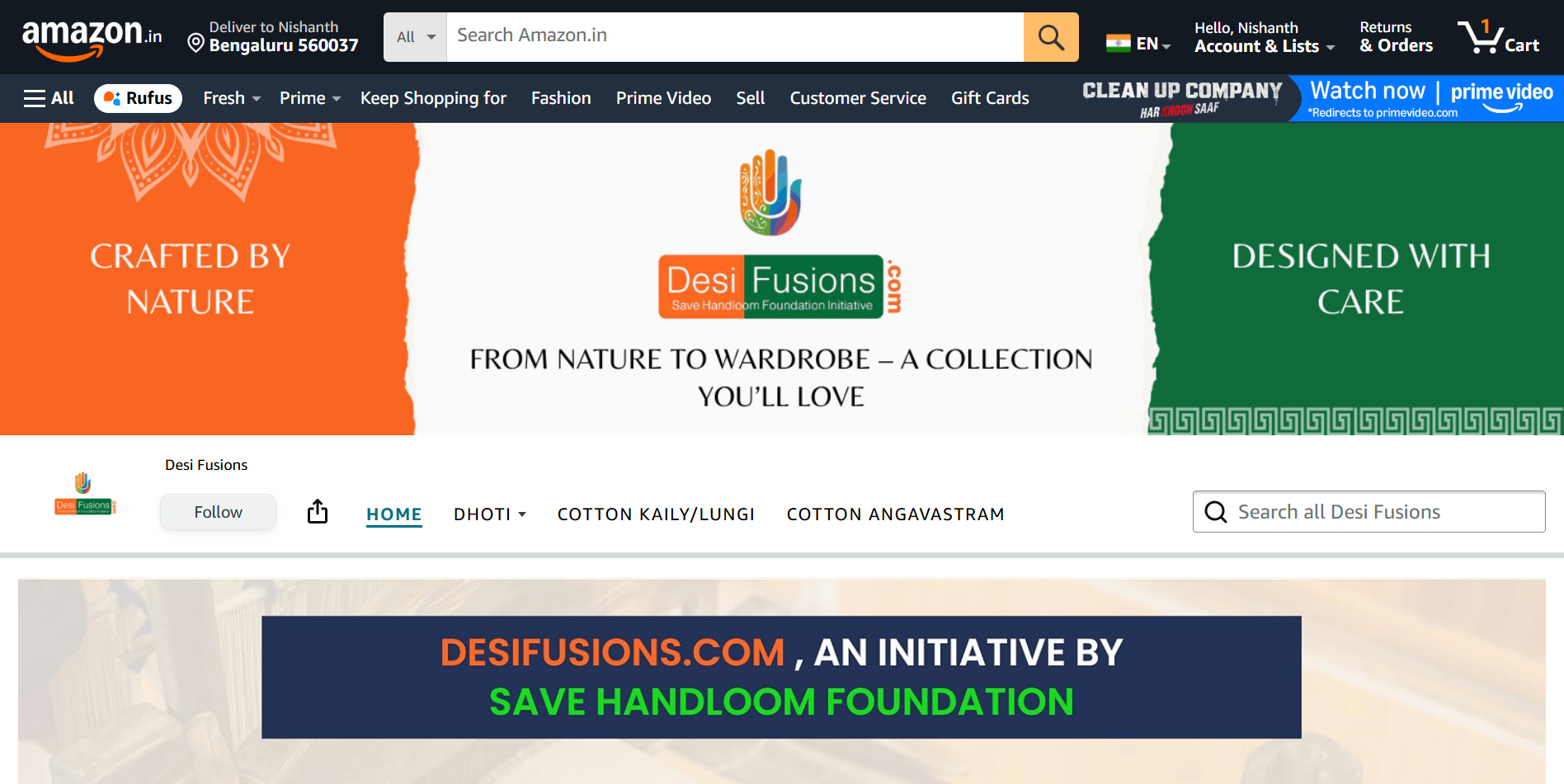
And there was an important advantage: Amazon Karigar.
For genuine handmade and artisan products, Karigar provides features designed around India’s artisan ecosystem. More importantly, customers are already coming to Amazon with the intention to shop.
That changes the equation.
You don’t have to spend your entire budget convincing someone to visit an unknown website. The customer is already inside one of the world’s largest marketplaces.
FBA: The Headache You Don’t Have to Carry
For a small team, another major challenge is logistics.
Imagine having to:
- Store inventory yourself
- Pack every order
- Print labels
- Wait for pickup
- Coordinate with delivery partners
- Handle orders from different parts of India
- Deal with days when the pickup doesn’t happen
For a small business, this can become a full-time job.
This is where Fulfilment by Amazon (FBA) becomes extremely useful.
Instead of keeping everything in your office or home, you send your inventory to Amazon’s fulfilment centre.
After that, Amazon handles much of the operational burden—storage, order processing, packing, shipping and customer-facing delivery operations.
For a small team, that is not just convenience. It is operational freedom.
Your Customer Could Be Anywhere in India
One of the biggest advantages is reach.
A small brand sitting in Bengaluru can receive an order from a customer hundreds or thousands of kilometres away.
You don’t have to build your own delivery network.
In our case, we currently maintain stock in Bengaluru. If an order comes from nearby, delivery can be remarkably fast. Customers in other cities can also receive products through Amazon’s established fulfilment network.
And as sales patterns become clearer, inventory can potentially be distributed across fulfilment locations to bring products closer to major customer clusters.
That means a growing brand can think beyond its neighbourhood without immediately building warehouses across India.
But Isn’t Your Own Website Better?
Eventually, yes.
Your own website gives you greater control over branding, customer experience, data, margins and the relationship with your customers.
But there is a difference between where you ultimately want customers to shop and where you initially need customers to discover you.
Amazon can act as a stepping stone.
A customer may first discover DesiFusions.com on Amazon, purchase a product, experience the quality and remember the brand.
Later, when the same customer sees the brand on social media or discovers its website, the question is no longer:
“Who are they?”
It becomes:
“I’ve heard of this brand.”
That small difference can be enormously valuable.
Marketplace First. Brand Building Next.
This doesn’t mean every business should depend entirely on Amazon.
It means a new brand should use available ecosystems intelligently.
Amazon can provide reach and fulfilment.
Your website can provide ownership and deeper customer relationships.
Social media can provide storytelling and community.
The smartest strategy may not be choosing one over another—but using each for what it does best.
For us, Amazon Karigar and FBA provide an important foundation while we continue building DesiFusions.com, Save Handloom Foundation and our own digital presence.

For a new entrepreneur, that dashboard represents something bigger than sales numbers.
It represents access.
Access to customers.
Access to logistics.
Access to a national marketplace.
And sometimes, before a small brand can afford to build everything itself, using someone else’s infrastructure intelligently is exactly how it gets started.
Comments

Hi, I’m Nishanth Muraleedharan (also known as Nishani)—an IT engineer turned internet entrepreneur with 25+ years in the textile industry. As the Founder & CEO of "DMZ International Imports & Exports" and President & Chairperson of the "Save Handloom Foundation", I’m committed to reviving India’s handloom heritage by empowering artisans through sustainable practices and advanced technologies like Blockchain, AI, AR & VR. I write what I love to read—thought-provoking, purposeful, and rooted in impact. nishani.in is not just a blog — it's a mark, a sign, a symbol, an impression of the naked truth. Like what you read? Buy me a chai and keep the ideas brewing. ☕💭 For advertising on any of our platforms, WhatsApp me on : +91-91-0950-0950 or email me @ support@dmzinternational.com