
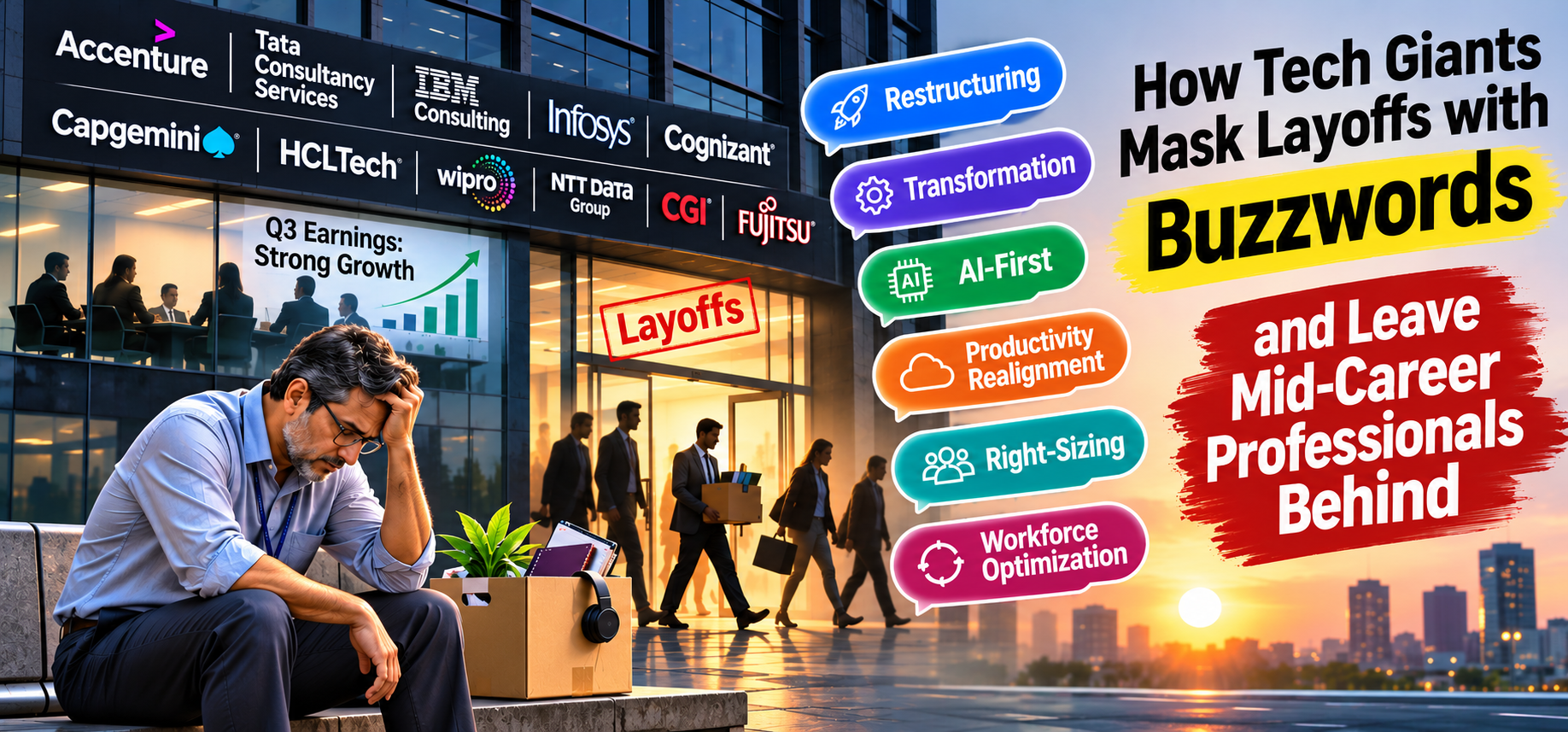
How Tech Giants Mask Layoffs with Buzzwords and Leave Mid-Career Professionals Behind

Today, we need to talk about something happening right now behind closed doors across major global IT services and consulting multinational corporations like:—
Accenture
Tata Consultancy Services
IBM Consulting
Infosys
Cognizant
Capgemini
HCLTech
Wipro
NTT DATA Group
Fujitsu etc…
and you will witness a carefully rehearsed corporate illusion.
Behind this corporate campaign lies a quiet structural crisis. The corporate push for enterprise-wide AI literacy is not a well-crafted roadmap for organizational growth; it is an unachievable mandate designed to shift the blame for structural layoffs onto individual employees.
The Top-Down AI Illusion
The Broken Enterprise Promise
“If the project isn’t hitting its margin targets, it’s because the team hasn’t upskilled enough in AI.”
The Mid-Career Trap: Why 40s & 50s Bear the Brunt
-
Unrealistic Skill Pivots: Expecting a 45-year-old delivery manager or functional consultant to overnight become a proficient machine learning engineer—while managing 60-hour workweeks—is an impossible standard.
-
The Cost-Cutting Math: A mid-career professional earning a senior salary costs significantly more than an entry-level graduate. When companies demand “AI-ready” talent, they frequently use it as a pretext to clear out higher-earning middle management.
-
The Fresher Replacement Dynamic: Engineering colleges worldwide now graduate thousands of students who have trained on AI platforms, Python libraries, and prompt frameworks throughout their coursework. For companies focused purely on short-term margins, replacing a seasoned professional with a fresher at a fraction of the cost—under the guise of “getting modern AI talent”—is a tempting financial calculation.
The Unspoken Crisis of Indian Engineering
-
Legacy mid-career professionals are being pushed out for lacking immediate AI expertise.
-
Millions of incoming graduates lack the fundamental problem-solving skills needed to build production-grade applications.
What Real Upgrading Looks Like
-
Role-Specific AI Augmentation: Stop asking non-technical teams to learn deep Python. Teach HR how to leverage talent analytics platforms, show marketing how to use generative media tools responsibly, and let engineers focus on deep model integration and system architecture.
-
Valuing Domain Knowledge: AI is a tool, not a strategy. An LLM cannot write domain-specific financial compliance software or navigate complex insurance logic without experts who understand those domain nuances. Companies must pair domain experts in their 40s and 50s with AI tools, rather than replacing them with junior prompt engineers.
-
Transparent Restructuring: Stop hiding operational downsizing behind mandatory upskilling metrics. Acknowledge structural realignments candidly instead of gaslighting teams with unachievable learning targets.
Why Product Company Layoffs Are Brutal (AI Perspective)
Product company layoffs are uniquely harsh because product firms generate revenue from digital software products rather than human labor hours. When generative AI automates core technical tasks—such as code writing, automated testing, bug fixing, and platform operations—the ratio of engineers required to build and maintain a software product plummets. Because product companies thrive on ultra-high operating margins, keeping redundant roles directly erodes corporate efficiency. Consequently, AI implementation triggers structural, permanent cuts where entire legacy software teams and middle-management layers are removed, as AI tooling steps in to maintain the software lifecycle at a fraction of the cost.
Why Service Company Layoffs Differ from Product Companies
IT service companies (such as Accenture, Infosys, and Cognizant) operate on a billable-hours business model where revenue directly correlates with headcount. Massively cutting workforce size overnight directly shrinks a service provider’s earning capacity, so service companies avoid the sudden structural wipes seen in product firms. Instead, some service company layoffs stem primarily from client contract cancellations, project slowdowns, or skill mismatches. Service providers typically absorb AI transitions more gradually—managing headcount reductions through bench-time cuts, hiring freezes, and workforce reskilling as they attempt to shift from time-based billing models to AI-assisted outcome pricing.
Unannounced Downsizing Tactics in IT Service Companies
-
Silent Layoffs vs. Public Mass Layoffs: IT service companies rarely broadcast large single-day layoffs because major job cuts send negative signals to corporate clients regarding stability and project capacity. Instead, they rely on “silent layoffs”—trimming headcount continuously under the radar across localized business units.
-
Tightening the “Bench” Timelines: The primary trigger for unplanned service company exits is unbilled bench time. When clients suddenly freeze budgets or end contracts, companies shrink the allowed bench window (e.g., cutting it down to 30–45 days). Employees who fail to secure internal client billability within that short window face exit discussions.
-
Performance Improvement Plans (PIPs) & Strict Evaluations: Unannounced downsizing is frequently executed through stricter performance reviews. Employees who are not currently on billable projects or who lack in-demand AI and cloud skills are placed on short PIPs or tagged for low performance, leading to involuntary exits framed as performance-based rather than economic layoffs.
-
Mandatory Office Policies & Location Friction: Service firms often enforce strict return-to-office or location relocation requirements. This creates voluntary attrition or grounds for termination without the company having to declare formal layoff plans.
-
AI-Driven Skill Mismatch: As clients demand outcome-based pricing and automation-heavy delivery, service firms immediately release employees tied to legacy, non-billable skills. Without a long ramp-up period for internal reskilling, workers in redundant manual maintenance or testing roles face quick, quiet offboarding.
Moving Forward Beyond the Hype
Comments

Hi, I’m Nishanth Muraleedharan (also known as Nishani)—an IT engineer turned internet entrepreneur with 25+ years in the textile industry. As the Founder & CEO of "DMZ International Imports & Exports" and President & Chairperson of the "Save Handloom Foundation", I’m committed to reviving India’s handloom heritage by empowering artisans through sustainable practices and advanced technologies like Blockchain, AI, AR & VR. I write what I love to read—thought-provoking, purposeful, and rooted in impact. nishani.in is not just a blog — it's a mark, a sign, a symbol, an impression of the naked truth. Like what you read? Buy me a chai and keep the ideas brewing. ☕💭 For advertising on any of our platforms, WhatsApp me on : +91-91-0950-0950 or email me @ support@dmzinternational.com