
When Success Turns Silent: The Tragic Story of Harshavardhana Kikkeri and the Crisis We Are Ignoring
In one of the most heart-wrenching stories emerging from the Indian diaspora in the United States, Harshavardhana S Kikkeri — a brilliant Indian-origin tech entrepreneur — allegedly killed his wife and teenage son before ending his own life at their Washington home on April 24, 2025. The younger son, just seven years old, escaped the tragedy as he was not at home during the incident.
This is not just a story about death. It is a haunting mirror into the mind of someone who seemingly had it all — education, success, innovation, a family — and yet chose to walk down a dark road no one saw coming.
Who Was Harshavardhana?
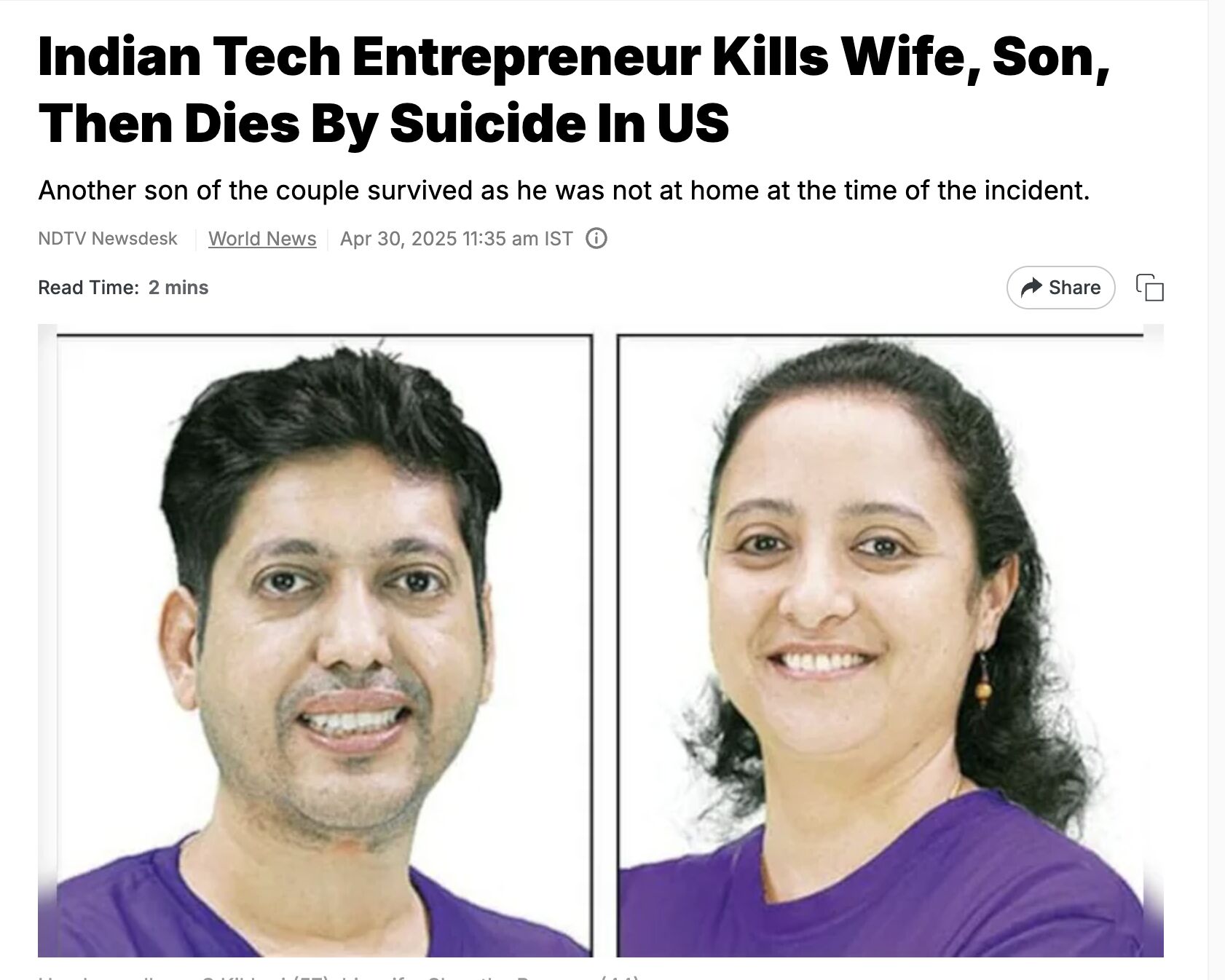
Harshavardhana hailed from Kikkeri village in Karnataka’s Mandya district. He was a bright mind who went on to pursue his Master’s in Electrical Engineering from Syracuse University in the US. He worked with Microsoft and led advanced robotics projects, earning both recognition and admiration.
In 2017, along with his wife Shwetha Panyam, he co-founded HoloWorld in Mysuru — a startup dedicated to robotics and immersive motion capture technology. Their flagship innovation was the HoloSuit, an AI-powered full-body motion capture suit designed to allow virtual and remote experiences using wearable tech.
By 2022, HoloWorld shut down. The reasons are not officially documented, but various reports and industry chatter suggest that the company was unable to scale, possibly due to funding issues and the high cost of sustaining deep-tech ventures. After the closure, the family returned to the United States.
The Incident: What Happened?
On April 24, 2025, police in Newcastle, Washington, responded to an emergency call and found Harshavardhana, his wife Shwetha, and their 14-year-old son dead at home. All had suffered gunshot wounds. The younger son, fortunately, was at school.
Initial reports suggest it was a murder-suicide. Shwetha and the teenage son were killed by gunshots, and Harshavardhana later shot himself. A bullet casing was found on the street, and there were signs of distress visible from outside the home. The King County Medical Examiner confirmed the deaths and categorized the case as a double homicide followed by suicide.
But Why? What Could Drive a Man to This?
The deeper we look, the more we see a disturbing pattern — not just in this case but in many similar stories of Indian professionals, especially techies, abroad.
There are a few possible factors:
1. Crushing Business Failure
The shutting down of HoloWorld might have been a massive personal and financial setback for Harshavardhana. Many Indian entrepreneurs in foreign countries take massive risks, often pumping in family savings, loans, and reputation into ventures. When it fails, the guilt is enormous — especially when the family is involved as co-founders.
2. Isolation in a Foreign Land
Life abroad may look glamorous, but it often comes with deep emotional costs. Immigrant families in countries like the US often lack a strong support system — no extended family to talk to, no childhood friends to confide in, and a cultural stigma around seeking mental health support.
3. Pressure to Maintain a ‘Perfect’ Image
In a society that glorifies success, failure becomes shameful. For many Indian men raised with the belief that they must be the “providers,” failure in business can feel like the end of their identity. Instead of seeking help, they withdraw, mask their pain, and sometimes spiral into unimaginable thoughts.
4. Possibly Unspoken Mental Health Struggles
Entrepreneurs, especially in high-tech fields, face long hours, unpredictable outcomes, investor pressure, and the constant fear of irrelevance. Add personal and marital stress, and it becomes a dangerous emotional cocktail. There is no confirmation yet if Harshavardhana had prior mental health issues, but clearly, something pushed him beyond his breaking point.
Why Are We Seeing More of This?
This is not an isolated case. In recent years, multiple cases have surfaced where Indian professionals, especially men in high-pressure jobs, have committed suicide or harmed family members before doing so. This tragic trend points to something deeper than personal failure.
We as a society have normalized glorifying overwork, romanticizing startup burnout, and brushing aside mental health. We applaud people for sleeping 4 hours a night, raising crores in funding, and never asking for help. We talk about depression only when someone famous dies. And even then, we forget by the next news cycle.
The truth is simple — people are collapsing under invisible weights.
What Can Be Done?
- Normalize Seeking Help: Therapy is not weakness. It is healing. We need to break the stigma around mental health, especially in the Indian community.
- Build Real Conversations: Ask your friends how they are — not just about work or business, but about how they truly feel. Be there, genuinely.
- Teach Financial Failure is Not Life Failure: Losing money or shutting down a business should not equate to losing your identity or worth.
- Support Systems Matter: Whether in India or abroad, we need systems that support emotional health — community groups, professional help, helplines, and honest workplaces.
- Look for Signs: Often, people give signals — withdrawal, silence, anxiety, erratic behavior. Let us learn to spot them early.
In the End
A bright family full of dreams is no more. A young boy will grow up with a gaping hole in his life. A promising innovator is now a tragic name in a headline.
Let us not wait for more such stories to make us care. Success stories need applause, yes — but failure stories need compassion.
Let us build a world where people are not just building startups but also building peace in their hearts. Because no technology, no title, no achievement is worth more than a single human life.
Comments

Hi, I’m Nishanth Muraleedharan (also known as Nishani)—an IT engineer turned internet entrepreneur with 25+ years in the textile industry. As the Founder & CEO of "DMZ International Imports & Exports" and President & Chairperson of the "Save Handloom Foundation", I’m committed to reviving India’s handloom heritage by empowering artisans through sustainable practices and advanced technologies like Blockchain, AI, AR & VR. I write what I love to read—thought-provoking, purposeful, and rooted in impact. nishani.in is not just a blog — it's a mark, a sign, a symbol, an impression of the naked truth. Like what you read? Buy me a chai and keep the ideas brewing. ☕💭 For advertising on any of our platforms, WhatsApp me on : +91-91-0950-0950 or email me @ support@dmzinternational.com