
Why Gold Is Still the King of Investments – Especially in India
Gold has been called the safest haven for centuries. From ancient civilizations to modern economies, gold has held a reputation for stability, security, and lasting value. But why does gold still shine so brightly, even when compared to hot investment options like stocks, real estate, or mutual funds?
Let’s break it down and uncover some fascinating, little-known facts — especially about why South Indians, particularly Keralites, are global champions when it comes to gold.
🌍 Why Nations Keep Gold in Reserve
Did you know that most central banks around the world hold gold reserves?
Why? Because:
✅ Gold backs the value of a nation’s currency.
✅ Gold is considered a universal asset — it has value across cultures, countries, and political systems.
✅ Even when currencies crash, gold’s purchasing power usually remains intact.
For example, India, the US, China, Germany, and Russia have thousands of tonnes of gold in their central bank vaults. These reserves give confidence to the currency they print — because too much printing without backing leads to inflation.
Gold and India: A Love Story
India’s love for gold is legendary. But here’s what many don’t realize:
✨ South India, especially Kerala, leads India’s gold consumption.
Why?
- Gold is deeply tied to marriage traditions, with daughters’ weddings often involving heavy gold ornaments.
- Festivals like Akshaya Tritiya, Onam, and Vishu see a surge in gold purchases.
- Keralites working in the Gulf send remittances home, often used to buy gold as investment.
- Keralite families see gold as a symbol of status, security, and respect.
It’s no wonder that some of India’s biggest gold jewellery brands were born in Kerala:
- Joy Alukkas
- Jos Alukkas
- Bhima Jewellers
- Chemmanur
- Josco Jewellers
- Malabar Gold
- Kalyan Jewellers
Even national-level brands like Kalyan Jewellers and Malabar Gold come from Kerala roots and have now become international names, opening stores in the Middle East, US, and UK. Add to this Tanishq from the Tata Group, and you have a booming gold industry worth billions!
🏦 Why Gold Beats Other Investments
| Aspect | Gold | Stocks/Mutual Funds | Real Estate |
|---|---|---|---|
| Risk | Low – value rarely crashes suddenly | High – market volatility | Medium – depends on location, economy |
| Liquidity | High – can sell quickly | Moderate – depends on market conditions | Low – takes time to sell property |
| Maintenance | Low (if stored safely) | No physical maintenance | High – needs upkeep, taxes, repairs |
| Long-term reliability | Excellent – value stable for centuries | Can be great or disastrous depending on pick | Can be reliable but capital intensive |
Since India’s independence in 1947, gold has shown an extraordinary rise in value, proving itself as a trusted and reliable investment.
In 1947, the price of 10 grams of 24-karat gold was approximately ₹88. Over the decades, this price steadily climbed:
- 1964: ₹63 (note: prices fluctuated early on due to currency adjustments)
- 1980: ₹1,330
- 2000: ₹4,400
- 2010: ₹18,500
- 2020: ₹48,650
- 2025 (as of May): ₹94,630
This clear growth shows that gold has not only preserved purchasing power but also provided massive returns over the years. The consistent increase reflects how investors across generations have trusted gold as a hedge against inflation, currency devaluation, and economic uncertainty.
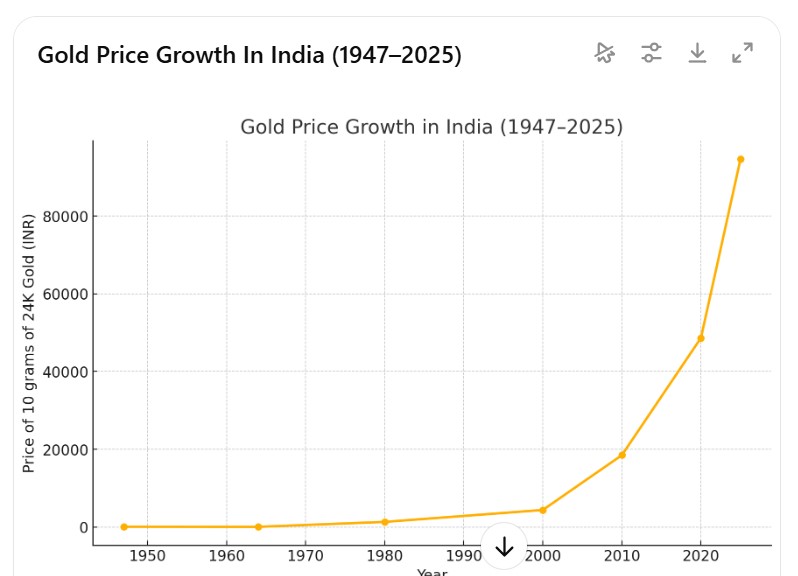
Here’s the visual journey of India’s gold prices from 1947 to 2025 — you can clearly see the strong, steady rise that reinforces why gold is viewed as a symbol of security and long-term prosperity in Indian households.
✅ Gold doesn’t go bankrupt.
✅ Gold doesn’t rely on government policies or corporate performance.
✅ Gold has intrinsic value.
🌎 Do People in the US, UK, Europe Also Invest in Gold?
Yes!
But with a difference — Western investors mostly prefer:
- Gold ETFs (exchange-traded funds)
- Gold coins/bars
- Gold mining stocks
They often don’t buy gold jewellery as investments the way Indians do. In India, gold ornaments serve a double purpose — they are an emotional asset and a liquid financial asset.
🔗 Why Physical Gold (Especially Ornaments) Is Wiser
Many financial advisors push people toward Gold ETFs or Gold SIPs — but here’s why physical gold, especially jewellery, makes more sense for most Indians:
✅ You own the actual asset, not just paper claims.
✅ Jewellery can be worn and enjoyed.
✅ It can be passed down generations — preserving family wealth.
✅ Selling ornaments is easier at jewellers than liquidating ETFs or funds.
Gold bars and coins, while good for bulk investment, can sometimes be harder to sell quickly and often come with additional purity and storage concerns.
⚖️ Pros and Cons of Investing in Gold
Pros:
✅ Safe and stable
✅ High liquidity
✅ Hedge against inflation
✅ Cultural and emotional value
✅ No maintenance cost (if safely stored)
Cons:
❌ Physical gold can be stolen if not stored safely
❌ Jewellery involves making charges, which you won’t get back when reselling
❌ Does not generate passive income (like stocks or real estate rents)
❌ Over-investment can leave you under-diversified
🌟 Final Thought: Why Everyone Should Own Some Gold
In India, gold is more than just an investment — it’s part of our identity, culture, and security net. While stocks, mutual funds, and real estate all have their place, gold remains the ultimate fallback, especially in uncertain times.
If you’re starting your investment journey, it’s always wise to allocate at least 10–15% of your portfolio to physical gold — especially gold jewellery, which carries both financial and emotional value.
Remember:
Your stock market can crash, your real estate can slump, but your gold will always shine. 🌟
Comments

Hi, I’m Nishanth Muraleedharan (also known as Nishani)—an IT engineer turned internet entrepreneur with 25+ years in the textile industry. As the Founder & CEO of "DMZ International Imports & Exports" and President & Chairperson of the "Save Handloom Foundation", I’m committed to reviving India’s handloom heritage by empowering artisans through sustainable practices and advanced technologies like Blockchain, AI, AR & VR. I write what I love to read—thought-provoking, purposeful, and rooted in impact. nishani.in is not just a blog — it's a mark, a sign, a symbol, an impression of the naked truth. Like what you read? Buy me a chai and keep the ideas brewing. ☕💭 For advertising on any of our platforms, WhatsApp me on : +91-91-0950-0950 or email me @ support@dmzinternational.com