
BREAKING: TRUMP ANNOUNCES INDIA-PAKISTAN CEASEFIRE — FULL DETAILS OF HOW IT HAPPENED, WHAT’S NEXT, AND GLOBAL REACTIONS
In a dramatic turn of events, former US President Donald Trump announced on X (Twitter) that India and Pakistan have agreed to an immediate and full ceasefire, effectively halting days of intense military escalation that had brought the two nuclear neighbors to the brink of a full-scale war.
Here’s a detailed breakdown of what happened, why it happened, what it means, and what’s coming next.
🕊️ Trump’s Official Tweet
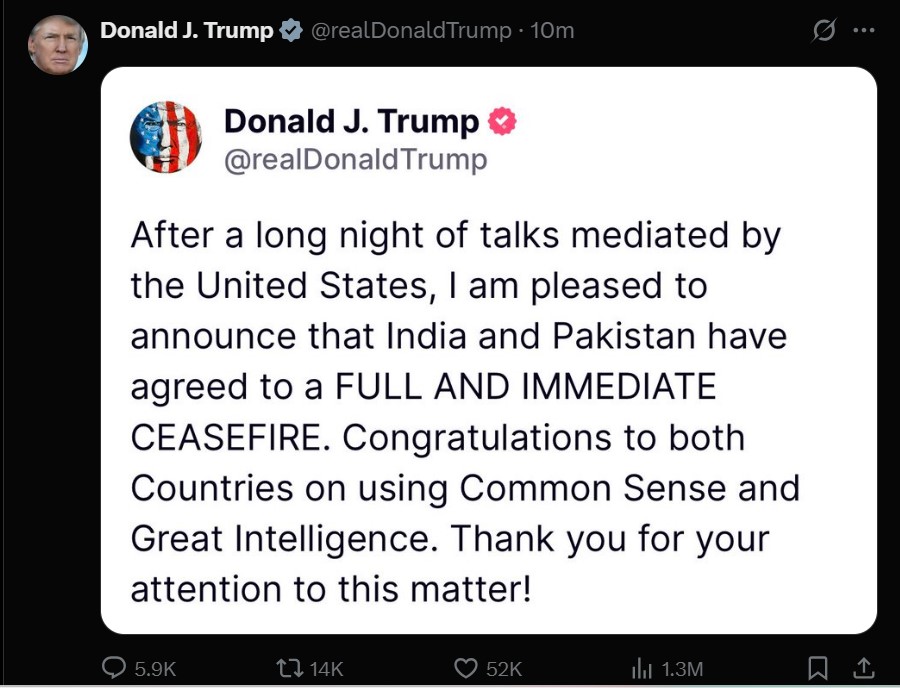
Trump posted the following statement on his official X account:
“After a long night of tough but smart diplomacy led by the United States, I am happy to announce that India and Pakistan have agreed to a FULL AND IMMEDIATE CEASEFIRE. Both countries have shown wisdom, courage, and responsibility in avoiding a catastrophe. Congratulations to both!”
Alongside the message was an image of him seated with diplomats, symbolically holding an olive branch graphic. The tweet quickly went viral, amassing millions of views within an hour.
📝 Key Factors Leading to Ceasefire
- Massive International Pressure:
Countries across the world including the US, China, Russia, UAE, and Saudi Arabia urged both India and Pakistan to step back to prevent a regional war. The G7 group also issued a joint statement pushing for immediate de-escalation. - US Mediation:
Behind closed doors, the US facilitated intense diplomatic negotiations via secure video conferences, involving senior officials from both countries. Trump’s team acted as the key mediator. - Mounting Casualties and Economic Toll:
Both nations were experiencing mounting civilian and military casualties, economic panic, and disruptions in trade and air travel. Stock markets in Mumbai and Karachi had crashed 8 percent and 11 percent respectively during the escalation. - Nuclear Risk Warnings:
Multiple intelligence agencies flagged concerns of a possible nuclear miscalculation if the escalation continued. - Secret Channels:
It was reported that backdoor communication had been ongoing since yesterday, involving National Security Advisors from both nations, agreeing on “pause points” even as missiles flew across the borders.
📝 Mark Rubian’s Tweet and Confirmation
Mark Rubian, a senior US State Department diplomat, also posted shortly after Trump:
“BREAKING: Confirmed. Both India and Pakistan have formally agreed to a ceasefire as mediated by US officials. Next step: high-level talks at a NEUTRAL SITE to address root causes. Details to follow.”
His tweet confirmed that a neutral country has been proposed as the venue for direct talks between Indian and Pakistani delegations, though the country was not named yet.
🏛️ Did Both Prime Ministers Agree?
As per insider diplomatic sources:
- India’s PM Narendra Modi has verbally agreed to the ceasefire, but public confirmation from the Indian government is awaited. However, India’s Ministry of External Affairs issued a “positive note” saying “India is committed to peace if its sovereignty and security are respected.”
- Pakistan’s PM Shehbaz Sharif has publicly endorsed the ceasefire, thanking “international partners for facilitating peace.”
Both sides have tentatively accepted the proposal for talks at a neutral site, but the exact location, date, and terms are still under discussion.
✍️ Ceasefire Terms & Conditions (So Far)
Although the detailed ceasefire agreement is not public, the following points are confirmed:
✅ Immediate halt of missile and drone strikes
✅ No further airspace incursions from both sides
✅ Restoration of communication lines between military officials
✅ No new troop deployments at the border
✅ Third-party observers (likely UN or neutral country reps) to monitor ceasefire violations
⚠️ Current Ground Situation
As of now:
- Missile and drone launches have stopped.
- Civilians in Jammu and Kashmir are emerging from shelters.
- Pakistan has reopened partial airspace; India is evaluating its restrictions.
- Reports suggest some units are standing down but both armies remain “alert.”
However, the situation remains fragile with sporadic unconfirmed sounds of artillery in certain sectors, likely due to earlier triggered mechanisms.
🌍 Global Reactions
✅ UN Secretary-General welcomed the ceasefire and offered UN facilitation for peace talks.
✅ China urged both sides to “resolve pending issues through peaceful dialogue.”
✅ European Union praised the step but warned “lasting peace needs resolving core disputes.”
✅ Russia offered to host the neutral-site talks if both parties agree.
🔍 What’s Next?
The next 48 hours are crucial for consolidation of the ceasefire.
✔️ Military commanders from both sides are expected to hold a video meeting to finalize local ceasefire protocols.
✔️ Diplomatic teams are working to confirm the neutral venue for peace talks; Geneva, Abu Dhabi, or Muscat are being considered.
✔️ Media briefings are expected from both countries to clarify their stance and conditions for the peace process.
✔️ Vigilance continues along the borders despite the ceasefire to prevent rogue violations.
💬 Conclusion: Fragile Peace, but a Window of Hope
This ceasefire marks a sudden but welcome pause in what was a rapidly spiraling conflict. The role of external mediators, particularly the United States, shows the continuing global stakes in South Asia’s security.
While peace has been declared on paper, true peace will depend on trust, transparency, and addressing the deep-rooted conflicts that led to this dangerous escalation.
As the world watches, India and Pakistan now stand at a historic crossroads: Will they build on this ceasefire, or fall back into old patterns of hostility?
Only time will tell.
“Peace is not merely the absence of war but the presence of justice.” — Martin Luther King Jr.
🇮🇳🇵🇰 The world hopes this ceasefire paves the way toward justice and peace for both nations.
Comments

Hi, I’m Nishanth Muraleedharan (also known as Nishani)—an IT engineer turned internet entrepreneur with 25+ years in the textile industry. As the Founder & CEO of "DMZ International Imports & Exports" and President & Chairperson of the "Save Handloom Foundation", I’m committed to reviving India’s handloom heritage by empowering artisans through sustainable practices and advanced technologies like Blockchain, AI, AR & VR. I write what I love to read—thought-provoking, purposeful, and rooted in impact. nishani.in is not just a blog — it's a mark, a sign, a symbol, an impression of the naked truth. Like what you read? Buy me a chai and keep the ideas brewing. ☕💭 For advertising on any of our platforms, WhatsApp me on : +91-91-0950-0950 or email me @ support@dmzinternational.com