
When AI Crosses the Line: The Naked Truth From New Zealand’s Parliament
In a moment that sent chills down the spine of every person with a conscience, New Zealand MP Laura McLure stood in the nation’s Parliament, held up an image, and declared:
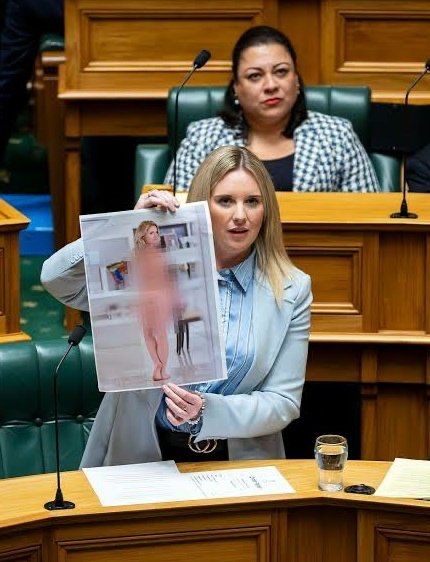
“This is my nude photo.”
A stunned silence swept the room. But within seconds, she revealed the truth:
It was fake. AI-generated. A deepfake. Created in less than five minutes.
💣 A Bombshell with a Purpose
This wasn’t a stunt. It was a wake-up call.
McLure wasn’t exposing herself—she was exposing a flaw in our systems, our tech, and our moral compass. The image was artificially generated, but the fear it conveyed was brutally real.
She was there to support a bill aimed at criminalizing non-consensual deepfake content. And in a world where technology races ahead of legislation, she showed just how horrifyingly easy it is to destroy someone’s dignity with a few clicks.
🎯 The Main Target: Young Women
Deepfake porn is no longer confined to dark corners of the internet. It’s going mainstream, fast—and young women are the most common victims.
- Their faces are stolen from innocent selfies.
- Their identities are dragged through digital hell.
- And worst of all? The law often shrugs.
McLure’s bold action was more than symbolic—it was a punch in the gut to complacency. She wasn’t asking for attention. She was demanding justice.
🤖 When Technology Outpaces Humanity
Let’s be brutally honest: AI is not the problem. People misusing AI are.
The tools are here to stay—faster, cheaper, and more powerful every day. What hasn’t kept up?
→ Laws. Ethics. Awareness.
If it takes an MP to show fake nudes of herself in Parliament to make people care, what does that say about the rest of us?
📜 The Legislation We Desperately Need
What McLure advocates isn’t radical. It’s basic human decency codified into law:
- Strict criminal penalties for creators and distributors of non-consensual deepfakes
- Fast takedown protocols for victims
- Education programs for schools and workplaces
- Digital fingerprinting tech to detect AI-manipulated images and videos
And most importantly, treating digital abuse like real-world abuse—because it is.
🌍 It’s Not Just New Zealand
Let’s be clear: This isn’t a “New Zealand problem.” This is a global digital epidemic.
From high school girls in India to celebrities in the U.S., no one is immune.
The only thing that separates a potential victim from a perpetrator is intent—and often, ignorance.
🚨 Final Thought: The Silence Is Over
In that moment of silence in Parliament, Laura McLure shattered a global silence.
She showed what courage looks like in the AI era—not a TED talk, not a press release, but a raw, uncomfortable truth that forces action.
So now the question isn’t “How did she do it?”
It’s “What are WE going to do now?”
Because if we let AI strip away consent, dignity, and justice—
what’s left to protect?
Let’s make laws as fast as we make deepfakes.
Let’s not wait until your daughter, your sister, or your friend becomes a viral victim.
It’s time to get real.
Even if the images aren’t.
Comments

Hi, I’m Nishanth Muraleedharan (also known as Nishani)—an IT engineer turned internet entrepreneur with 25+ years in the textile industry. As the Founder & CEO of "DMZ International Imports & Exports" and President & Chairperson of the "Save Handloom Foundation", I’m committed to reviving India’s handloom heritage by empowering artisans through sustainable practices and advanced technologies like Blockchain, AI, AR & VR. I write what I love to read—thought-provoking, purposeful, and rooted in impact. nishani.in is not just a blog — it's a mark, a sign, a symbol, an impression of the naked truth. Like what you read? Buy me a chai and keep the ideas brewing. ☕💭 For advertising on any of our platforms, WhatsApp me on : +91-91-0950-0950 or email me @ support@dmzinternational.com