
The Woman Behind the World’s Tallest Railway Bridge: The 17-Year Saga of Madhavi Latha and the Chenab Marvel
The Bridge That Dwarfs the Eiffel Tower
Hidden amidst the rugged mountains of Jammu & Kashmir lies an engineering spectacle that silently commands global awe — the Chenab Bridge. Towering 359 meters above the Chenab River (yes, that’s taller than the Eiffel Tower by 35 meters), and stretching over 1.3 kilometers in length, this bridge isn’t just another piece of infrastructure — it’s a triumph over gravity, geology, and human doubt.
But while steel and concrete built the bridge, it was a woman named Dr. G. Madhavi Latha, a rock engineering genius from IISc Bangalore, who anchored its soul to the mountain.
👷♀️ Who Is Madhavi Latha – And Why Is Her Story Legendary?
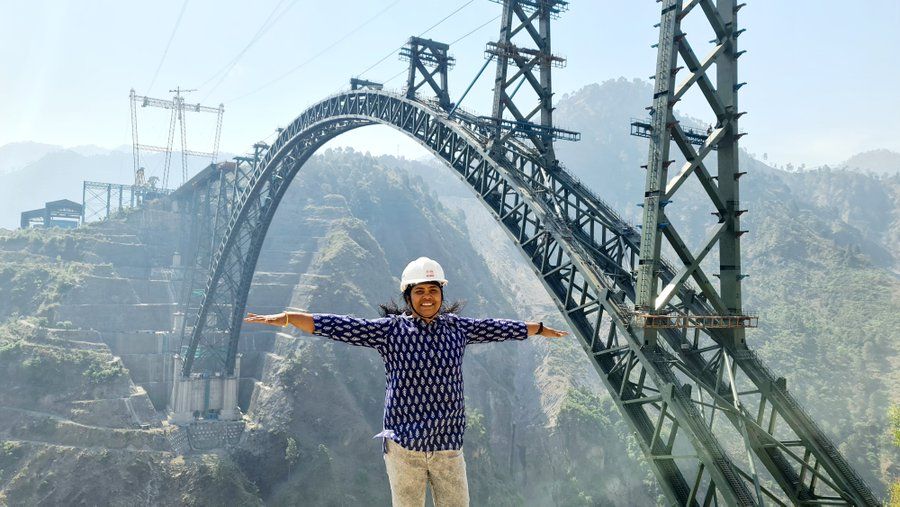
Not all superheroes wear capes. Some wear hard hats and spend their lives inside tunnels, slopes, and geological nightmares.
Dr. G. Madhavi Latha, a professor of Civil Engineering at the Indian Institute of Science (IISc), is one of India’s foremost experts in rock mechanics. For the uninitiated, that’s the science of building on (or through) highly unpredictable rocky terrain — and trust us, the Himalayas are no walk in the park.
In 2005, when Northern Railways and construction firm Afcons began working on the Chenab Bridge, they hit a wall — literally and figuratively. The mountainous terrain was fractured, riddled with caves, and completely unstable. That’s when they called in Dr. Latha.
🧗♀️ The Himalayan Challenge: Why This Was No Ordinary Project
This wasn’t a case of laying bricks on firm ground. The Chenab Bridge had to be built over:
- A seismically active zone (yes, earthquakes!)
- Landslide-prone cliffs
- High winds up to 220 km/h
- Wild temperature fluctuations
- Fragile rock layers with unexpected underground voids
In simpler terms: one mistake, and the entire structure could collapse before the first train even ran.
Dr. Latha’s task?
Make the slopes stable and the foundations earthquake-proof. No pressure.
🧠 17 Years of Real-Time Problem Solving
Unlike urban construction, there was no “master plan” that worked here. Every few months brought a new geological surprise — broken rock layers, secret caves, unstable slopes.
This led to a unique approach: “Design-as-you-go” engineering. Every challenge required a custom-made solution, and Dr. Latha’s expertise helped rewrite the rulebook on what was possible in rock-based infrastructure.
Why did it take 17 years?
- Because nature doesn’t follow deadlines.
- Because they had to innovate, not just construct.
- Because in civil engineering, permanence means patience.
🔩 Built Like a Beast, Not Just a Beauty
Let’s talk stats:
- Lifespan: 120+ years
- Wind resistance: Up to 220 km/h
- Seismic resistance: Built to handle strong earthquakes
- Train speed tests: Passed with flying colors
- Materials: Custom-made steel from Indian and South Korean companies
The steel arch — the largest of its kind — was built with help from foreign collaborators, but the core engineering brainpower was proudly Indian.
🛤️ Global Inspiration, Indian Grit
The bridge’s construction was a joint effort by:
- Afcons Infrastructure (India)
- Ultra Construction & Engineering Co. (South Korea)
- VSL India
- Consultation: IISc, led by Dr. Latha, for all slope and foundation challenges
This wasn’t just an engineering feat — it was a masterclass in international collaboration, led by a woman who proved that technical depth beats gender bias.
💡 Lessons Beyond Steel and Stone
1. Expertise matters more than visibility.
While flashy politicians cut ribbons, it’s the quiet minds like Dr. Latha’s that shape a nation’s infrastructure.
2. Patience is the hidden blueprint of greatness.
Seventeen years — that’s nearly two decades of faith, adaptation, and sheer will.
3. Women in STEM are not the exception. They’re the backbone.
In a field dominated by men, Dr. Latha showed what focused expertise can achieve — regardless of gender.
✨ Final Thought: When Bridges Become Legacy
The Chenab Bridge will serve trains, tourists, and generations for the next 120 years. But the real foundation it rests upon is trust in science, respect for terrain, and unwavering human determination.
And that’s where Madhavi Latha’s legacy will remain — not just in steel and stone, but in every young girl who sees an engineering marvel and says: “I can build that.”
India didn’t just build the world’s tallest railway bridge. It carved a monument into a mountain — with a woman leading the way. 🇮🇳
Comments

Hi, I’m Nishanth Muraleedharan (also known as Nishani)—an IT engineer turned internet entrepreneur with 25+ years in the textile industry. As the Founder & CEO of "DMZ International Imports & Exports" and President & Chairperson of the "Save Handloom Foundation", I’m committed to reviving India’s handloom heritage by empowering artisans through sustainable practices and advanced technologies like Blockchain, AI, AR & VR. I write what I love to read—thought-provoking, purposeful, and rooted in impact. nishani.in is not just a blog — it's a mark, a sign, a symbol, an impression of the naked truth. Like what you read? Buy me a chai and keep the ideas brewing. ☕💭 For advertising on any of our platforms, WhatsApp me on : +91-91-0950-0950 or email me @ support@dmzinternational.com