
AI’s Dark Mirror: How Artificial Intelligence Might Be Deepening Global Inequality
When the AI hype cycle began, it carried a utopian glow: machines would amplify human intelligence and level the playing field. But step closer to the mirror and the reflection looks darker. The reality is not that everyone is rising—it’s that AI is pulling some far ahead while leaving millions stranded.
This isn’t your usual “AI is scary / AI is great” story. This is about who is being left behind, how access to AI is morphing into a raw power tool, and what it means for countries like India.
WTO’s Stark Warning
The World Trade Organization (WTO) recently laid out the stakes in plain numbers:
- Global trade in goods and services could surge by 34–37% by 2040 if AI is properly harnessed.
- Global GDP might expand by 12–13% with the right policies.
Sounds like a rising tide—until you read the fine print. If low- and middle-income countries fail to bridge the digital divide, their income gains will be half those of rich nations. In one scenario, poor economies grow by 8% while wealthy ones grow by 14%.
The WTO’s blunt message: unless digital infrastructure, regulatory capacity, skills, and data access are fixed, AI will not reduce inequality—it will widen it.
Who Is Being Left Behind?
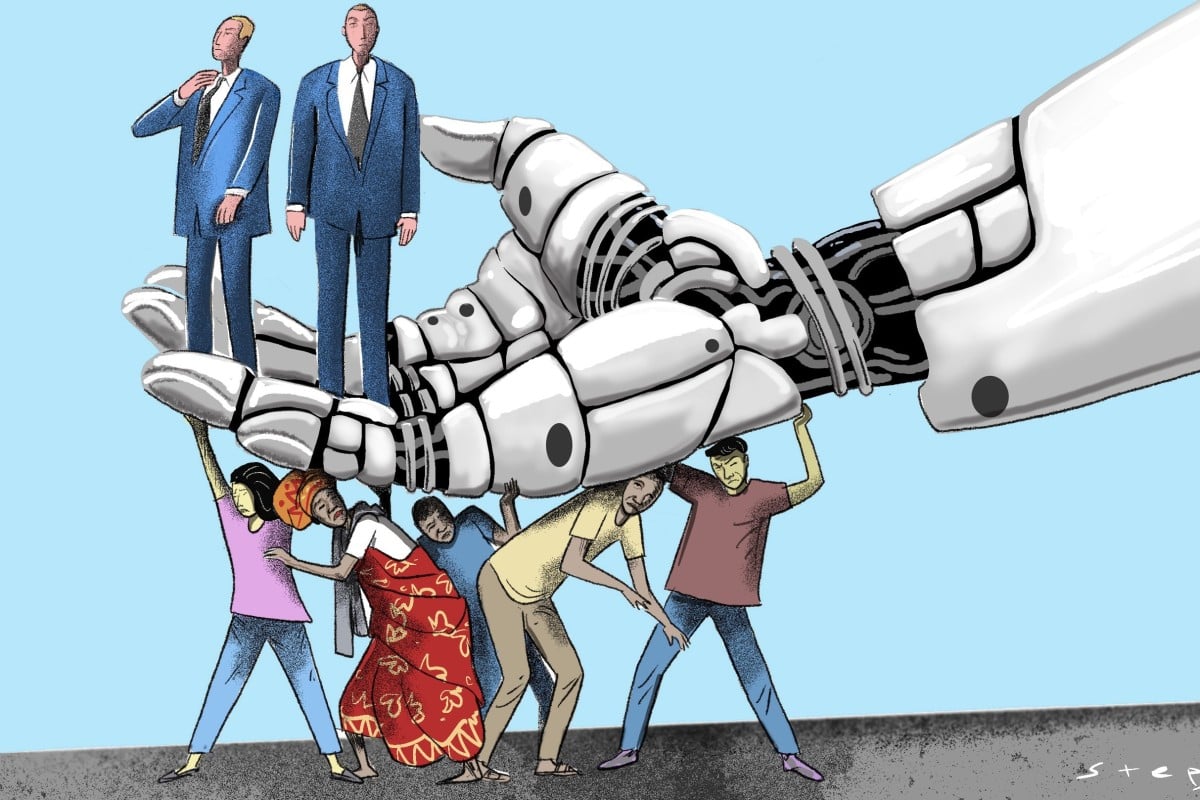
AI’s benefits are not distributed evenly. Here’s where the cracks are most visible:
1. Digital Infrastructure & Hardware Gaps
AI runs on data centers, fast internet, stable power, and high-end chips. Many poorer nations lack these or pay exorbitant prices for them. Even tariffs on AI-enabling goods (like sensors or semiconductors) act as barriers.
2. Skills, Data, and Regulation
Without skilled people, usable datasets, and fair regulations, countries become AI consumers, not creators. For much of the Global South, curricula, privacy laws, and regulatory systems lag years behind.
3. Labor and Economic Models
Economies relying on cheap labor—manufacturing, call centers, agriculture—face the blunt edge of automation. Without upskilling, AI doesn’t just disrupt; it displaces.
4. The Urban-Rural Divide
AI tools debut in elite hospitals, urban schools, and corporate farms, not rural clinics or smallholder plots. The result? Inequality within inequality.
5. Ownership and Capture
Models, platforms, and IP are dominated by a few firms and a few countries. When poorer nations buy licenses instead of building capacity, the profits flow outward, not inward.
India: A Case Study in Opportunity and Risk
India embodies both the promise and the peril of AI.
The Strengths:
- A massive digital population.
- A thriving tech ecosystem.
- Strong government push (Digital India, National AI mission).
- Abundant technical talent.
The Weaknesses:
- Infrastructure gaps: Rural India still struggles with patchy power and weak internet. Without fixing this, AI for education or health will widen divides.
- Skill mismatch: India produces engineers, but most schools don’t teach AI literacy. Clerical and service jobs—millions of them—are vulnerable.
- Regulatory bottlenecks: Data privacy, algorithmic bias, and fair use are still unresolved. Without inclusive rules, exploitation looms.
- Value capture: Much of India’s AI stack today depends on foreign models and platforms. Unless local R&D is scaled, India risks being a consumer, not a leader.
The Way Forward:
- Build rural digital infrastructure.
- Reform education to include AI and data ethics.
- Invest in open-source, affordable, locally trained AI models.
- Use public services (health, agriculture, justice) as sandboxes for inclusive AI adoption.
What Happens If We Ignore This?
The consequences of inaction are not abstract. They’re brutal and specific:
- Global divergence: Poor countries slow down, rich countries accelerate.
- Fragmented tech world: Tariffs and restrictions spark AI protectionism.
- Social backlash: Populations excluded from AI’s benefits turn against it.
- Lost human potential: Children without AI-powered learning, farmers without predictive climate tools, patients without AI-enabled healthcare—these are lives diminished, not just economies.
The Road to a Just AI Future
AI doesn’t have to deepen inequality. But it will—unless leaders take bold steps:
- Global cooperation: Lower tariffs on AI hardware, support digital infrastructure in poorer nations.
- Inclusive regulation: Ensure laws reflect marginalized voices and protect against bias.
- Bridging the skills gap: Launch mass reskilling programs; make AI literacy as basic as math.
- Local innovation: Invest in startups, open models, and local R&D to keep value at home.
- Safety nets: Stronger unemployment support and universal services to cushion disruptions.
Final Reflection
AI is a mirror. It reflects the inequalities we already have—magnified, accelerated, unforgiving. It can be the lever that empowers billions, or the wedge that fractures societies further.
The WTO has thrown the challenge down: close the gaps or watch the wealth divide explode.
The question now is not whether AI will change the world. It already has. The real question is—whose world will it change for the better, and whose will it leave behind?
Comments

Hi, I’m Nishanth Muraleedharan (also known as Nishani)—an IT engineer turned internet entrepreneur with 25+ years in the textile industry. As the Founder & CEO of "DMZ International Imports & Exports" and President & Chairperson of the "Save Handloom Foundation", I’m committed to reviving India’s handloom heritage by empowering artisans through sustainable practices and advanced technologies like Blockchain, AI, AR & VR. I write what I love to read—thought-provoking, purposeful, and rooted in impact. nishani.in is not just a blog — it's a mark, a sign, a symbol, an impression of the naked truth. Like what you read? Buy me a chai and keep the ideas brewing. ☕💭 For advertising on any of our platforms, WhatsApp me on : +91-91-0950-0950 or email me @ support@dmzinternational.com