
Elon Musk Says Robots Will Give Us “Universal High Income.” What Does That Really Mean?
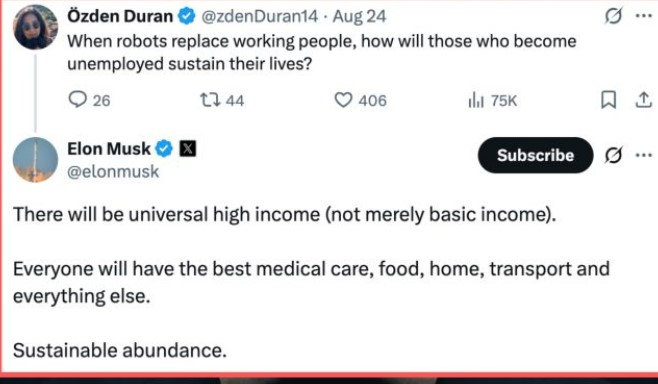
When Elon Musk tweets, the internet listens. Recently, someone asked him a simple but powerful question: “When robots replace working people, how will those who become unemployed sustain their lives?” Musk’s reply was short, bold, and almost utopian:
👉 “There will be universal high income (not merely basic income). Everyone will have the best medical care, food, home, transport and everything else. Sustainable abundance.”
Sounds like science fiction? Let’s break it down.
From Universal Basic Income to Universal High Income
Most of us have heard of Universal Basic Income (UBI) – the idea that governments should pay every citizen a minimum monthly allowance, whether they work or not. The goal is survival: enough to buy food, pay rent, and live modestly.
But Musk isn’t talking about survival. He’s talking about Universal High Income (UHI) – where automation and AI make so much wealth that people aren’t just scraping by, they’re living comfortably.
Imagine a world where:
- Your rent or house is covered.
- Food is fresh, healthy, and affordable.
- Healthcare is top-notch for everyone, not just the rich.
- Transportation (self-driving cars, hyperloops, electric air taxis) is cheap or free.
In short, robots and AI wouldn’t just take jobs—they’d also create so much productivity that society could afford to give everyone a much higher standard of living.
Why Musk Believes This Future Is Possible
Elon Musk’s thinking is rooted in one simple idea: automation creates abundance.
- Robots don’t need salaries. They can work 24/7, producing goods and services at almost zero cost once built.
- AI systems reduce inefficiency. Think of warehouses, logistics, and even surgeries being done faster, cheaper, and with fewer mistakes.
- Energy is heading toward abundance. With solar power, batteries, and nuclear advances, the cost of energy (the fuel behind everything) could become near zero.
If producing food, clothing, homes, and cars becomes almost free, then the whole economy shifts. Scarcity—the reason prices are high today—would no longer dominate our lives.
Sustainable Abundance: The Key Word
The phrase Musk used—“sustainable abundance”—isn’t just about wealth. It’s about avoiding collapse.
Think about it:
- If robots can mass-produce everything but destroy the planet in the process, we’re doomed.
- If AI makes billionaires richer but leaves ordinary people starving, inequality explodes.
Musk is pointing toward a vision where technology is used responsibly—green energy, recycled materials, eco-friendly transport—so that future generations inherit not just wealth, but a liveable planet.
But Here’s the Hard Truth
Right now, we are nowhere near this dream. What we actually see:
- AI and robots are already cutting jobs, especially in manufacturing, customer support, and even creative industries.
- Wealth is concentrating, not spreading. Tech companies grow richer, while gig workers struggle.
- Governments are still debating basic income, let alone high income.
So while Musk paints a rosy picture, the question remains: who decides whether robots serve everyone, or just a tiny elite?
A Common Man’s Take
Let’s be real. If machines start doing all the work tomorrow:
- Without strong policies, the rich will own the robots and everyone else could end up broke.
- If society makes the right choices, we could all live better lives without working 12-hour shifts just to survive.
The real challenge isn’t the technology. It’s politics, greed, and fairness.
Will governments tax AI-driven corporations to fund universal high income?
Will humanity embrace abundance or cling to scarcity-driven systems?
Will “sustainable abundance” be shared, or hoarded?
Final Thought
Elon Musk may sound like he’s dreaming, but he’s hinting at something very real:
For the first time in history, technology has the power to make poverty optional.
The question is—do we, as humans, have the wisdom to use it that way? Or will we let robots work for billionaires while the rest of us fight for scraps?
That’s not a question AI can answer. That’s up to us.
Comments

Hi, I’m Nishanth Muraleedharan (also known as Nishani)—an IT engineer turned internet entrepreneur with 25+ years in the textile industry. As the Founder & CEO of "DMZ International Imports & Exports" and President & Chairperson of the "Save Handloom Foundation", I’m committed to reviving India’s handloom heritage by empowering artisans through sustainable practices and advanced technologies like Blockchain, AI, AR & VR. I write what I love to read—thought-provoking, purposeful, and rooted in impact. nishani.in is not just a blog — it's a mark, a sign, a symbol, an impression of the naked truth. Like what you read? Buy me a chai and keep the ideas brewing. ☕💭 For advertising on any of our platforms, WhatsApp me on : +91-91-0950-0950 or email me @ support@dmzinternational.com