
Entrepreneur in Residence – A fancy title. A confusing job.
If you spend five minutes on LinkedIn job postings, you will see many job posts with a big title:
Entrepreneur in Residence (EIR).
It sounds powerful.
It sounds elite.
It sounds like freedom.
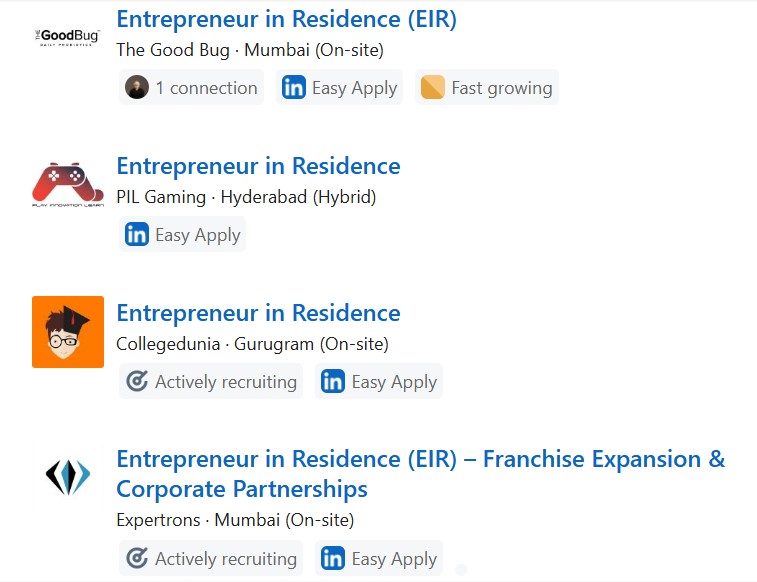
But what does it actually mean?
Let’s break it down without drama, without marketing words, and without pretending.
What is an Entrepreneur in Residence?
An Entrepreneur in Residence is not a regular job.
It is a temporary role where a company, investor, university, or accelerator brings in an entrepreneur to:
- Work on new business ideas
- Help startups already connected to them
- Explore new markets or products
- Find promising founders or ideas
In simple words:
They want your brain, experience, and network for a short period.
You are “in residence” — not permanent, not fully free either.
Where did this role come from?
This role started in:
- Venture capital firms
- Universities
- Startup incubators
These places wanted people who had already built businesses to help others do the same.
Later, big companies copied the idea.
Now you see EIR roles in:
- VC firms
- Startup accelerators
- Universities
- Corporate innovation labs
- Even government programs
LinkedIn made it look like a hot new trend.
In reality, it has existed quietly for years.
Who hires Entrepreneurs in Residence?
Usually, EIRs are hired by:
- Investors who want new startup ideas
- Accelerators that guide early founders
- Universities trying to turn research into businesses
- Corporates wanting “startup thinking” without hiring founders full-time
They don’t want fresh graduates.
They want people who have already struggled.
Who can apply?
There is no clear rule, but most EIRs are:
- Startup founders (successful or failed)
- Senior professionals with deep industry experience
- Product builders and operators
- People with strong networks
If you have never built anything, this role is hard to get.
If you have built something and survived, you have a chance.
How are candidates selected?
This is not like normal hiring.
The process usually looks like this:
- Someone refers you
- You speak to senior people directly
- They test how you think, not what you say
- They check your past work and reputation
- Final decision is made by partners or leadership
Cold applications rarely work.
Relationships matter more than resumes.
How long does an EIR role last?
Most EIR roles last:
- 6 months
- 9 months
- 12 months
It is not permanent.
The idea is:
- Either you build something valuable
- Or you help them enough during that period
Then the role ends.
How much do they pay?
This is where things get interesting.
Some EIRs are paid:
- A monthly salary
- Or a fixed yearly amount
In India, pay can range widely.
Some get decent money.
Some get very little.
And some get paid mostly in “future opportunity”.
There is no standard salary.
Everything depends on who hires you and how badly they need you.
Do you get equity?
Sometimes yes.
Sometimes no.
Possible outcomes:
- You build a startup and get equity in it
- The host invests in your idea later
- Or nothing happens at all
Many EIRs leave without any equity.
This is rarely highlighted in job posts.
What benefits do you really get?
Common benefits include:
- Office space
- Mentors
- Access to investors
- Brand value
- Time to think and build
The biggest benefit is network access.
The biggest risk is working hard without clear returns.
The uncomfortable truth
Let’s say this plainly.
For organizations:
- EIRs are low-risk, high-reward
- They get ideas, talent, and insights cheaply
For entrepreneurs:
- It can be a launchpad
- Or it can be a dead end
Some EIR roles are genuinely supportive.
Some are simply a way to extract ideas without commitment.
If the job post is vague, assume risk is on you, not them.
What you must ask before accepting
Before saying yes, ask clearly:
- How much will I be paid?
- What happens if I build something valuable?
- Who owns the idea?
- Can I raise money outside?
- What happens when the term ends?
If answers are unclear, that is your answer.
Final truth
Entrepreneur in Residence is not a dream job.
It is a calculated risk.
For the right person, it can change everything.
For the wrong setup, it can waste a year.
Don’t be impressed by the title.
Be impressed by the terms.
Because in the startup world,
clarity is more valuable than opportunity.
Comments

Hi, I’m Nishanth Muraleedharan (also known as Nishani)—an IT engineer turned internet entrepreneur with 25+ years in the textile industry. As the Founder & CEO of "DMZ International Imports & Exports" and President & Chairperson of the "Save Handloom Foundation", I’m committed to reviving India’s handloom heritage by empowering artisans through sustainable practices and advanced technologies like Blockchain, AI, AR & VR. I write what I love to read—thought-provoking, purposeful, and rooted in impact. nishani.in is not just a blog — it's a mark, a sign, a symbol, an impression of the naked truth. Like what you read? Buy me a chai and keep the ideas brewing. ☕💭 For advertising on any of our platforms, WhatsApp me on : +91-91-0950-0950 or email me @ support@dmzinternational.com