
Reliance’s AI Data Center: Evaluating the Nvidia Partnership Amid DeepSeek’s Disruption
Mukesh Ambani’s Reliance Industries is embarking on an ambitious project to establish the world’s largest AI data center in Jamnagar, Gujarat. This initiative, in collaboration with Nvidia, aims to position India at the forefront of artificial intelligence advancements. However, the recent emergence of DeepSeek, a Chinese AI startup, has introduced new dynamics into the AI hardware landscape, prompting a reevaluation of traditional approaches.
The Reliance-Nvidia Collaboration

Reliance has partnered with Nvidia to equip the Jamnagar data center with state-of-the-art AI semiconductors. This partnership underscores a commitment to leveraging cutting-edge technology to drive AI innovation in India.
DeepSeek’s Disruptive Innovation
DeepSeek has developed an AI model, the R1, which delivers performance comparable to leading models like OpenAI’s ChatGPT but at a fraction of the cost. Notably, DeepSeek achieved this using approximately 2,000 Nvidia H800 GPUs, incurring a development cost of around $5.6 million. In contrast, traditional models often require significantly more resources and investment.
Cost Comparison: Nvidia’s High-End Hardware vs. DeepSeek’s Approach

Nvidia’s advanced AI hardware, such as the H100 GPUs, is known for its high performance but comes with substantial costs. For instance, the cost per GB of memory for Nvidia’s H100 is approximately $312.
DeepSeek’s approach demonstrates that effective AI models can be developed with less expensive hardware, challenging the notion that only top-tier equipment can yield top-tier results.
Strategic Considerations for Reliance

Given DeepSeek’s breakthrough, Reliance faces critical decisions regarding its hardware investments:
The Opportunity: Leveraging Open-Source AI
A major advantage Reliance could explore is the rise of open-source AI models like DeepSeek. DeepSeek has made its AI technology openly available, meaning that companies like Reliance can leverage its models to accelerate development without starting from scratch. If Mukesh Ambani and his team strategically adopt open-source AI tools, they could rapidly enhance Reliance’s AI capabilities and address the challenges of building foundational AI models from the ground up. By integrating open-source AI with localized datasets and infrastructure improvements, Reliance could still become a powerful player in India’s AI revolution, reinforcing its dominance in the digital and technology ecosystem.
- Performance Requirements: Assessing whether Nvidia’s high-end hardware is necessary for their specific AI applications or if more cost-effective solutions could suffice.
- Scalability and Future-Proofing: Considering the long-term scalability of the data center and the potential need for advanced hardware to accommodate future AI developments.
- Cost Efficiency: Balancing the benefits of cutting-edge technology against the financial implications, especially in light of emerging alternatives like DeepSeek’s model.
Conclusion
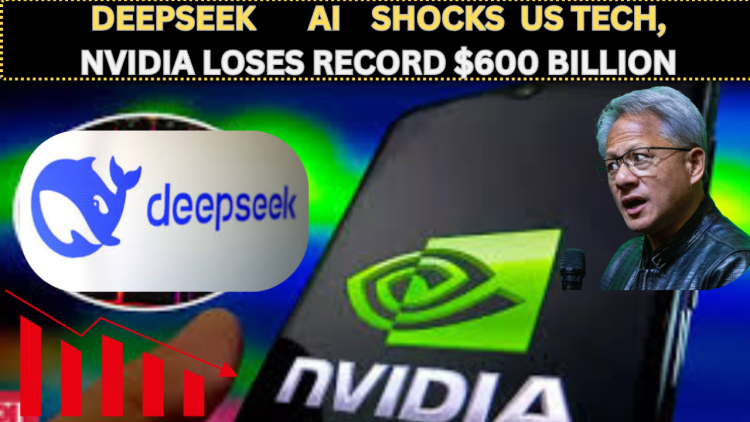
While Nvidia’s hardware offers unparalleled performance, DeepSeek’s innovation highlights the potential for more economical approaches to AI development. Reliance must carefully evaluate its strategy, weighing the advantages of established, high-performance hardware against emerging, cost-effective alternatives to ensure the optimal balance between performance and investment.
Comments

Hi, I’m Nishanth Muraleedharan (also known as Nishani)—an IT engineer turned internet entrepreneur with 25+ years in the textile industry. As the Founder & CEO of "DMZ International Imports & Exports" and President & Chairperson of the "Save Handloom Foundation", I’m committed to reviving India’s handloom heritage by empowering artisans through sustainable practices and advanced technologies like Blockchain, AI, AR & VR. I write what I love to read—thought-provoking, purposeful, and rooted in impact. nishani.in is not just a blog — it's a mark, a sign, a symbol, an impression of the naked truth. Like what you read? Buy me a chai and keep the ideas brewing. ☕💭 For advertising on any of our platforms, WhatsApp me on : +91-91-0950-0950 or email me @ support@dmzinternational.com