
Vote Chori, the Election Commission and the Political Battle Ahead: India’s Situation on 1 November 2026
-
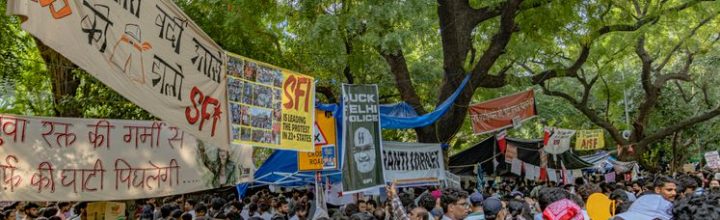
1. The Cockroach Janta Party (CJP), led by Abhijeet Dipke, demonstrated that a youth-led agitation can force a political response even without the organisational strength of a national party.
CJP’s prolonged Jantar Mantar protest over the NEET paper-leak controversy ended on 25 July 2026, when Education Minister Dharmendra Pradhan resigned. The government also accepted demands concerning legal action against protesters and compensation for families of NEET aspirants who died by suicide.
The lesson is not simply that a protest can remove a minister. It is that a clearly defined demand, sustained public attention, emotional resonance and pressure on the government can create political costs that become difficult to ignore.
CJP’s confrontation with the authorities, including arrests of its leaders, also helped establish its identity as a youth protest movement. But one successful campaign does not guarantee that every subsequent protest will achieve the same result.
2. Why CJP is supporting the cause but not joining Rahul Gandhi’s rally
On 31 October, CJP founder Abhijeet Dipke met Trinamool Congress leader Mamata Banerjee in Delhi. CJP expressed solidarity with the INDIA bloc’s protest but maintained that it would not formally participate in the 1 November rally. Dipke said the organisation wanted to preserve its independent and politically neutral identity.
There are three plausible strategic reasons:
-
Protecting its independent identity: CJP does not want its earlier youth-led agitation to be portrayed as a Congress campaign.
-
Maintaining public credibility: Its supporters may include people who oppose electoral irregularities but do not support the opposition politically.
-
Keeping pressure on multiple parties: An independent organisation can criticise the BJP-led government without becoming accountable for every decision made by Congress or its allies.
This does not mean CJP has abandoned the issue. Its public position is that it supports the cause of free and fair elections while retaining organisational independence.
3. What happened at Kharge’s residence on 31 October?
Congress president Mallikarjun Kharge hosted a symbolic parliamentary proceeding at his Delhi residence. Former Lok Sabha Speaker Meira Kumar presided, and Rahul Gandhi delivered concluding remarks.
The INDIA bloc adopted a resolution seeking Chief Election Commissioner Gyanesh Kumar’s removal. Reports described participation by leaders from 21 opposition parties.
The opposition’s argument is that ordinary parliamentary proceedings have not provided adequate space to raise concerns about voter-list revision and the Election Commission’s conduct. The symbolic proceeding was intended to dramatise that complaint.
The BJP attacked the exercise as a political spectacle. Its spokesperson Sambit Patra mocked Rahul Gandhi as a “mock Prime Minister,” while other BJP leaders argued that Congress was creating its own parliament rather than accepting democratic outcomes.
The legal distinction is crucial: a resolution passed at a mock parliament cannot remove the CEC. Removal requires the constitutional procedure prescribed by law. The event was a political demonstration, not a legally effective impeachment.
4. What are Rahul Gandhi and the opposition trying to achieve today?
The 1 November rally at Delhi’s Ramlila Maidan is intended to turn the voter-list controversy into a national political issue. Opposition parties expect a very large turnout, and security arrangements have been strengthened around the venue.
The opposition’s likely strategy has four parts:
-
Demand Gyanesh Kumar’s resignation to make accountability at the Election Commission the central issue.
-
Mobilise voters affected by the Special Intensive Revision (SIR) and families worried about losing their voting rights.
-
Build a coalition beyond Congress, including regional parties and youth organisations, to demonstrate that the issue is not confined to one party.
-
Force a parliamentary debate and sustained scrutiny, using rallies, legal petitions, public testimony and evidence from electoral rolls.
The opposition’s strongest argument is not that it can remove the CEC through a street demonstration. It is that the electoral system must demonstrate that every eligible citizen can vote and that any disputed deletion can be challenged effectively.
For years, Congress and the wider opposition seemed to be doing the BJP’s job for it—raising issues, holding press conferences, staging brief protests and then failing to sustain the fight, making Congress-mukt Bharat appear increasingly achievable.
The CJP’s battle over the NEET controversy showed what determined, sustained public agitation could achieve, forcing the Education Minister’s resignation when political pressure became impossible to ignore.
Now, with CJP demonstrating the power of youth-led resistance, the opposition appears to have rediscovered its fighting spirit over alleged vote chori and Gyanesh Kumar. The question is whether this newfound energy will deliver real accountability and electoral reform, or fade away like so many earlier protests.
5. The central controversy: Were 13 crore voters really deleted?
The scale of the SIR exercise is the most important factual issue.
According to reported Election Commission figures, approximately 13.39 crore electors were placed in the absent, shifted, deceased or duplicate (ASDD) categories during the revision of electoral rolls across 30 states and Union Territories. The ECI says this figure does not mean that 13.39 crore eligible voters were wrongly removed from final electoral rolls.
The opposition argues that a process involving such a large number of names risks excluding genuine voters, particularly people who migrate for work, live at changing addresses or cannot be reached by election officials.
The key questions are:
-
Were voters given adequate notice and an opportunity to respond?
-
Were field verifications conducted properly?
-
Can people wrongly excluded restore their names without excessive paperwork?
-
Are deletions and additions transparent, auditable and politically impartial?
These are legitimate questions to investigate. But the number of names placed in deletion categories alone does not establish that those voters were deliberately removed to benefit the BJP.
The two other Election Commissioners, Sukhbir Singh Sandhu and Vivek Joshi, reportedly raised objections to aspects of the SIR process and decision-making.
6. What has the Supreme Court said?
The court’s recent directions are important because they distinguish the legality of voter-list revision from the protection of individual voting rights.
On 29 October, the Supreme Court questioned the ECI’s approach to Delhi voters whose names were missing from draft rolls. It asked the Commission not to insist that approximately 43 lakh affected residents reapply as new voters through Form 6 if they had already appeared on the 2026 rolls. The court also pressed the ECI to proactively contact potentially excluded voters.
On 30 October, the court reiterated that completion of SIR does not freeze electoral rolls permanently: eligible voters can still seek inclusion through the continuing process, subject to the applicable election deadlines. It also asked for details concerning complaints about voter deletions and procedural lapses.
The distinction matters: the Supreme Court has not ordered every one of the 13 crore names to be restored. It has emphasised safeguards, continued inclusion and scrutiny of specific concerns.
The ECI, meanwhile, maintains that SIR is intended to remove deceased, duplicate and relocated electors, and that only the competent Electoral Registration Officer can order additions or deletions. In its Supreme Court submissions, the Commission also defended its decisions as unanimous.
7. What is the BJP planning, and how could it respond?
Union Home Minister Amit Shah has challenged Rahul Gandhi and Samajwadi Party leader Akhilesh Yadav to debate the allegations in a special parliamentary session. He has dismissed the accusations as baseless and argued that the opposition is blaming the electoral authorities after losing elections.
The BJP’s likely political approach is to:
-
portray the rally as a Congress-led attempt to discredit democratic institutions;
-
highlight the distinction between draft-stage classifications and confirmed wrongful deletions;
-
insist that allegations be supported by verifiable evidence;
-
use parliamentary debate and the ECI’s explanations to counter the opposition’s narrative.
These are strategic inferences, not confirmation of a secret BJP plan. Whether the government actually convenes a special session remains a separate question.
For the opposition, the strongest next step would be to publish constituency-wise evidence, identify genuine voters who were excluded, document failed appeals and demand time-bound corrective action. For CJP, remaining independent while monitoring the ECI’s response could preserve its credibility and allow it to mobilise again if promised safeguards fail.
8. Where does the real battle lie?
The real issue is bigger than Rahul Gandhi, Gyanesh Kumar or the mock parliament. It concerns whether India’s electoral system can demonstrate that eligible citizens are not deprived of their voting rights through administrative failures.
A large rally may generate attention, but it cannot itself remove the CEC. A mock impeachment may dramatise opposition anger, but it has no legal effect. And the BJP’s political counterattack does not, by itself, resolve questions about individual voter exclusions.
The decisive test is evidence and correction: transparent voter records, accessible appeals, independent scrutiny and proof that eligible citizens can vote.
CJP’s earlier victory showed that sustained public pressure can produce political consequences. The opposition’s challenge now is to turn mass mobilisation into verifiable electoral reform. The government’s challenge is to answer the concerns with evidence rather than ridicule alone.
If genuine voters have been excluded, their restoration must take priority over party politics. If the deletions were lawful, the ECI must demonstrate that clearly. That is where the credibility of the entire electoral process will ultimately be judged.
-
Comments

Hi, I’m Nishanth Muraleedharan (also known as Nishani)—an IT engineer turned internet entrepreneur with 25+ years in the textile industry. As the Founder & CEO of "DMZ International Imports & Exports" and President & Chairperson of the "Save Handloom Foundation", I’m committed to reviving India’s handloom heritage by empowering artisans through sustainable practices and advanced technologies like Blockchain, AI, AR & VR. I write what I love to read—thought-provoking, purposeful, and rooted in impact. nishani.in is not just a blog — it's a mark, a sign, a symbol, an impression of the naked truth. Like what you read? Buy me a chai and keep the ideas brewing. ☕💭 For advertising on any of our platforms, WhatsApp me on : +91-91-0950-0950 or email me @ support@dmzinternational.com