If One Government School Can Do It, Why Not All? The Munderi Model That Should Shake India Awake

A small school in rural Kannur just did something that should embarrass every private school chain charging lakhs in fees. On February 11, 2026, Kerala Chief Minister Pinarayi Vijayan declared Munderi Government Higher Secondary School as the state’s first comprehensive international school. Not a private institution backed by billionaire investors. Not an elite urban academy. A government school — free, accessible, and now world-class.
Let that sink in.
From Four Classrooms to a Planetarium
Munderi GHSS was established in 1981 in a rural pocket of Kannur’s Kanhirode panchayat. For decades, it was like any other government school — underfunded, overlooked, surviving on the bare minimum. Today, its campus features smart classrooms with interactive flat-panel systems, a fully equipped auditorium, a planetarium, a science exhibition centre, an open-air theatre, a biodiversity park, modern playgrounds, and a digital library.
This transformation didn’t happen by accident. It happened because of intent.
The MUDRAA project — Munderi Higher Secondary School Development, Reformation and Academic Advancement — was initiated by the Kannur District Panchayath under the leadership of former Rajya Sabha MP K.K. Ragesh. The brilliance of this project was in how it was funded: a combination of government allocation and Corporate Social Responsibility funds. Cochin Shipyard Limited alone contributed ₹59 lakhs for smart classrooms through an MOU with the District Panchayath. NTPC funded solar power installations and renovation work. Multiple public sector companies channelled their mandatory CSR spending into a single school, creating something extraordinary.
The question is not whether this model works. It clearly does. The question is — why isn’t it being replicated?
The Uncomfortable Reality of Private School Chains
While Munderi was being transformed with public money and public will, something very different was happening on the other side of Indian education. Private equity firms — many of them American — have been quietly turning Indian schools into investment portfolios.
In late 2024, Kenro Capital invested $40 million into K12 Techno Services, which manages the Orchids International Schools chain. This is not charity. This is private equity looking at Indian children as a revenue stream. The model is clever and deeply cynical: Indian law mandates that schools must be non-profit entities. So these firms create separate for-profit companies — property companies that charge inflated rent to the school trust, operations companies that bill for IT, HR, and curriculum services. The non-profit school pays out to these for-profit arms, and the money flows upward to investors expecting returns.
Parents are paying ₹2–5 lakhs per year in fees for a mediocre private school. The international school fees even goes up to 7-15 lacs per year. The school trust technically shows no profit. But the investors absolutely do.
India’s education sector is now viewed as what financial analysts call a “recession-proof asset class with predictable cash flows.” That language alone should alarm every parent and policymaker in this country. Our children’s education is being described in the same terms as toll roads and power grids — assets to be extracted from.
Why the Government Must Compete Head-On
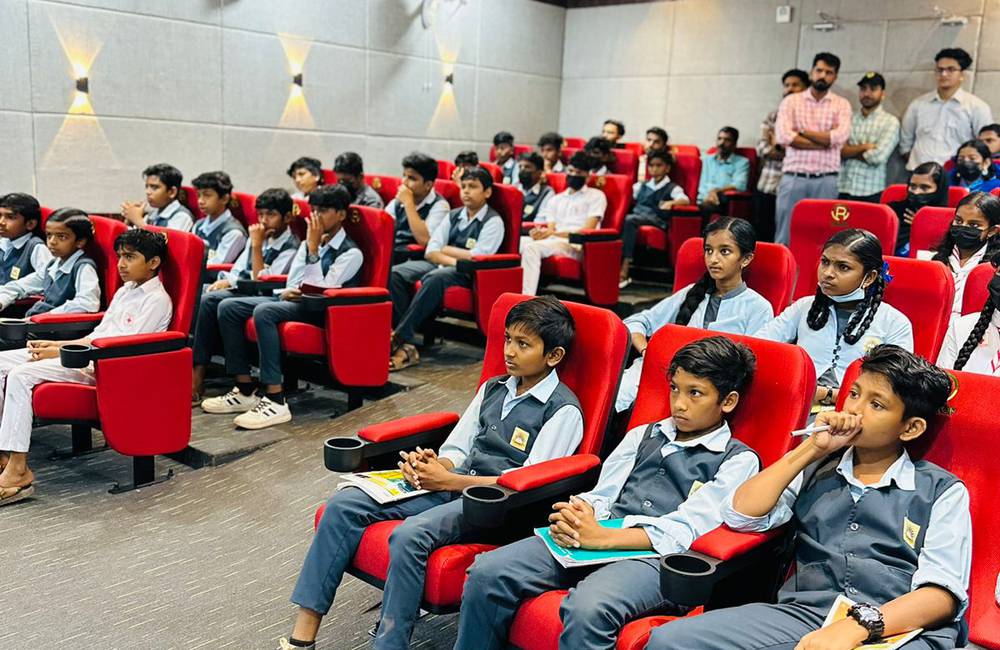
This is precisely where the Munderi model becomes not just inspiring but urgent. If a single district panchayath in Kerala can coordinate CSR funds from public sector companies and transform a rural school into an international-standard institution, imagine what could happen with systematic state and central government commitment.
India’s Companies Act mandates that every company with a net worth of ₹500 crore or more, or turnover of ₹1,000 crore or more, must spend 2% of average net profits on CSR. In 2023-24 alone, Indian companies spent over ₹30,000 crore on CSR activities. A significant portion of this goes into education — but scattered across thousands of small, disconnected initiatives with little measurable impact.
What if there was a coordinated national framework? What if every district identified one government school for a MUDRAA-style transformation, pooling CSR contributions from multiple companies into a single, visible, high-impact project? Kerala has shown the blueprint. The central government should mandate this model across every state.
The Global Standard India Is Missing
Walk into a public school in Germany, and you will find state-of-the-art laboratories, free meals, and zero tuition fees — from kindergarten through university. In Finland, there are virtually no private schools because the public system is so good that nobody needs an alternative. In Australia, Canada, and the UK, public school education is free and of a standard that families across income levels willingly choose it. The United States spends roughly 6% of GDP on education, and public schooling through Grade 12 is entirely free.
India spends around 3% of GDP on education. The National Education Policy 2020 promised to raise this to 6%, but that increase has been painfully slow. Meanwhile, the private sector fills the vacuum — and fills its pockets.
The developed world understood something decades ago that India still resists: when public education is excellent, private education becomes unnecessary for most families. The money parents currently spend on private school fees — money that flows to investors in New York and London — could stay in family savings, housing, healthcare, and local economies.
The Munderi Question
Munderi is not just a success story. It is a question posed to every government official, every bureaucrat, every elected representative in this country: if this can be done for one school with CSR funds and political will, why can’t it be done for a hundred? For a thousand?
Kerala has 4,775 government schools. India has over 10 lakh. Even transforming 1% of them into Munderi-level institutions would create a network of 10,000 world-class free schools. The CSR money exists. The public sector companies exist. The children certainly exist — 26 crore of them enrolled in schools across India, the majority in government institutions.
What is missing is not money. What is missing is intent.
Every time a private equity firm invests another $40 million into an Indian school chain, it is a vote of confidence — not in Indian education, but in the Indian government’s continued failure to provide quality public schooling. Every parent who takes a loan to pay private school fees is essentially paying a tax on government apathy.
Munderi proves that this doesn’t have to be the way things are. One school in rural Kerala, with the right coordination and the right intent, now stands shoulder to shoulder with institutions that charge fifty times what it costs to study there.
The children of India deserve a government that takes this seriously. Not one Munderi — but one in every district. That is not a dream. That is a policy decision waiting to be made.
The author writes about India’s cultural heritage, handloom traditions, and social development at nishani.in
Comments

Hi, I’m Nishanth Muraleedharan (also known as Nishani)—an IT engineer turned internet entrepreneur with 25+ years in the textile industry. As the Founder & CEO of "DMZ International Imports & Exports" and President & Chairperson of the "Save Handloom Foundation", I’m committed to reviving India’s handloom heritage by empowering artisans through sustainable practices and advanced technologies like Blockchain, AI, AR & VR. I write what I love to read—thought-provoking, purposeful, and rooted in impact. nishani.in is not just a blog — it's a mark, a sign, a symbol, an impression of the naked truth. Like what you read? Buy me a chai and keep the ideas brewing. ☕💭 For advertising on any of our platforms, WhatsApp me on : +91-91-0950-0950 or email me @ support@dmzinternational.com