Marks, Pressure & Childhood: Are We Raising Students or Silent Survivors?
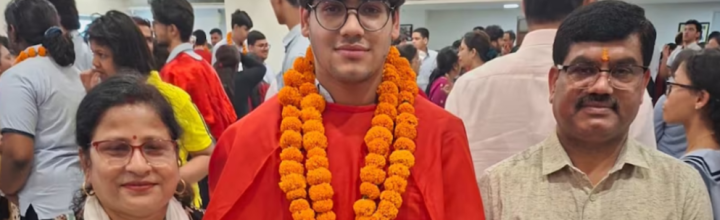
When news came out about a student named Siddharth scoring 99.25% while reportedly studying only around four focused hours a day, many parents were shocked. In a country where students are often pushed into 12–15 hours of study, coaching centers, endless tuition classes, and sleepless nights, his routine looked almost unbelievable.
But maybe the real lesson is not about “studying less.”
Maybe the real lesson is this: children learn better when they are not mentally suffocated.
Today, many students are not studying because they enjoy learning. They study because they are scared. Scared of parents. Scared of teachers. Scared of comparison. Scared of relatives asking marks during family functions. Scared that friends will laugh if they fail. Scared that society will judge them based on one exam paper.
And this fear often begins from school itself.
A child who once loved drawing, cricket, music, science experiments, or storytelling slowly becomes trapped inside a system that measures intelligence only through marks. Report cards become more important than happiness. Rank becomes more important than mental health.
The result?
A generation of anxious children.
India has repeatedly witnessed heartbreaking incidents where students end their lives after getting “low marks.” Even more painful is the fact that some students take extreme steps despite scoring high marks — simply because they could not meet the expectations of parents, schools, or society.
Think about how dangerous that mindset has become.
If a child scoring 60% feels worthless and another scoring 95% still feels like a failure, then the problem is not the student. The problem is the system around them.
Parents often say they are pushing children “for their future.” But sometimes, in trying to secure a future, we unknowingly destroy a child’s present.
Not every child is born to become a doctor, engineer, IAS officer, or software professional. Some children are naturally gifted in sports. Some in arts. Some in business. Some in design. Some in communication. Some in leadership. Some in technical skills. Some in farming, cooking, gaming, acting, animation, or music.
A fish will always fail in a tree-climbing competition.
The responsibility of parents and teachers is not just to force children into textbooks. It is to identify their real strengths early.
If a child is passionate about cricket, football, basketball, badminton, chess, dance, photography, painting, or coding, that interest should not be treated as a “waste of time.” It should be encouraged seriously.
Yes, education is important. But education is not equal to memorizing answers under pressure.
Real education helps children discover who they truly are.
Many successful athletes, artists, entrepreneurs, and creators were average students in school. But someone noticed their talent and gave them space to grow. Imagine how many talented children India loses every year because society keeps forcing everyone into the same race.
Parents today work long hours for their children. That sacrifice is real. But one of the greatest gifts parents can give is emotional safety — a home where marks are discussed calmly, not like courtroom verdicts.
A child should never feel:
“If I fail, my life is over.”
Unfortunately, many students feel exactly that.
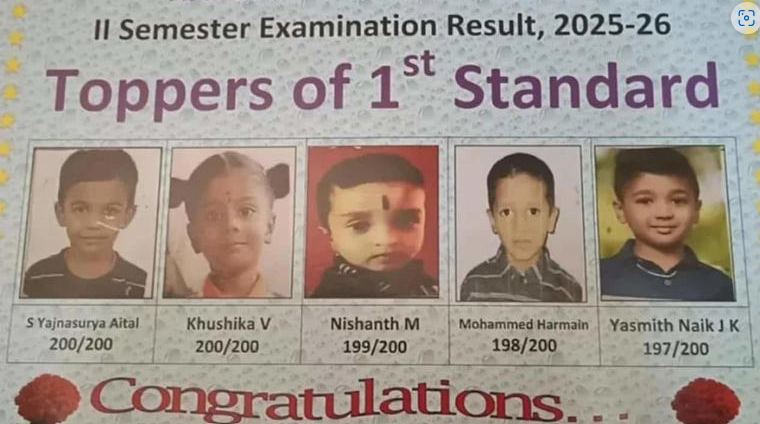
The viral “Class 1 toppers chart” from a Karnataka school has once again raised serious questions about how early academic pressure begins in India.
At an age when children should be learning through play, curiosity, friendships, and creativity, many are already being ranked, compared, and judged based on marks.
Such practices may create unhealthy competition, fear of failure, and anxiety even before a child fully understands what education truly means. Childhood should not become a race for ranks before kids even learn to enjoy learning itself.
Schools also need major changes. Mental health awareness should become as important as mathematics and science. Teachers should stop humiliating weak students publicly. Comparison between students should reduce. Every child develops differently.
Another important point many families still ignore is alternative education systems like National Institute of Open Schooling (NIOS). These systems can help students who struggle in traditional school environments. Some children perform much better with flexible learning methods while simultaneously developing skills in sports, arts, entrepreneurship, or vocational careers.
There is nothing wrong if a teenager spends time mastering football, chess, music production, fashion design, animation, or athletics alongside academics. In fact, in today’s world, specialized skills can create global careers.
The world has changed. But sadly, many mindsets have not.
Marks can open doors. But they do not define human worth.
A peaceful child with confidence, curiosity, creativity, emotional strength, and real-world skills will go much further in life than a burnt-out student living only for report cards.
Perhaps Siddharth’s story teaches us something bigger than academic success.
Maybe success does not come from studying in fear for 16 hours a day.
Maybe it comes from balance, focus, happiness, discipline, and learning without emotional torture.
And maybe the biggest question parents should ask today is not:
“How many marks did my child get?”
But instead:
“Is my child mentally happy while growing up?”
Comments

Hi, I’m Nishanth Muraleedharan (also known as Nishani)—an IT engineer turned internet entrepreneur with 25+ years in the textile industry. As the Founder & CEO of "DMZ International Imports & Exports" and President & Chairperson of the "Save Handloom Foundation", I’m committed to reviving India’s handloom heritage by empowering artisans through sustainable practices and advanced technologies like Blockchain, AI, AR & VR. I write what I love to read—thought-provoking, purposeful, and rooted in impact. nishani.in is not just a blog — it's a mark, a sign, a symbol, an impression of the naked truth. Like what you read? Buy me a chai and keep the ideas brewing. ☕💭 For advertising on any of our platforms, WhatsApp me on : +91-91-0950-0950 or email me @ support@dmzinternational.com