Before the CEC’s Chair: Gyanesh Kumar’s Kerala Controversies and the Questions India Must Not Ignore
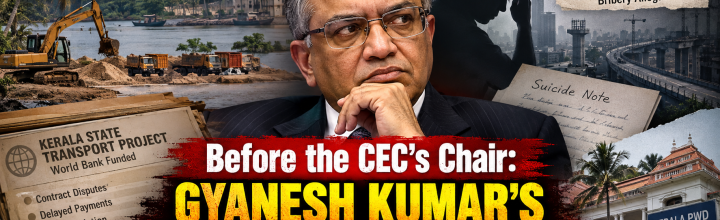
Chief Election Commissioner Gyanesh Kumar’s years in Kerala have returned to public discussion because of two episodes: allegations of illegal sand mining during his tenure as Ernakulam district collector and the controversy surrounding a World Bank-funded road project when he served as Kerala’s Public Works Department (PWD) secretary.
These episodes raise important questions about accountability, transparency and the treatment of allegations against powerful officials.
1. Ernakulam: The Sand-Mining Controversy
During approximately 2003–2004, Kumar served as Ernakulam district collector. His tenure became controversial following allegations made by T. H. Musthafa, then an MLA from Kunnathunadu.
The principal allegations were:
- Failure to control illegal sand mining: Musthafa questioned whether the district administration was taking sufficient action against unauthorised extraction.
- Alleged links with the sand mafia: The MLA reportedly accused Kumar of protecting illegal mining interests.
- A political confrontation: At a meeting convened by minister T. M. Jacob in March 2004 to discuss drought conditions, an argument reportedly erupted between Musthafa and Kumar.
- A privilege notice: Musthafa subsequently raised a legislative privilege complaint concerning the confrontation and the collector’s conduct.
- Other administrative complaints: Retrospective reporting also mentions concerns about land conversion, although it does not establish a proven offence by Kumar.
These were serious accusations involving the enforcement of environmental and mining regulations. However, the available reports do not establish that Kumar personally participated in illegal mining, received money from mining operators or was convicted in a related case.
The central question remains whether the district administration adequately addressed the illegal extraction alleged at the time. That question deserves evidence-based scrutiny rather than assumptions about personal guilt.
2. The World Bank Road Project: A More Serious Controversy
The second episode emerged during Kumar’s tenure as Kerala PWD secretary in 2006.
The Kerala State Transport Project (KSTP), supported by World Bank funding, aimed to improve important roads in the state. The Indo-Malaysian joint venture PATI-BEL undertook road works worth approximately ₹216 crore.
The project became embroiled in a dispute involving:
- Delays in land acquisition and the handover of construction sites.
- Disagreements over construction delays and contractual responsibilities.
- The contractor’s demand for an increase of around 30% in the contract amount.
- Disputes over bills, including reported claims worth approximately ₹18 crore.
- Disagreement within the government over the proposed contract increase and whether the work should be retendered.
- A subsequent contract cancellation and renewed arrangements reportedly involving an additional allocation of approximately ₹72 crore.
The contractor blamed delays in land acquisition, while the government questioned whether the contractor had completed work in areas already available to it.
These disputes raise questions about project management, public expenditure, payment procedures and responsibility for cost escalation. Nevertheless, a troubled contract is not automatically a corruption case. Evidence is required to connect particular officials to any unlawful conduct.
3. Lee See Been’s Death: The Question That Refuses to Disappear
The most disturbing aspect of the controversy concerns Lee See Been, a 54-year-old Malaysian engineer associated with PATI-BEL.
On November 11, 2006, Lee died by suicide in Kuala Lumpur. Subsequent media reports described notes in which he allegedly raised concerns about Kerala PWD officials and project payments. Gyanesh Kumar’s name was reportedly mentioned.
This allegation triggered serious questions about the administration of the project and the circumstances surrounding the contractor’s difficulties.
The Kerala government ordered a vigilance inquiry, and Kumar was removed from the PWD secretary position amid the controversy.
But a crucial distinction must be maintained: the reported contents of a suicide note are allegations requiring investigation, not conclusive proof of criminal responsibility. The available reporting does not establish that Kumar caused Lee’s death or that a court found him guilty of corruption.
The original notes, their authentication, witness statements and the investigation records are therefore essential to understanding what actually happened.
4. What Happened to the Original Investigation?
The controversy did not end in 2006.
- 2006: The government ordered a vigilance inquiry into allegations surrounding the road project.
- 2007–2008: The contract dispute continued, with cancellation, retendering difficulties and revised arrangements.
- 2012: According to the Kerala government’s subsequent account, eight cases were reported to the court as “mistake of fact”. The court accepted the reports.
- October 2026: The historical allegations returned to public attention, and the government ordered renewed examination following a fresh complaint alleging shortcomings in the earlier inquiry.
The earlier proceedings did not substantiate the alleged corruption. At the same time, the renewed examination raises a legitimate question: were all relevant records and allegations adequately examined the first time?
A fresh inquiry must establish whether genuinely new evidence exists, not merely repeat accusations. Equally, the closure of an earlier case should not be used to prevent the lawful examination of credible new material.
5. Other Episodes from His Kerala Career
Retrospective reports also discuss Kumar’s involvement in other administrative matters, including:
- Goshree bridges: Projects connecting mainland Kochi with surrounding islands.
- Thoppumpady bridge: A toll-based infrastructure project that generated public and administrative debate.
- A church-related dispute: An administrative challenge during his district tenure.
- Drought administration: The meeting that became the setting for the sand-mining confrontation.
These episodes provide context about his administrative career. The available reports do not establish that they constituted corruption cases against him.
There is insufficient verified evidence in the reporting reviewed to responsibly add other specific Kerala corruption cases to the list.
6. The Bigger Question: Accountability or Political Convenience?
India must distinguish between two equally dangerous tendencies: treating every allegation against a public official as proof of guilt, and dismissing every allegation because an official later occupies a powerful position.
The Kerala controversies raise questions about environmental enforcement, public procurement, land acquisition, contractor payments, cost escalation and the independence of vigilance investigations.
The answers should come from original inquiry reports, court records, contractual documents, payment records and authenticated evidence—not political speeches or selective headlines.
As Chief Election Commissioner, Kumar occupies a constitutional position in which public confidence is essential. That does not make him guilty of historical allegations, but neither does his position make his past record immune from scrutiny.
The real test of accountability is whether the same standards apply to everyone: investigate credible allegations, disclose the findings, acknowledge what remains unresolved and hold individuals responsible only when the evidence supports it.
Gyanesh Kumar’s Kerala years deserve examination for precisely this reason. The objective should not be to manufacture a verdict before an investigation, but to ensure that no serious public-interest question is buried merely because the person concerned has risen to a powerful office.
Comments

Hi, I’m Nishanth Muraleedharan (also known as Nishani)—an IT engineer turned internet entrepreneur with 25+ years in the textile industry. As the Founder & CEO of "DMZ International Imports & Exports" and President & Chairperson of the "Save Handloom Foundation", I’m committed to reviving India’s handloom heritage by empowering artisans through sustainable practices and advanced technologies like Blockchain, AI, AR & VR. I write what I love to read—thought-provoking, purposeful, and rooted in impact. nishani.in is not just a blog — it's a mark, a sign, a symbol, an impression of the naked truth. Like what you read? Buy me a chai and keep the ideas brewing. ☕💭 For advertising on any of our platforms, WhatsApp me on : +91-91-0950-0950 or email me @ support@dmzinternational.com