
AI Just Stepped Into the Cancer Lab — And It Might Never Leave
When Sundar Pichai tweets, the world listens. But this time, it’s not about a Pixel phone or a new Gemini update — it’s about something far bigger.
Something that could redefine how humanity understands life itself.
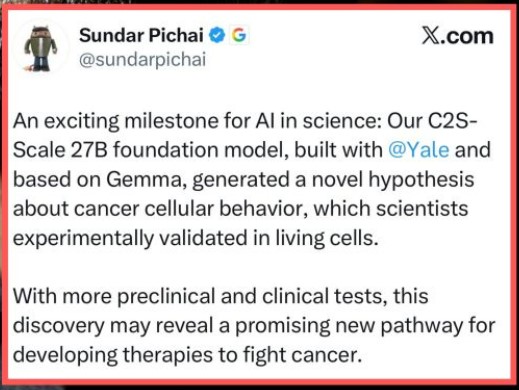
Google’s C2S-Scale 27B foundation model — built with Yale and based on Gemma — has just generated a novel hypothesis about cancer cellular behavior, and scientists have experimentally validated it in living cells.
Yes, you read that right. An AI didn’t just crunch data or predict outcomes — it came up with a scientific idea that turned out to be true in the real world.
This is not a simulation. It’s the birth of AI-driven science.
The Turning Point: When Machines Start Thinking Like Scientists
For decades, AI has been the assistant — crunching numbers, analyzing genomes, helping researchers accelerate discoveries. But now, the assistant just turned into a co-author of science.
If this model’s hypothesis leads to a validated cancer therapy in the coming years, it will mark the first time in history that an AI helped create a new medical pathway.
Let that sink in:
We’re entering an age where algorithms are not only predicting the future but inventing it.
So What Exactly Did Google’s AI Do?
The C2S-Scale 27B foundation model — trained on an ocean of biological and cellular data — analyzed complex cancer cell behaviors.
It then proposed a new hypothesis about how certain cancer cells behave under specific molecular conditions.
Normally, such hypotheses take years of trial, error, and human intuition. This AI model generated it in days — and scientists confirmed it works in living cells.
That’s not automation — that’s acceleration of evolution itself.
The Future: AI-Discovered Medicine by 2030?
If early-stage AI hypotheses like this continue to hold up, the next decade could see:
- AI designing cancer drugs in silico (within simulations) before they even hit the lab.
- Faster clinical trials, guided by models that predict outcomes before a single patient is dosed.
- Personalized treatments, where your body’s molecular data feeds an AI that designs therapy just for you.
And with the rate of AI evolution, we’re not talking 2050 — this could start showing results by 2030.
But here’s the kicker — this is not limited to cancer. The same tech can be used for neurodegenerative diseases, autoimmune disorders, and even aging.
The human lifespan curve might soon take a sharp turn upward.
The Truth Nobody Talks About
Now let’s strip the hype for a second.
Yes, AI is powerful. But it’s also trained on data produced by humans, full of biases, errors, and commercial influence.
Who owns this AI-driven discovery?
Google? Yale? Humanity?
What happens when AI starts finding cures faster than regulators can approve them?
And let’s be brutally honest — Big Pharma won’t cheer this easily. AI discovering cures faster means less monopoly time and less profit margin.
So don’t expect overnight miracles — expect quiet resistance first.
The true revolution will begin when governments, not corporations, start building open-source AI for health — owned by the people, not patents.
The Age of Synthetic Intuition
For centuries, we believed only human curiosity could push science forward.
Now, a machine just proved us wrong.
This is not just AI — this is synthetic intuition at work.
The next Einstein might not be born — it might be built.
We’re stepping into a world where scientists collaborate with algorithms, where biological mysteries are decoded by neural networks, and where the line between discovery and computation fades away.
The age of “trial and error” is dying.
The age of “learn and evolve” has begun.
Final Thought: The Future Will Ask Who Owns Knowledge
Today, an AI helped understand cancer.
Tomorrow, it might discover how to reverse it.
But the real question is —
When machines start decoding life itself, who decides how that knowledge is used?
Will it be a few labs, a few corporations, or all of humanity?
Because make no mistake — the war for truth, data, and health is already on.
And AI just became the most powerful weapon in it.
– Nishani
“Truth is not what we are told; it’s what the machines are now starting to find.”
Comments

Hi, I’m Nishanth Muraleedharan (also known as Nishani)—an IT engineer turned internet entrepreneur with 25+ years in the textile industry. As the Founder & CEO of "DMZ International Imports & Exports" and President & Chairperson of the "Save Handloom Foundation", I’m committed to reviving India’s handloom heritage by empowering artisans through sustainable practices and advanced technologies like Blockchain, AI, AR & VR. I write what I love to read—thought-provoking, purposeful, and rooted in impact. nishani.in is not just a blog — it's a mark, a sign, a symbol, an impression of the naked truth. Like what you read? Buy me a chai and keep the ideas brewing. ☕💭 For advertising on any of our platforms, WhatsApp me on : +91-91-0950-0950 or email me @ support@dmzinternational.com