
Journal Entry #009 (Part 1 of 3) : The AI Classroom – What India Must Learn from China’s Education Revolution Before It’s Too Late
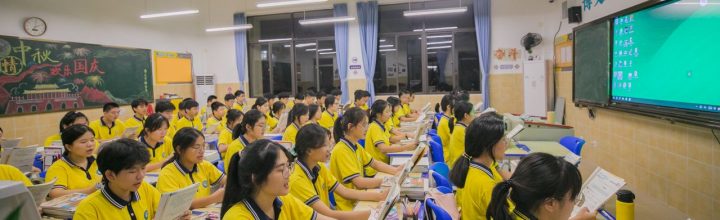
“Every industrial revolution rewards one generation and punishes another. The difference is never intelligence—it is preparation.”
Introduction: The Revolution Has Already Begun
Imagine two children born on the same day in 2025.
One grows up in Bengaluru.
The other grows up in Shenzhen.
Both are equally intelligent.
Both are equally curious.
Both dream of changing the world.
Fast forward to 2045.
The child in Bengaluru graduates with excellent marks, a university degree, and years of examination experience.
The child in Shenzhen graduates with something different.
They have already worked with Artificial Intelligence, programmed robots, collaborated with industry laboratories, built prototypes, analysed large datasets, and contributed to real-world innovation projects before leaving university.
Who is more prepared for the economy of tomorrow?
This question is not about India versus China.
It is about education versus employability.
Knowledge versus capability.
Certificates versus competence.
The world is entering an era where Artificial Intelligence will reshape almost every profession. The question is no longer whether AI will change education—it already is. The real question is whether education systems can evolve quickly enough to prepare students for that future.
History teaches us that every great technological revolution follows a familiar pattern.
During the Industrial Revolution, countries that embraced mechanisation became economic leaders. Those that delayed adoption spent decades trying to catch up.
Electricity transformed manufacturing.
Computers transformed business.
The Internet transformed communication.
Artificial Intelligence is now transforming everything at once.
Unlike previous technological shifts, AI is not confined to a single industry. It is becoming a foundational technology that influences healthcare, finance, manufacturing, agriculture, logistics, education, law, defence, scientific research and creative industries.
Every nation will use AI.
But only a few nations will build it.
Those nations will shape the global economy for decades.
India Stands at a Historic Crossroads
India possesses advantages that many countries can only dream of.
It has one of the world’s youngest populations.
It produces millions of graduates every year.
Its engineers lead some of the world’s largest technology companies.
Its startup ecosystem is among the fastest growing globally.
India has also demonstrated that it can build technology at national scale.
Digital Public Infrastructure such as Aadhaar, UPI, DigiLocker and ONDC have shown that India can solve complex technological challenges affecting hundreds of millions of people.
These achievements deserve recognition.
They prove that India has both talent and ambition.
Yet there is another reality that deserves equal attention.
The technologies driving today’s AI revolution are still largely designed, trained and operated outside India.
Millions of Indians use AI every day to write code, prepare presentations, analyse documents, create images and solve business problems.
But most of these systems are built by companies headquartered elsewhere.
India is beginning to change this.
Government initiatives such as the IndiaAI Mission aim to strengthen computing infrastructure, research and AI innovation. Projects such as BharatGen seek to build foundation models that understand India’s languages and cultural diversity. Indian companies including Sarvam AI are working to create indigenous AI capabilities.
These are important first steps.
But the global AI race is accelerating faster than ever before.
The question is no longer whether India should participate.
The question is whether India will lead or follow.
The Greatest Misunderstanding About Education
For decades, success followed a predictable formula.
Study hard.
Score high marks.
Earn a degree.
Find a good job.
For previous generations, this advice worked remarkably well.
But Artificial Intelligence is quietly rewriting those rules.
Today, AI systems can already draft reports, translate languages, summarise books, write software, analyse contracts, generate marketing campaigns, assist doctors, detect financial fraud and even help scientists accelerate research.
As these capabilities improve, the value of simply remembering information will continue to decline.
Information is no longer scarce.
Judgement is.
Creativity is.
Critical thinking is.
Problem-solving is.
The workers most likely to thrive in the coming decades will not necessarily be those who know the most facts.
They will be those who can ask better questions, work effectively with intelligent machines, evaluate AI-generated outputs, solve unfamiliar problems and continuously learn new skills.
In other words, future success will depend less on memorisation and more on adaptability.
This does not make traditional education irrelevant.
It makes educational reform urgent.
India Has Already Begun Changing
Public debate often creates the impression that India has ignored Artificial Intelligence.
That is not accurate.
Several significant reforms are already underway.
The National Education Policy (NEP) 2020 shifted attention toward experiential learning, multidisciplinary education and digital literacy.
CBSE has introduced Computational Thinking and Artificial Intelligence into school education, with AI-related learning beginning from the primary grades.
NCERT is gradually integrating AI awareness into learning resources.
The IndiaAI Mission seeks to strengthen AI infrastructure, datasets, research and startup support.
Indian researchers are also developing indigenous foundation models capable of understanding India’s many languages.
These developments represent meaningful progress.
However, there is an important distinction between beginning a transformation and completing one.
Most schools are still adapting.
Teacher training remains uneven.
Infrastructure varies widely across states.
Many classrooms continue to rely heavily on memorisation rather than inquiry, experimentation and interdisciplinary learning.
India has started the journey.
The challenge now is speed and scale.
Why China Deserves Attention
Whenever China is mentioned in discussions about education, opinions often become polarised.
Some argue that India should ignore China’s example entirely.
Others believe India should simply copy everything China has done.
Both positions are flawed.
Every nation has its own political system, social priorities and educational philosophy.
India should never imitate another country blindly.
But refusing to learn from successful strategies would be equally unwise.
History shows that nations often accelerate their own progress by studying the achievements of others.
Japan learned from Europe during the Meiji Restoration.
South Korea studied industrial development models from advanced economies before becoming a global manufacturing powerhouse.
Singapore adapted international best practices while developing its own education system.
China has done the same.
The lesson is not imitation.
The lesson is adaptation.
India should examine what has worked elsewhere, retain what aligns with its democratic values and national priorities, and improve upon it.
The goal is not to become another China.
The goal is to become the best version of India.
China Didn’t Just Reform Schools—It Built an Ecosystem
One of the biggest misconceptions is that China’s rise in Artificial Intelligence happened because it introduced AI into classrooms.
The reality is far more ambitious.
China treated Artificial Intelligence as a national capability rather than simply another academic subject.
Education became only one component of a much larger strategy.
Universities expanded AI programmes.
Research institutions received greater support.
Technology companies collaborated with academic institutions.
Manufacturing industries adopted automation.
Semiconductor development became a strategic priority.
Cloud computing infrastructure expanded.
Large-scale investments were directed toward computing power, robotics and advanced manufacturing.
Students entering universities found themselves surrounded by an ecosystem designed to translate education into innovation.
Learning was connected to laboratories.
Laboratories connected to industry.
Industry connected to national priorities.
The result was not merely better education.
It was a stronger innovation pipeline.
This is perhaps the most important lesson for India.
Education alone cannot produce an AI superpower.
It must be supported by research, computing infrastructure, industry collaboration, entrepreneurial ecosystems and long-term national commitment.
The classroom is only the starting point.
The ecosystem determines how far students can go.
Journal Entry #009 (Part 2 of 3)
From Strategy to Reality: How China Built an AI Ecosystem (2017–2026)
Artificial Intelligence did not become one of China’s strengths overnight.
Behind every successful technology ecosystem lies something that is often invisible to the outside world—years of planning, sustained investment and remarkable consistency.
One of the biggest differences between China and many developing economies is that it rarely treats technology as a short-term political initiative.
Instead, it often plans decades ahead.
AI is perhaps the clearest example of this approach.
2017: The Year Everything Changed
In July 2017, China released its New Generation Artificial Intelligence Development Plan.
Unlike many policy documents that remain aspirational, this plan established a long-term national vision.
Its objective was clear:
- Become one of the world’s leading AI innovation centres.
- Build a globally competitive AI industry.
- Integrate AI into manufacturing, healthcare, agriculture, transportation, defence and public administration.
- Develop domestic AI talent at every educational level.
This was not simply an education policy.
It was an economic strategy.
It recognised that whoever leads Artificial Intelligence will influence the global economy for decades.
India, during this period, was strengthening Digital India initiatives and expanding digital infrastructure. AI was gaining attention in academic and industry circles, but it had not yet become a central national education priority.
2018–2019: Universities Became Innovation Engines
China expanded AI programmes across universities.
New AI institutes were established.
Existing engineering programmes were updated.
Students increasingly worked alongside industry through internships, research collaborations and innovation laboratories.
Universities were encouraged to solve real industrial problems instead of focusing only on academic publications.
This changed the role of higher education.
Universities became contributors to economic growth rather than only providers of degrees.
India also has exceptional institutions such as the IITs, IISc, IIITs and leading private universities.
Their research quality is internationally respected.
However, only a relatively small percentage of India’s higher education system has strong industry collaboration.
Many colleges still operate with limited exposure to emerging technologies or industrial research.
2020: The Pandemic Accelerated Digital Transformation
COVID-19 disrupted education across the world.
For China, it also accelerated investment in digital learning, cloud infrastructure and AI-enabled education.
Remote learning became a catalyst for technological adoption.
Schools increasingly experimented with intelligent learning platforms, personalised education systems and digital teaching tools.
Meanwhile, India demonstrated remarkable capability through digital platforms such as DIKSHA, SWAYAM and PM eVIDYA.
These initiatives expanded access to learning at unprecedented scale.
However, they also exposed significant challenges.
Millions of students lacked reliable internet access.
Teacher readiness varied considerably.
Digital infrastructure differed dramatically between urban and rural schools.
The pandemic reminded every nation that educational technology is only as effective as the infrastructure supporting it.
2021–2023: Building the Complete AI Value Chain
During these years, China’s focus expanded beyond software.
The country accelerated investments in areas that many people rarely associate with Artificial Intelligence.
Semiconductor Manufacturing
Every AI model depends on powerful computing chips.
Without advanced processors, even the best software cannot function efficiently.
China invested heavily in semiconductor research, fabrication capability and chip design.
Although export restrictions created new challenges, they also accelerated domestic innovation.
India has recognised this need as well.
Recent semiconductor manufacturing initiatives and incentives represent important progress.
However, India’s semiconductor ecosystem remains at a much earlier stage compared with global leaders.
Robotics
China rapidly expanded industrial robotics.
Factories increasingly automated repetitive processes.
Students studying engineering encountered robotics not merely as theory but as practical industrial technology.
India has excellent robotics talent and successful startups.
Yet industrial robotics adoption remains comparatively limited in many manufacturing sectors.
Advanced Manufacturing
China understood something important.
Artificial Intelligence becomes economically valuable only when connected to real industries.
Factories became testing grounds for automation.
Machine vision improved quality control.
Predictive maintenance reduced downtime.
AI optimised logistics.
Digital twins transformed manufacturing.
Education and industry evolved together.
India’s manufacturing sector is improving through initiatives such as “Make in India.”
The next phase should integrate AI into manufacturing education far more deeply.
2024–2026: AI Becomes Mainstream Education
By the mid-2020s, China was no longer discussing whether AI should be taught.
The discussion had shifted to how deeply AI should be integrated across education.
Artificial Intelligence was increasingly viewed not as another optional subject but as a foundational technology influencing every discipline.
Medical students learned AI-assisted diagnosis.
Engineering students studied intelligent manufacturing.
Business students explored AI-driven analytics.
Teachers received additional training.
Universities expanded interdisciplinary programmes.
AI became part of the educational ecosystem rather than an isolated classroom topic.
India is beginning a similar journey.
CBSE’s introduction of Computational Thinking and AI from earlier grades, along with initiatives under NEP 2020 and the IndiaAI Mission, represents an important shift.
The challenge is implementation across thousands of schools with different levels of infrastructure, teacher preparedness and digital access.
The Real Difference Was Never AI
Many observers believe China’s advantage comes from better Artificial Intelligence.
That is only partly true.
The larger advantage lies in systems thinking.
China aligned multiple sectors toward common long-term objectives.
Education.
Research.
Manufacturing.
Semiconductors.
Cloud computing.
Universities.
Private industry.
Government policy.
Each reinforced the other.
This reduced the gap between learning and employment.
Students graduated into industries already prepared to absorb their skills.
That ecosystem is difficult to build quickly.
It requires consistent investment over many years.
India Versus China: A Balanced Comparison
Comparisons often become emotional.
They should instead be analytical.
India and China have different political systems, demographic profiles and economic histories.
The goal is not to declare a winner.
The goal is to understand where each country currently stands and where India has opportunities to accelerate.
| Area | China | India |
|---|---|---|
| AI Strategy | Long-term national AI roadmap since 2017 | IndiaAI Mission and NEP provide a strong foundation, with implementation gathering pace |
| School AI Education | AI increasingly integrated across levels | AI introduced through CBSE and expanding gradually |
| Teacher Training | Large-scale AI-focused training | Growing, but uneven across regions |
| University–Industry Collaboration | Strong integration in many sectors | Excellent in leading institutions, limited in many colleges |
| Semiconductor Ecosystem | Extensive investment and manufacturing capability | Rapidly emerging with government support |
| Industrial Robotics | Broad deployment in manufacturing | Growing, but adoption remains lower |
| AI Compute Infrastructure | Significant domestic capacity | Expanding through IndiaAI and private investment |
| AI Companies | Large domestic ecosystem | Dynamic startup ecosystem with promising indigenous models |
| Manufacturing Integration | AI embedded into production | Significant opportunity for expansion |
| Research Translation | Strong commercialisation | High-quality research with scope for faster productisation |
This comparison should not discourage India.
Instead, it should provide clarity.
India already possesses many of the ingredients required for leadership.
The challenge lies in connecting them more effectively.
India’s Hidden Strengths
Too often, discussions about AI focus only on what India lacks.
That is incomplete.
India also possesses extraordinary advantages.
A Young Population
Few countries have such a large working-age population.
If educated effectively, this demographic advantage could become one of India’s greatest economic assets.
Software Leadership
Indian engineers already contribute to AI systems developed by many of the world’s leading technology companies.
The talent clearly exists.
The opportunity is to create more companies that build foundational AI technologies from India itself.
Digital Public Infrastructure
Aadhaar.
UPI.
FASTag.
DigiLocker.
ONDC.
CoWIN.
These projects demonstrate India’s ability to design and operate technology systems at enormous scale.
Few countries have achieved comparable digital transformation.
This experience can become a foundation for AI adoption.
Entrepreneurship
India’s startup ecosystem continues to grow rapidly.
Thousands of entrepreneurs are building solutions in healthcare, agriculture, fintech, education, logistics and manufacturing.
Artificial Intelligence can significantly amplify this innovation ecosystem.
The Biggest Gap Is Not Talent
After examining both countries, one conclusion becomes increasingly clear.
India does not suffer from a shortage of intelligence.
Nor does it suffer from a shortage of ambition.
The largest gap is coordination.
Education often moves in one direction.
Industry moves in another.
Research follows its own priorities.
Startups solve immediate commercial problems.
Government initiatives operate on separate timelines.
When these pieces are aligned, innovation accelerates dramatically.
China’s greatest lesson may therefore have little to do with AI itself.
Its greatest lesson is how multiple systems can move toward a common long-term objective.
That is a lesson every nation—including India—can study.
Journal Entry #009 (Part 3 of 3)
From AI Consumers to AI Creators: India’s Roadmap to 2040
The comparison between India and China is not about declaring one nation superior to another.
It is about asking a simple question:
If another country has successfully accelerated its AI capabilities, what lessons can India adapt to its own democratic values, diverse society and unique strengths?
History has shown that countries which learn quickly are often the ones that lead.
The objective is not imitation.
The objective is evolution.
India’s greatest advantage has never been cheap labour.
It has always been its people.
The next chapter of India’s growth will depend on whether those people are equipped with the right skills for an AI-driven world.
A New Definition of Literacy
For centuries, literacy meant reading and writing.
Then came digital literacy.
Today, another form of literacy is emerging.
AI literacy.
Within the next decade, understanding Artificial Intelligence may become as fundamental as understanding mathematics or English.
Every student should know:
- What AI is.
- What AI cannot do.
- How AI makes decisions.
- How AI can make mistakes.
- How to verify AI-generated information.
- How to use AI responsibly.
- How to protect privacy while using AI.
This knowledge should not be reserved for engineering students.
It should become part of general education.
A doctor using AI-assisted diagnosis.
A lawyer analysing legal documents.
A farmer using precision agriculture.
A teacher preparing personalised lessons.
All will require AI literacy.
What NCERT Should Do
NCERT has already begun incorporating AI concepts into educational resources. The next phase should move beyond awareness.
Imagine if, from Class 3 onwards, students encountered age-appropriate lessons in:
- Logical thinking
- Pattern recognition
- Ethical use of technology
- Problem-solving
- Data interpretation
- Basic programming concepts
- Responsible digital behaviour
The objective should not be to create programmers at age eight.
It should be to nurture curiosity and computational thinking.
As students progress through higher classes, AI should naturally integrate into science, mathematics, economics, biology, geography and even the humanities.
AI should not become another isolated chapter in a textbook.
It should become a tool that enriches learning across subjects.
What CBSE, ICSE and State Boards Should Do
India’s education boards should compete in one area only:
Preparing students for the future.
Not over which board is more prestigious.
Not over which syllabus is more difficult.
Not over which language receives more emphasis.
Language debates will continue, and preserving India’s linguistic diversity is important. A strong foundation in one’s mother tongue supports learning, while proficiency in English continues to provide access to global knowledge and collaboration. These goals are complementary, not competing.
The larger challenge is ensuring that every student—regardless of board or state—graduates with the skills needed for an AI-driven economy.
Every board should work toward a common minimum framework that includes:
- AI literacy
- Cybersecurity awareness
- Digital ethics
- Financial literacy
- Climate science
- Entrepreneurship
- Design thinking
- Media literacy
- Data literacy
- Critical thinking
Whether a student studies in Kerala, Tamil Nadu, Karnataka, Gujarat, Assam or Delhi, these foundational skills should be universal.
Universities Must Change Faster
Universities cannot remain isolated from industry.
The traditional model of updating curricula every five or ten years is no longer sufficient.
Artificial Intelligence evolves almost monthly.
Universities should establish permanent partnerships with:
- AI startups
- Manufacturing companies
- Hospitals
- Agricultural technology firms
- Semiconductor companies
- Robotics organisations
- Cybersecurity firms
Students should graduate having worked on real-world problems rather than only classroom assignments.
Internships should become a core part of learning.
Research should increasingly solve practical challenges faced by society and industry.
Teachers Will Decide India’s AI Future
Technology does not transform classrooms.
Teachers do.
No AI curriculum can succeed unless educators receive continuous training and support.
India has more than nine million teachers.
Imagine the multiplier effect if every one of them became confident in using AI responsibly.
Teacher development should become one of the country’s highest educational priorities.
Rather than fearing AI, teachers should learn how it can:
- Personalise learning.
- Reduce administrative workload.
- Generate practice materials.
- Identify students who need additional support.
- Enhance creativity and collaboration.
AI should empower teachers, not replace them.
Industry Must Become Part of Education
One lesson from successful innovation ecosystems is clear:
Education cannot operate in isolation.
Companies should actively participate in shaping the workforce they will eventually employ.
This could include:
- Mentorship programmes.
- Innovation challenges.
- Industry-funded laboratories.
- Apprenticeships.
- Joint research centres.
- Startup incubators.
Education and employment should no longer exist as separate worlds.
Parents Must Rethink Success
Perhaps the most difficult transformation is cultural.
For generations, many parents measured success through marks.
Marks remain important.
Discipline remains important.
Academic excellence remains important.
But they are no longer sufficient.
Parents should also encourage children to:
Build.
Experiment.
Question.
Create.
Fail.
Improve.
Repeat.
The future rewards curiosity as much as correctness.
A child who asks difficult questions may ultimately contribute more to society than one who simply memorises every answer.
Students Must Become Lifelong Learners
Graduation will no longer mark the end of education.
It will become the beginning.
Future professionals may need to update their skills every few years.
The most valuable habit students can develop is not memorisation.
It is continuous learning.
The winners of the AI era will not necessarily be those with the highest IQ.
They will be those who learn fastest.
Why Sovereign AI Matters
One topic deserves thoughtful discussion: AI sovereignty.
Today, many of the world’s most capable AI systems are developed by companies headquartered outside India.
These tools have transformed productivity and innovation, and they will continue to play an important role.
At the same time, every nation should ask whether it also needs domestic AI capabilities for strategic sectors such as healthcare, governance, defence, scientific research and public services.
This is not about rejecting global technology.
It is about ensuring resilience, choice and the ability to develop solutions tailored to India’s languages, laws and societal needs.
India has already begun this journey through initiatives such as the IndiaAI Mission, BharatGen and emerging home-grown AI companies.
These efforts deserve sustained support.
The AI Economy Will Reward Builders
The next generation of wealth may not come from those who simply use AI tools.
It may come from those who build:
AI models.
Robotics platforms.
Semiconductor technologies.
Medical AI.
Agricultural AI.
Climate technologies.
Cybersecurity solutions.
Educational platforms.
Manufacturing automation.
The global AI economy is expected to create opportunities across almost every sector.
India has the talent to participate at every level.
A Vision for India in 2040
Imagine India fifteen years from now.
Every school introduces AI literacy alongside mathematics and science.
Teachers confidently use AI to personalise education.
Universities collaborate closely with startups and industry.
Students graduate with portfolios of real projects.
Indian AI models support dozens of Indian languages.
Indian semiconductor facilities contribute to global supply chains.
Factories increasingly deploy robotics and intelligent manufacturing.
Researchers publish world-class innovations.
Startups build globally competitive AI products from India.
Young entrepreneurs no longer ask, “Can India build this?”
Instead, they ask, “How can India build it better?”
That future is achievable.
But it will not happen automatically.
It will require sustained investment, educational reform, research, entrepreneurship, infrastructure and collaboration across government, academia and industry.
Final Thoughts
The Industrial Revolution rewarded nations that mastered machines.
The Digital Revolution rewarded nations that mastered software.
The AI Revolution will reward nations that master intelligence.
India should not approach this moment with fear.
Nor with complacency.
It should approach it with confidence—and urgency.
Confidence because India possesses extraordinary strengths: a young population, globally respected engineers, a thriving startup ecosystem, strong digital public infrastructure and an increasingly ambitious innovation agenda.
Urgency because technological leadership is never guaranteed.
Countries that move early build experience.
Experience attracts investment.
Investment creates innovation.
Innovation builds industries.
Industries create prosperity.
The cycle reinforces itself.
That is precisely why the decisions India makes today—in classrooms, universities, laboratories, boardrooms and Parliament—will shape the opportunities available to the next generation.
The question is no longer whether Artificial Intelligence will change the world.
It already is.
The real question is whether India’s children will merely learn to use AI created elsewhere—or whether they will become the scientists, engineers, entrepreneurs, teachers and innovators who build the next generation of AI for India and for the world.
History rarely remembers the countries that arrived late.
It remembers the countries that recognized change early, prepared their people and had the courage to build the future instead of waiting for it.
India has everything it needs to be one of those countries.
The time to prepare is not tomorrow.
The time to prepare is now.
Epilogue: A Question for Every Reader
Before debating what subjects should occupy another hour of the school timetable, perhaps we should ask a larger question:
When a child enters Class 1 today, what kind of nation do we want that child to lead in 2045?
If the answer is an innovative, self-reliant, globally respected India, then AI education, scientific thinking, research, entrepreneurship and lifelong learning must become national priorities alongside language, culture and values.
The AI race will not be won in data centres alone.
It will be won in classrooms.
And the classrooms we build today will determine the India we inherit tomorrow.
Comments

Hi, I’m Nishanth Muraleedharan (also known as Nishani)—an IT engineer turned internet entrepreneur with 25+ years in the textile industry. As the Founder & CEO of "DMZ International Imports & Exports" and President & Chairperson of the "Save Handloom Foundation", I’m committed to reviving India’s handloom heritage by empowering artisans through sustainable practices and advanced technologies like Blockchain, AI, AR & VR. I write what I love to read—thought-provoking, purposeful, and rooted in impact. nishani.in is not just a blog — it's a mark, a sign, a symbol, an impression of the naked truth. Like what you read? Buy me a chai and keep the ideas brewing. ☕💭 For advertising on any of our platforms, WhatsApp me on : +91-91-0950-0950 or email me @ support@dmzinternational.com