
One Man, One Trillion. The World Has Never Seen This Before.
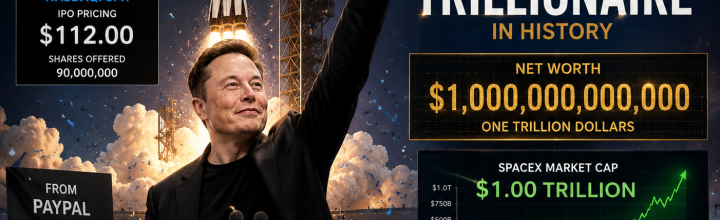
On June 12, 2026, history was made — not at a government summit, not at a UN conference, not by any elected leader. It was made at the Nasdaq in New York, by a single person from South Africa who dropped out of a PhD program to build rockets.
Elon Musk‘s net worth crossed $1 trillion, making him the first individual in history to achieve trillionaire status. The trigger was SpaceX going public. He raised $75 billion through the IPO, which valued SpaceX at $1.77 trillion — the largest IPO in recorded history.
Let that number sink in for a moment.
What Does One Trillion Actually Look Like?
A billion dollars is already hard to grasp — enough to spend $27,000 every single day over a hundred-year lifetime. A trillion dollars is practically impossible to imagine. It is equivalent to spending $27 million per day for a century.
Now compare that to India.
At over $1.1 trillion, Musk’s personal wealth is equivalent to nearly one-fourth of India’s annual GDP, which stands at around $4.15 trillion. India — 1.4 billion people, the world’s fifth-largest economy, a civilisation thousands of years old — produces in a full year what one man is worth on paper.
His net worth is more than the GDP of nearly 160 countries. His fortune is nearly four times the size of the next-richest person on earth, and exceeds the combined fortunes of Larry Page, Sergey Brin, and Jeff Bezos — put together.
This is not wealth. This is a new category of power that we do not yet have words for.
The Welders, The Cooks, The Baristas — They All Became Millionaires Too
Here is the part of this story that almost nobody is talking about enough.
When most people think of a tech IPO minting millionaires, they picture Silicon Valley engineers and C-suite executives. The SpaceX story is different — profoundly different.
More than 4,400 current and former SpaceX employees are expected to become millionaires through this IPO. Unlike most recent tech IPOs dominated by software startups, SpaceX built its empire in factories, launchpads, and manufacturing facilities as much as in engineering labs. To become the world’s most dominant rocket company, Musk needed more than coders and executives. He needed welders, machinists, technicians, and manufacturing specialists by the thousands — many of whom were offered company stock as part of their compensation.
What makes this IPO unusual, even by Silicon Valley standards, is how far down the organisational chart the equity grants reached. Here are the kinds of workers who became millionaires overnight:
Welders and fabricators — Juan Hernandez, a former SpaceX welder who joined in 2015 earning $28 an hour, is sitting on shares now worth roughly $880,000 at the IPO price. A decade of welding metal for rockets turned into life-changing wealth.
Cafeteria workers and cooks — The people who served lunch to engineers, running the daily kitchen operations at Starbase, held equity. Their stock options, received instead of higher salaries, are now worth millions.
Baristas and service staff — Those who made coffee at company facilities, kept the workspace running, and never wrote a single line of code also received stock as part of their compensation packages.
Blue-collar technicians and ground crew — The hands-on workers who prepared rockets for launch, maintained equipment on the pad, and ran overnight shifts at the facility in South Texas.
Machinists and manufacturing workers — Factory floor operators who shaped metal, assembled components, and built the physical hardware that made SpaceX what it is today.
SpaceX’s first employee, Tom Mueller, captured the spirit of this perfectly. He said Musk always told his team: “Your salary is one thing, but it’s the equity that’s gonna be worth something.” The employees smiled and said, “Yeah, okay, someday.” Mueller’s response on IPO day: “That day is here. It’s great.”
The windfall is heavily concentrated around Brownsville, Texas — one of the poorest cities in the United States — where SpaceX employs more than 3,000 people at its Starbase facility. A poor border town near Mexico just minted hundreds of millionaires who drive pickup trucks and weld metal for a living. That is not a normal IPO story. That is something rarer.
SpaceX equity, typically granted in the form of restricted stock, represents up to 90% of many of these employees’ total wealth. These are not people who invested or speculated. They showed up, did their jobs, and were given a share of the mission. And the mission became worth $1.77 trillion.
The Video That Played at Nasdaq — And What It Said About the Future
On the morning of the IPO, before markets opened, the curved screens of the Nasdaq building in Times Square lit up with something unusual. Crowds gathered outside — some dressed as astronauts, others wearing T-shirts reading “Occupy Mars.” On the giant screens played scenes of rockets launching, orbital data centers being constructed, and Musk himself describing humanity’s future in space.
It was not a corporate promotional film. It was a declaration.
Musk told his employees — and the world — from SpaceX headquarters in Texas: “Whoever you are watching this, SpaceX wants to be able to take you to the moon, take you to Mars, and ultimately beyond.”
He described specifically what the $75 billion raised would fund: plans to place over 100,000 satellites in orbit for communications, and to build artificial intelligence data centers in space.
Not data centers on the ground. In orbit. Powered by the sun. Beyond any government’s jurisdiction.
Musk explained that space-based solar-powered AI satellites could eventually scale to hundreds of terawatts of power annually, drawing unlimited energy from the sun without occupying any land on Earth. He said a solar field just 160 kilometres by 160 kilometres could power the entire United States — and in space, there are no such limits at all.
He also laid out plans for a joint Tesla-SpaceX chip manufacturing facility called Terafab — aimed at producing advanced computer chips inside the United States, reducing dependence on Taiwan, and building a hardware stack that no other private entity on earth currently controls.
These are not dreams. These are funded roadmaps, backed by the largest IPO in history.
Businessman or Geopolitical Actor?
Here is where it gets genuinely uncomfortable.
Musk does not just own companies. He owns capabilities that were previously the exclusive domain of nation-states.
He owns rockets that carry military payloads. He owns Starlink, which provided battlefield internet to Ukraine when no government could move fast enough. He controls X, the world’s most influential real-time information platform. He owns xAI, now merged into SpaceX, giving him AI infrastructure aligned to no national interest except his own. He holds deep US defense contracts. And until recently, he ran DOGE — a government cost-cutting operation — giving him unusual visibility into the machinery of the American state.
At Davos in January 2026, Musk predicted that AI would become smarter than any individual human by the end of 2026, and surpass the collective intelligence of all of humanity within five years.
In a three-hour podcast earlier this year, he predicted that by 2040, the global population of humanoid robots could reach ten billion — more than the number of humans alive today. He argued that robots would outperform the best human surgeons in precision within three years.
The robots will be built by his factories. The satellites are his. The AI carries his company’s name. The chip fab is his. The launch vehicles are his.
The real question is not whether Elon Musk is the world’s richest man. The real question is: at what point does a private citizen become something our existing political and legal systems simply have no category for?
What This Means for the Rest of Us
India is growing fast. We contribute 17% of global economic growth, more than the United States. Our GDP will cross five trillion dollars soon. These are genuine achievements that took decades of policy, sacrifice, and institutional effort by 1.4 billion people.
And yet, one man — born in Pretoria, rejected by car companies in 2008, who once gave SpaceX less than a 10% chance of surviving — is now personally worth a quarter of everything India produces in a year.
History has seen powerful merchants before. The East India Company controlled trade routes and armies. The Rothschilds financed governments on both sides of wars. But none of them simultaneously controlled rockets, satellites, AI, social media, chip manufacturing, and a direct line to the most powerful government on earth.
What is also new here is this: the welder from Brownsville who welded steel for $28 an hour just became a millionaire. The cook who made lunch for rocket engineers just became a millionaire. The barista who made morning coffee at a Texas launch facility just became a millionaire. Musk chose to share the upside across his entire workforce — and that matters, even if the scale of his own wealth defies all comprehension.
He is not a villain in this story. He may not be a hero either. But he is something genuinely new. And the world’s governments, institutions, and citizens have not yet figured out what to do about that.
One man, more wealth than a quarter of India. One company, more valuable than most nations. The question is not how he got here. The question is what happens next — and who gets to decide.
Comments

Hi, I’m Nishanth Muraleedharan (also known as Nishani)—an IT engineer turned internet entrepreneur with 25+ years in the textile industry. As the Founder & CEO of "DMZ International Imports & Exports" and President & Chairperson of the "Save Handloom Foundation", I’m committed to reviving India’s handloom heritage by empowering artisans through sustainable practices and advanced technologies like Blockchain, AI, AR & VR. I write what I love to read—thought-provoking, purposeful, and rooted in impact. nishani.in is not just a blog — it's a mark, a sign, a symbol, an impression of the naked truth. Like what you read? Buy me a chai and keep the ideas brewing. ☕💭 For advertising on any of our platforms, WhatsApp me on : +91-91-0950-0950 or email me @ support@dmzinternational.com