
Success, Failure, and the War Within: What the Bhagavad-Gita Can Teach Us in a World on Fire
Human beings suffer not only because of what happens to them, but because of how they define what happens to them.
If people have the wrong definition of success, they will automatically have the wrong definition of failure. And that simple misunderstanding quietly shapes most of the stress, jealousy, and despair we see in modern life.
According to many spiritual traditions, success is not the result. Success is not the achievement. Success is not what you get at the end of your journey.
Success is the intention behind your action, the effort you put in, and the character you build while doing something meaningful.
Once you have invested your sincere effort, integrity, and dedication, whatever result appears at the end becomes secondary. Because the truth is simple: none of us control the result.
There are countless forces in the universe that influence outcomes — timing, circumstances, other people, luck, and sometimes pure chaos. When people measure success purely through results, they trap themselves in a dangerous psychological cycle. They become afraid to even begin a journey because they fear the possibility of failure.
But when success is defined as giving your best effort, something remarkable happens. Fear disappears. The journey itself becomes meaningful.
The goal of life is not to be the best.
The goal of life is to try your best.
If destiny places you in a position where you become the best and can serve the world in a bigger way, then that is wonderful. But if destiny does not give you that role, it does not reduce your worth in any way. Your sincere effort itself is already success.
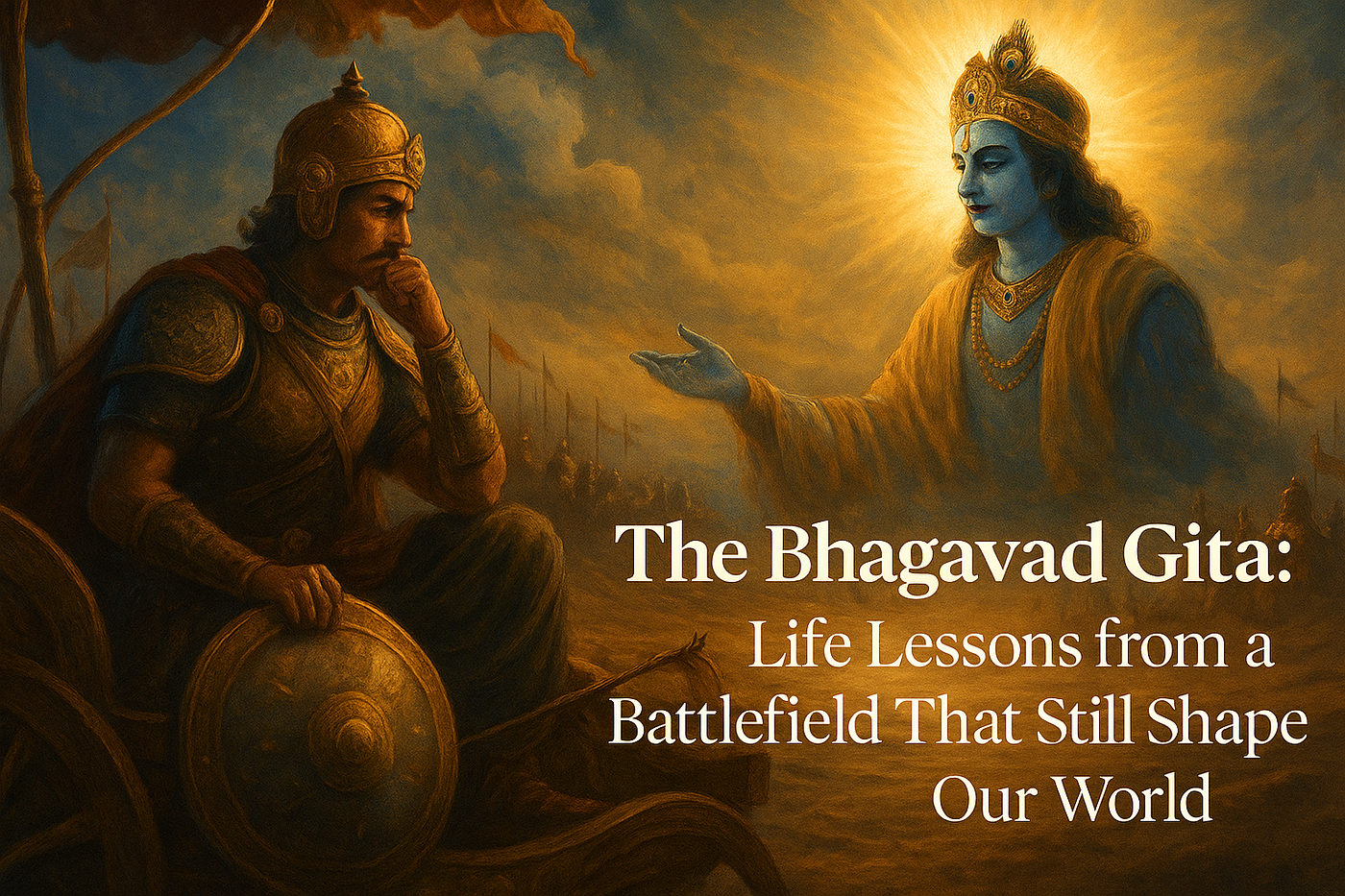
This idea is deeply rooted in the Bhagavad-Gita, where it is called Karma Yoga — the art of detached action.
Karma Yoga teaches a powerful principle: You have control over your actions, but never over the results of those actions.
When people forget this wisdom, they begin measuring their lives through comparisons.
A student who scores 90% in exams may still feel like a failure if their friend scores 96%. A professional who receives a 20% salary raise may still feel disappointed because a colleague got slightly more.
Objectively, these individuals have succeeded. But psychologically, they feel defeated — simply because they defined success incorrectly.
This constant comparison becomes a mental disease. It creates anxiety, competition, jealousy, and depression. Instead of focusing on their own journey, people become obsessed with someone else’s scoreboard.
The Bhagavad-Gita reminds us of a simple truth: you are on your own path. Your only responsibility is to perform your duty with sincerity and integrity.
Yet this wisdom is not only relevant to personal life. It can also be used to understand the larger conflicts unfolding in the world today.
Consider the rapidly escalating war that began on 28 February 2026, when the United States and Israel launched military operations against Iran. Within days, the conflict intensified dramatically. Bombardments expanded, tensions spread across the Gulf region, and many analysts began warning about the possibility of a wider global conflict.
On the surface, wars are often presented as battles for security, power, or ideology. But underneath these narratives lies another reality: the relentless human obsession with winning.
Nations measure success through dominance. Leaders measure success through victory. Political narratives frame outcomes in terms of defeat or triumph.
But history shows that wars rarely produce true winners.
When cities burn, economies collapse, and thousands of lives are lost, the concept of victory becomes morally fragile.
From a spiritual perspective, wars often arise when leaders operate from ego, fear, and geopolitical competition rather than wisdom and restraint. Power politics becomes a game of outcomes — who controls more territory, who eliminates which adversary, who proves strength on the global stage.
In such an environment, decisions are driven by the desire to achieve a result, not by the deeper question of whether the action itself is aligned with human well-being.
Leaders like Donald Trump in the United States and Benjamin Netanyahu in Israel represent strong, highly assertive political styles. Their leadership approaches emphasize power projection, decisive action, and strategic dominance. Supporters often view such leadership as necessary in a dangerous world.
Critics, however, argue that aggressive geopolitical strategies can escalate tensions and push the world toward greater instability.
History repeatedly shows that wars rarely unfold exactly as leaders expect. Complex alliances, economic reactions, public sentiment, and unforeseen consequences can reshape outcomes dramatically.
In other words, even powerful nations are not fully in control of the results they seek.
This is precisely where the philosophy of Karma Yoga becomes deeply relevant. It reminds humanity that actions should be guided not only by ambition or victory, but by responsibility, ethics, and awareness of consequences.
When individuals or nations become obsessed with results, they risk creating destruction far beyond their intentions.
When they focus instead on right action, the world moves closer to stability and peace.
Today, as global tensions rise and the possibility of wider conflict looms, the ancient wisdom of the Bhagavad-Gita feels strangely modern.
It reminds us that the real measure of success — whether for individuals or nations — is not the victory they claim at the end, but the values that guided their actions along the way.
Because in the end, history does not remember only who won.
It remembers how they chose to act when the world was watching.
Comments

Hi, I’m Nishanth Muraleedharan (also known as Nishani)—an IT engineer turned internet entrepreneur with 25+ years in the textile industry. As the Founder & CEO of "DMZ International Imports & Exports" and President & Chairperson of the "Save Handloom Foundation", I’m committed to reviving India’s handloom heritage by empowering artisans through sustainable practices and advanced technologies like Blockchain, AI, AR & VR. I write what I love to read—thought-provoking, purposeful, and rooted in impact. nishani.in is not just a blog — it's a mark, a sign, a symbol, an impression of the naked truth. Like what you read? Buy me a chai and keep the ideas brewing. ☕💭 For advertising on any of our platforms, WhatsApp me on : +91-91-0950-0950 or email me @ support@dmzinternational.com