
The Bottleneck Nobody’s Talking About: AI Is Running Into a Wall It Built Itself
Everyone’s having the wrong conversation about AI.
The mainstream narrative is seductive and simple: AI replaces humans because it’s cheaper. Automate everything. Cut headcount. Watch margins improve. The boardroom loves it. The LinkedIn thought leaders repeat it. And it’s wrong — or at the very least, dangerously incomplete.
Here’s what’s actually happening at the frontier.
The Cost Inversion Nobody Expected
Bryan Catanzaro, a senior researcher at NVIDIA, recently dropped a number that should have stopped the automation hype cycle cold: for his team, compute costs exceed the cost of human employees.
Read that again.
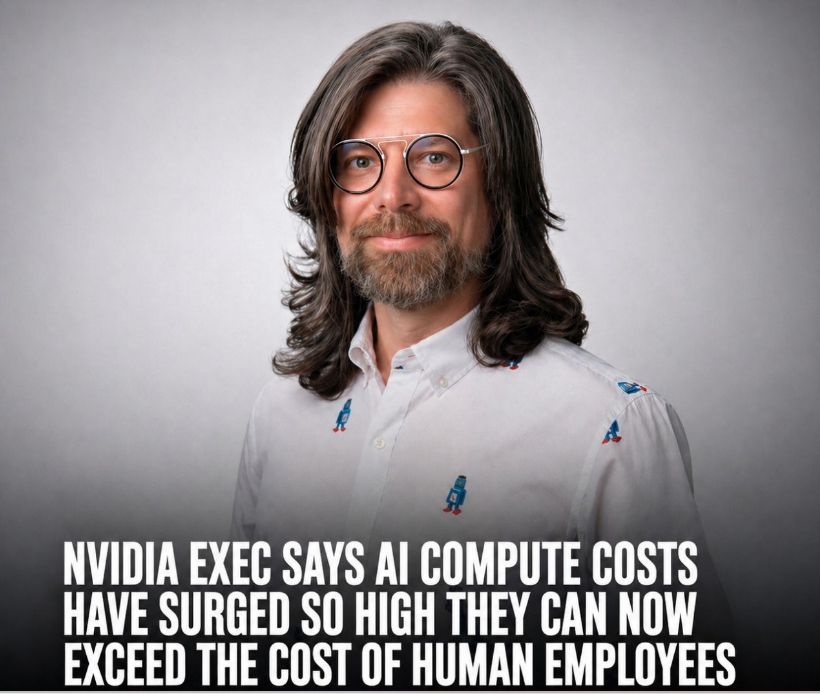
The AI — not the people — is the expensive line item.
This isn’t an edge case. This is what frontier AI actually looks like in production. You’re not paying a salary. You’re paying for GPU clusters, data centers, cooling infrastructure, and the electricity to run all of it around the clock. AI doesn’t run on software. It runs on physics. Real steel, real power, real water, real estate.
The economics of “AI is cheaper” collapse the moment you actually build something real with it.
MIT Said the Quiet Part Loud
A 2024 study from MIT looked at a straightforward question: when does automating a task with AI actually make financial sense? The answer was uncomfortable for the hype machine.
Only a fraction of tasks are cost-effective to automate today.
Not most tasks. Not the majority. A fraction. In a significant number of real-world scenarios, putting a human on the job is still the cheaper, faster, and more reliable option. Not because AI lacks capability — but because the infrastructure cost of deploying AI at scale makes the unit economics ugly.
This is the number that corporate AI strategies are quietly ignoring while they announce transformation roadmaps to investors.
The Environmental Bill Is Coming Due
Stanford’s Institute for Human-Centered AI tracks something most deployment conversations skip entirely: AI’s environmental cost is growing faster than its efficiency gains.
We’re talking about energy consumption that rivals mid-sized countries. Water usage for cooling that competes with agricultural demand. Infrastructure buildout that strains power grids across continents. A UC Riverside study specifically flagged water consumption in AI systems as a quietly escalating crisis.
So let’s be precise about what’s happening. Every time a company scales AI workloads, it’s not just buying compute. It’s consuming water, burning carbon, and adding pressure to infrastructure that wasn’t built for this. The environmental cost doesn’t show up in the automation ROI deck. But it shows up in reality.
The Real Bottleneck
Here’s the actual problem: we are scaling AI demand faster than we are solving the three things that would make that scaling sustainable.
Cost efficiency at the model and inference layer is improving, but not fast enough to outrun adoption curves. Infrastructure optimization — smarter cooling, more efficient chips, better data center design — is a decade-long engineering problem, not a quarterly sprint. And operational discipline, meaning companies actually understanding which use cases make economic sense before they deploy, is almost entirely absent from the current wave of enterprise AI adoption.
AI doesn’t win because it’s cheaper per task. It wins when it improves unit economics at scale, for the right tasks, in the right contexts. That’s a very specific condition. Most deployments don’t meet it.
The Mistake Most Companies Are Making
AI isn’t failing because it’s not capable. It’s failing — quietly, expensively, in ways that don’t make press releases — because it’s being sold into the wrong economics.
A company that deploys AI to handle a task that a well-trained human handles for ₹30,000 a month, and then spends ₹8 lakh a month on compute, cooling, and engineering support to run that AI? That company didn’t automate. It inflated its cost structure and called it innovation.
This is happening at scale right now. And the reckoning is coming.
What This Actually Means
The question was never “can AI do this task.” The question has always been “at what cost, at what scale, with what infrastructure, and at what environmental price.”
Human labor — especially in markets like India — is not the expensive variable in this equation. In most deployment scenarios, it’s the cheapest and most flexible variable available.
AI will matter enormously. But not because it’s cheaper. It will matter where it genuinely transforms unit economics at scale — which is a narrower and more specific claim than what’s being sold right now.
The bottleneck isn’t capability.
The bottleneck is reality.
And reality always wins.
Comments

Hi, I’m Nishanth Muraleedharan (also known as Nishani)—an IT engineer turned internet entrepreneur with 25+ years in the textile industry. As the Founder & CEO of "DMZ International Imports & Exports" and President & Chairperson of the "Save Handloom Foundation", I’m committed to reviving India’s handloom heritage by empowering artisans through sustainable practices and advanced technologies like Blockchain, AI, AR & VR. I write what I love to read—thought-provoking, purposeful, and rooted in impact. nishani.in is not just a blog — it's a mark, a sign, a symbol, an impression of the naked truth. Like what you read? Buy me a chai and keep the ideas brewing. ☕💭 For advertising on any of our platforms, WhatsApp me on : +91-91-0950-0950 or email me @ support@dmzinternational.com