
The Car Was a Gift. The Warning Was Missing
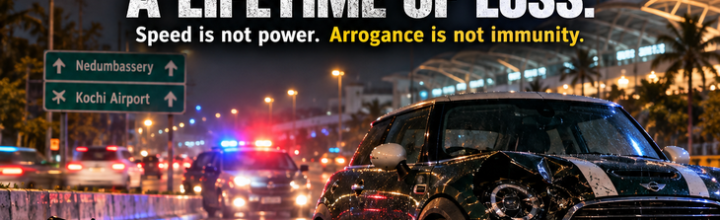
In the early hours of 11 October, a Mini Cooper hit a scooter near Kochi airport. Three young people died: Devika, Gopika and Iyas. They were students who also worked part-time, and they were riding home after tea. Police say the 19-year-old driver had drunk at three bars that night, with his friends beside him. He faces a case of culpable homicide.
Reports say that after the crash he told angry people, “My father will take care of everything.” This is an allegation, and the court will decide the truth. But a young man says such a sentence only if he has seen it work before.
A dream that came too early
I know the pull of a vehicle. In the fifth standard, I would see a cycle and refuse to leave. I cried and made scenes. I got that cycle in the tenth standard. My bike came during my postgraduate years. The Tata Safari I loved as a boy came only when I started working in Bangalore.
Those waits taught me that a vehicle is earned. It is heavy, fast and dangerous. The Mini Cooper was a birthday gift from his mother, and she shared that moment online with joy. He got his dream at 19, with no waiting.
What the young mind believes
Psychologists have studied this age for decades. The brain’s reward system matures early. The part that judges risk matures much later, often in the mid-twenties. Young people also take bigger risks when friends are watching.
There is a belief called the personal fable: “Bad things happen to others, not to me.” Alcohol makes it stronger. A drunk driver feels calm and in control while his reaction time is slower. Most of us felt unbreakable at 19. The difference is that most of us did not own a fast car.
The reel nobody stopped
He had posted a reel of himself driving at about 220 kmph. Police suspect the car was above 120 kmph on the night of the crash, and the exact speed is still being checked. Social media rewards speed and show, and every view told him he was doing well. I found no report of any action before the crash. Followers, relatives and officials saw the reel, and nobody stopped him.
Why some parents look away
I cannot know what this family thinks. But the pattern is common. Some parents confuse love with giving, so saying no feels like failing. Some feel guilty about being busy and pay with gifts. Some believe money solves every problem, because it has solved theirs before. Some protect the family name more than the child’s character.
The child learns one lesson: rules are for other people. He never feels the cost of a mistake, so he never learns caution. But money cannot return three lives.
Friends decide more than we admit
Most of our big decisions follow the people we sit with every day. This is truest for young people living in hostels or in another city. Parents are far away and cannot watch. The group becomes the family, and its habits become your habits.
I know this from my own life. When I lived away from home in college, I got my first chances to drink and smoke. I did not plan it. The group did it, so I did it. It took me years to stop. At that age I thought about nothing beyond the night. Many people also drink more just to show off in front of friends, and that is how small choices grow into real trouble. That night in Kochi shows the same thing: friends, three bars, a fast car, and no one willing to say, “Stop.”
If you live away from home
- Choose your circle in the first month. The friends you make early often stay for years. Look at how they behave, not just how much fun they are.
- Decide your rules before the party. Decide at home what you will not do. A decision made while sober is stronger than one made in a crowd.
- Never drive after any drink, and never ride with someone who has been drinking. Book a cab, or keep one sober friend who has promised to drive.
- Do not drink to prove anything. A real friend will not mock you for saying no. If a group does, leave it.
- Stay in touch with home. A short call every few days is enough. Tell one senior, one warden or one trusted friend where you are.
- Ask for help early. If drinking or smoking is already becoming a habit, speak to a counsellor or a doctor soon. It is far easier to stop in the first year than after ten.
Parents have work to do as well. Talk openly before your child leaves home. Call often. Do not give a fast vehicle to a young person who has not earned it. Take a speed reel as seriously as a bad report card.
What must change
Bars must refuse underage customers, and they must face real punishment when they do not. In Kerala the legal drinking age is 23, yet reports say three bars served a 19-year-old in one night. Police and transport officers should act on viral videos of dangerous driving without waiting for a death.
Most important, a child must learn that consequences cannot be bought. The justice system must prove the same, in this case and in the next one.
Every one of us has chased a dream. But a dream that comes without effort, limits or consequences is not a gift. It is a risk handed over, and the families of Devika, Gopika and Iyas are paying for it.
Comments

Hi, I’m Nishanth Muraleedharan (also known as Nishani)—an IT engineer turned internet entrepreneur with 25+ years in the textile industry. As the Founder & CEO of "DMZ International Imports & Exports" and President & Chairperson of the "Save Handloom Foundation", I’m committed to reviving India’s handloom heritage by empowering artisans through sustainable practices and advanced technologies like Blockchain, AI, AR & VR. I write what I love to read—thought-provoking, purposeful, and rooted in impact. nishani.in is not just a blog — it's a mark, a sign, a symbol, an impression of the naked truth. Like what you read? Buy me a chai and keep the ideas brewing. ☕💭 For advertising on any of our platforms, WhatsApp me on : +91-91-0950-0950 or email me @ support@dmzinternational.com