
The Founder Who Smiles on Stage and Cannot Sleep at Night
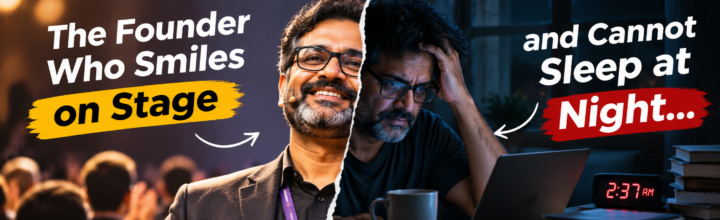
Every year, many Indian founders stand on stages, collect awards, and tell the world that the journey was worth it. Very few say what happened the night before. Many of them did not sleep.
This hidden struggle has a name: founder’s depression. It is not an official medical term. But the pain behind it is real, and the research is stronger than most people expect.
The Numbers That Surprised Researchers
In 2015, researchers from American universities studied 242 entrepreneurs. About half reported at least one mental health condition in their lifetime. Around 30 percent had faced depression, which is double the rate in the comparison group of non-founders. About 29 percent reported ADHD, against only 5 percent in the other group. About 11 percent reported bipolar conditions, against 1 percent.
The study was small, and the answers were self-reported. So it proves a pattern, not a final truth. But the pattern is hard to ignore: the people who build companies seem to carry a heavier load inside their minds.
Why a Founder’s Mind Is Under Unusual Pressure
There are three reasons.
First, the founder and the business become one person. An employee can say, “The company lost an order.” The founder hears, “I lost it.” Imagine a garment exporter in Tiruppur whose foreign buyer cancels a full container order. For the staff, it is a business problem. For him, it feels like a verdict on his worth as a person. When identity and company merge, every business setback becomes a personal injury.
Second, the founder has nobody to tell. He cannot show fear to employees, because they may panic or leave. He cannot show it to investors, because they may lose confidence. He may not tell his family, because they will worry. So the person who knows the most about the danger has the fewest people to share it with.
Third, the founder lives in uncertainty. Scientists at University College London studied how people react to stress. They found that people felt more stress when a bad outcome was a 50-50 chance than when it was certain. Now think about a founder. Will the payment arrive? Will the client stay? Will the funding close? His whole life runs on 50-50 questions.
The Cruel Part: Winning Does Not Always Cure It
Most people believe that depression will end once the business succeeds. Founders often report the opposite.
After a big funding round, or after selling the company, many describe a sudden emptiness. For years, one goal held their life together: the next target, the next deadline, the next crisis. When it ends, the structure that kept them moving disappears. Some feel lost in the very moment the world calls them successful.
This is why founders are often more shocked by the low after a win than by the low after a loss.
What India’s Official Data Quietly Shows
India’s National Crime Records Bureau records suicides by occupation. In 2024, nearly 18,000 of the deaths reported were of self-employed persons, about 10.5 percent of the total. This category includes small shopkeepers and traders, not only startup founders. But it shows how heavy the pressure of working for yourself can be in India. This is a country where a family’s name, savings, and pride often sit on one person’s business.
The Early Signs Nobody Talks About
Founder’s depression rarely looks like sadness. It often looks like normal hard work. Picture a bakery owner in Pune with twelve outlets. He wakes at 4 a.m., works until midnight, and never complains. But he has stopped enjoying the work he once loved. He shouts at small mistakes. He has constant headaches. He feels nothing after a good sales day.
These are the real warning signs: broken sleep, constant irritation, loss of interest in the work, physical pain with no clear cause, and a feeling of numbness. Society calls this commitment. A doctor may call it depression.
What Actually Helps
Two actions matter most.
Find your people. Talk to other founders who face the same pressure. When someone says, “I have also lain awake over a pending payment,” the weight of shame becomes lighter. Isolation makes this condition worse. Honest conversation makes it smaller.
Ask for professional help early. Waiting until a breakdown is the costly choice. In India, Tele-MANAS offers free, round-the-clock mental health support on 14416. A counsellor or a psychiatrist is not a sign of weakness. For a founder, it is risk management.
The Truth Every Founder Must Hear
A founder does not need to look strong every day. Many successful founders have sleepless nights that no award ceremony ever shows. Strength is not hiding the pain. Strength is saying, “I need help,” while the business is still standing.
A company can be rebuilt after a failure. A founder’s health cannot be replaced.
So protect the person who holds the company together. Without that person, there is no company at all.
Comments

Hi, I’m Nishanth Muraleedharan (Nishani)—an IT engineer turned internet entrepreneur with 25+ years of experience in the textile industry. As the Founder of "DMZ International Imports & Exports Pvt ltd" ( Handlooom.com) and President & Chairperson of the "Save Handloom Foundation" (DesiFusions.com), I’m committed to reviving India’s handloom heritage by empowering artisans through sustainable practices and advanced technologies like Blockchain, AI, AR & VR. I write what I love to read—thought-provoking, purposeful, and rooted in impact. nishani.in is not just a blog — it's a mark, a sign, a symbol, an impression of the naked truth. Like what you read? Buy me a chai and keep the ideas brewing. ☕💭 For advertising on any of our platforms, WhatsApp me on : +91-91-0950-0950 or email me @ nishani@nishani.in