
The Roadster Flew. Now Comes the Hard Part.
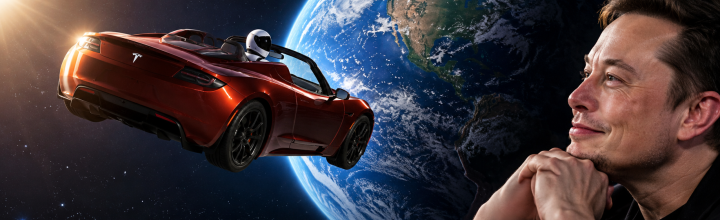
On the night of October 15, 2026, a car drove up a giant ramp in Texas, stuck to it upside down, left it, flipped in the air, and landed on its wheels. The crowd watched from hundreds of yards away. Tesla had just unveiled its new Roadster, nine years after the first one was shown.
What Happened
The event was held at SpaceX’s rocket test site near Waco. It was first planned for October 1, but bad weather pushed it back two weeks.
In the first demo, the Roadster climbed a curved ramp until it was fully upside down. Fans under the car created suction that held it to the surface. Then ten cold-gas thrusters, powered by compressed air, pushed it off the ramp. It flipped and landed safely. In the second demo, it jumped over a line of Tesla vehicles, including a Cybercab, a Cybertruck and a Semi truck, and landed on the other side.
Then came the number. Tesla said the car reached 60 mph in 0.81 seconds. For comparison, the best electric sports cars take about two seconds.
What Is Real and What Is Not
The stunts were real. The speed number is Tesla’s own, and no outside party has tested it. Some reviewers noted that a recorded test shown at the event gave one second, and the test conditions were not shared. Tesla also used different cars for different demos, and the car drove itself during the show.
The speed is not for everyone. Tesla will sell three versions. The road-ready Performance version does 0 to 60 mph in under 1.6 seconds. The Thrust version, made for the race track, claims under 0.9 seconds. The Rocket version claims under 0.59 seconds, seats one person, and is by invitation only. The 0.81-second run needed thrusters, so the buyer of a normal Roadster should not expect it.
Calling this a “flying car” is also a stretch. It makes short, controlled jumps. It cannot cruise through the sky.
What Does Elon Want From This?
Tesla has not said so directly, so this is my reading. I see three goals.
First, attention. Tesla’s sales of regular cars face tough competition, and a stunt like this fills every news feed for days. Second, a showcase of how Tesla and SpaceX can work together. Third, a reminder that Tesla can still build exciting machines, not only taxis and robots. Musk also said the Roadster will be the only Tesla that humans will still drive themselves. That is a strange promise from a company whose future depends on cars that drive without people.
Will It Reach the Market?
Tesla says production will happen at its Texas factory in 2027 or 2028. Musk has said it would follow the demo by twelve to eighteen months. I would treat those dates with care. In 2017, Tesla promised the first deliveries in 2020. Customers paid deposits of $50,000 and then waited close to a decade.
Price is another question. The base Roadster was once listed at $200,000, and the Thrust and Rocket versions will cost far more. Reports put the Thrust version near $250,000. For an Indian buyer, that is well over a crore rupees before import duties, which are among the highest in the world for cars. So for India, the Roadster is something to admire on a screen, not something to park at home.
Safety and law are also open. A car that carries tanks of high-pressure air and fires thrusters near people will face hard questions from regulators. Tesla has not said whether the thrusters will be legal on public roads.
What Else Is Tesla Building?
The Roadster is a showpiece. The real business plan is elsewhere.
The Cybercab is a two-seat taxi with no steering wheel and no pedals. It went into production in 2026, and Tesla has started giving limited rides in Austin. Musk has said he wants to sell it for $30,000 or less by 2027. He has also warned that early production of the Cybercab and of the Optimus humanoid robot would be “agonizingly slow” before it speeds up.
Optimus is the robot Tesla hopes will work in factories and homes. The Semi truck is also moving toward larger production. If these succeed, Tesla becomes a company of robots and driverless fleets. If they fail, the Roadster will be remembered as a very expensive firework.
What to Expect Next
Elon Musk’s plans are bold, but dates often slip. Tesla just showed a flying-style Roadster, yet customer deliveries have not begun. Starship reached orbit for the first time in September, and Flight 15 has no date.
Musk now puts a Moon city before Mars, with Mars work starting in five to seven years. Expect slow Cybercab and Optimus output, more robotaxi cities, and possibly Neuralink’s first Blindsight implant.
Starlink’s India launch still waits for final clearance and prices. SpaceX is also chasing orbital data centres, which remain unproven. Enjoy the vision, but judge Musk by what he delivers.
Expect more demos, more delays and more bold dates from Musk. Expect rivals to respond, because a stunt this loud forces others to answer. And expect the real test to come quietly, when the first customer asks a simple question: where is my car?
A great show earns attention. Only a delivered car earns trust.
Comments

Hi, I’m Nishanth Muraleedharan (also known as Nishani)—an IT engineer turned internet entrepreneur with 25+ years in the textile industry. As the Founder & CEO of "DMZ International Imports & Exports" and President & Chairperson of the "Save Handloom Foundation", I’m committed to reviving India’s handloom heritage by empowering artisans through sustainable practices and advanced technologies like Blockchain, AI, AR & VR. I write what I love to read—thought-provoking, purposeful, and rooted in impact. nishani.in is not just a blog — it's a mark, a sign, a symbol, an impression of the naked truth. Like what you read? Buy me a chai and keep the ideas brewing. ☕💭 For advertising on any of our platforms, WhatsApp me on : +91-91-0950-0950 or email me @ support@dmzinternational.com