
Trump Blinked in Beijing. India Should Be Very Worried.
While the world watched Trump and Xi exchange pleasantries at Zhongnanhai, something far more significant slipped past the diplomatic theatre: America quietly traded Taiwan’s security for a trade truce. And India, sitting thousands of kilometres away, apparently had nothing to say about it.
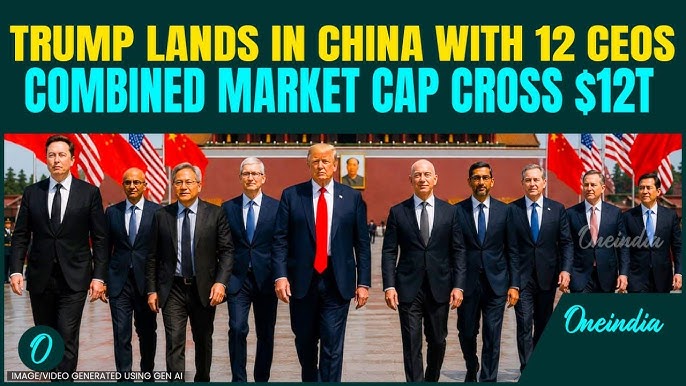
Trump’s Beijing delegation included Elon Musk (Tesla), Tim Cook (Apple), Larry Fink (BlackRock), Kelly Ortberg (Boeing CEO), and Jensen Huang (Nvidia) — essentially a who’s who of American corporate power, signalling the trip was as much a business mission as a diplomatic one.
Let that sink in.
The Summit That Settled Nothing — Except One Thing
Trump flew into Beijing with a laundry list — trade deficits, Iran, Taiwan, rare earths. He left with vague language about “strategic stability,” a promise that Xi will visit Washington in the fall, and zero concrete commitments on any of the hard issues.
But on Taiwan, something shifted. When asked directly about a major arms package for Taipei, Trump said: “The last thing we need right now is a war that’s 9,500 miles away.”
That is not a neutral statement. That is a retreat. Dressed in casual language, but a retreat nonetheless.
The US has maintained the Six Assurances since 1982 — a set of commitments to Taiwan that explicitly state Washington would not consult Beijing on arms sales to Taipei. Trump didn’t just pause the arms package. He told Xi about it first. Analysts aren’t mincing words: that’s a violation of the spirit of four decades of US-Taiwan policy, and Beijing got it for free.
China’s Foreign Minister called the summit “historical.” He’s right. Just not in the way Trump intended.
Meanwhile, the Iran War America Can’t Win
Here’s what the White House doesn’t want you to notice while the Beijing optics play out: the US-Iran war, now costing American taxpayers over $29 billion, is not going according to script. The New York Times is reporting that Iran’s military has regained access to 30 of its 33 missile sites near the Strait of Hormuz — directly contradicting Trump’s public assurances that the campaign has been effective.
The Strait of Hormuz. The chokepoint through which nearly 20% of global oil supply moves.
Iran is not closing the Strait completely — it is monetising it. Tehran created a new body called the Persian Gulf Strait Authority and issued a Vessel Information Declaration — a 40-plus question form ships must fill out declaring ownership, crew nationalities, cargo, and destination.
Only ships that comply and receive IRGC clearance are permitted safe passage. Iran also rerouted all traffic through a new corridor passing through its own territorial waters, abandoning the official international shipping lane entirely — allowing its navy to physically inspect vessels.
Around 1,000 ships remain stuck in a holding pattern, 800 inside the Gulf waiting to exit and 200 outside waiting to enter.
Iran decides who passes, when, and on what terms. That is the new reality of the world’s most critical energy chokepoint.
Iran isn’t broken. It’s battered and bleeding, yes — but it is still standing. And its Foreign Minister isn’t sitting quietly. He’s on the phone with BRICS nations, calling for unity against what he describes as American “bullying.” He’s pitching India. He’s pitching China. He’s pitching Russia and Brazil.
And Putin, for his part, has declared this week that he believes the Ukraine war is “coming to an end.” Whether that’s posturing or genuine, the signal is clear: the major non-Western powers are reading a world in transition. A world where American dominance is no longer a given — and where the next few months of diplomatic positioning will matter enormously.
Where Is India in All of This?
This is the question no mainstream outlet is asking.
India is a BRICS member. Iran’s FM is directly appealing to that bloc. India also has a defence and strategic partnership with the United States. And India shares a 3,488-kilometre contested border with China — the same China that just extracted a major concession from Trump on Taiwan without firing a single shot.
Think about what China demonstrated in Beijing: that America, under sufficient economic and diplomatic pressure, can be made to hesitate. To qualify. To soften. If the US won’t fully back a democratic island it has supported for decades when the stakes are high, what does that tell Beijing about its calculus on the Line of Actual Control? What does it signal about US resolve in any future India-China confrontation?
India’s foreign policy establishment — consummate practitioners of “strategic autonomy” — will process this quietly. But quiet processing is not the same as smart positioning. While New Delhi navigates BRICS solidarity, a US relationship it cannot afford to lose, and a Chinese neighbour that just scored a diplomatic coup, the margin for error is shrinking fast.
The Iran appeal to BRICS puts India in the most uncomfortable of seats: neither fully aligned with the US-led order, nor willing to burn that bridge by rallying against it. Perpetual fence-sitting was a luxury of a more stable world. That world is ending.
The Bottom Line
Trump went to Beijing to talk trade. China used the meeting to talk power. And the world’s most consequential bilateral relationship just shifted — subtly, but meaningfully — in Beijing’s favour.
India watched. India is still watching.
The real question is: for how much longer can watching be a strategy?
And if that weren’t enough, look at what Trump is juggling simultaneously: a $29 billion Iran war that isn’t going to plan, a Taiwan commitment he just quietly walked back, a Ukraine peace that exists only in Putin’s imagination, and a China that outmanoeuvred him in his own summit.
Yet somehow, in the middle of all this, the Trump administration has chosen to open a new front — Cuba.
A country 90 miles from Florida, completely out of oil, its people suffering 22-hour blackouts, its government on its knees. CIA Director Ratcliffe flew to Havana to deliver Trump’s message personally: change your regime or stay in the dark.
This is a president stretched across five geopolitical theatres at once, with no clean wins in any of them, now picking a fight with a broke, oil-starved island as if that is the crisis that needed his attention.
Cuba is not a threat. Cuba is a distraction. And the fact that Washington is treating it as a priority tells you everything about how thin American strategic bandwidth is right now.
A superpower that is simultaneously losing a war it started, retreating on Taiwan, and besieging a Caribbean island for leverage is not projecting strength. It is projecting exhaustion.
Nishani writes on geopolitics, technology, and India’s place in the emerging world order at nishani.in
Comments

Hi, I’m Nishanth Muraleedharan (also known as Nishani)—an IT engineer turned internet entrepreneur with 25+ years in the textile industry. As the Founder & CEO of "DMZ International Imports & Exports" and President & Chairperson of the "Save Handloom Foundation", I’m committed to reviving India’s handloom heritage by empowering artisans through sustainable practices and advanced technologies like Blockchain, AI, AR & VR. I write what I love to read—thought-provoking, purposeful, and rooted in impact. nishani.in is not just a blog — it's a mark, a sign, a symbol, an impression of the naked truth. Like what you read? Buy me a chai and keep the ideas brewing. ☕💭 For advertising on any of our platforms, WhatsApp me on : +91-91-0950-0950 or email me @ support@dmzinternational.com