
When AI Became a Better Doctor: How ChatGPT Is Quietly Saving Lives
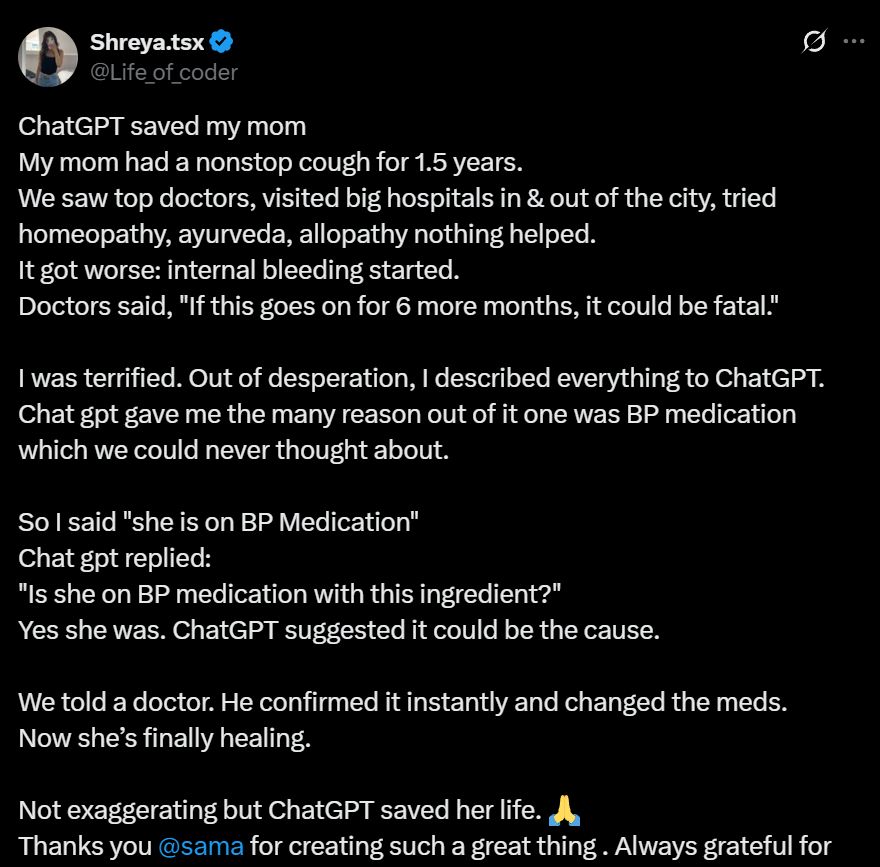
🧠Imagine watching your mother cough for 1.5 years.
You’ve taken her to top hospitals, met specialists across cities, tried every form of medicine from allopathy to Ayurveda. Nothing worked. Then it worsens—internal bleeding starts. And the doctor drops a bomb:
“If this goes on for six more months, it could be fatal.”
What would you do?
Most of us would crumble. But Shreya, a tech-savvy daughter, did something extraordinary: she asked ChatGPT.
Yes, an AI chatbot—not a stethoscope-wearing doctor, not a white coat-wrapped savior. A virtual assistant designed to have conversations.
And that simple conversation may have saved a life.
👩⚕️ The Diagnosis That Eluded Everyone
After months of pain, hospitals, and helplessness, Shreya described her mother’s symptoms to ChatGPT. The bot responded with a list of possible causes. One stood out:
“Is she on BP medication with this ingredient?”
It was a possibility no doctor had considered.
Turns out—yes, she was.
ChatGPT had flagged something buried in fine print and pharmaceutical jargon. A side effect of a common BP medication was chronic cough and internal bleeding.
Doctors had missed it. But AI hadn’t.
They told the doctor. He confirmed it. The medication was changed.
The cough is healing. The bleeding stopped. The mother is recovering.
⚕️ When AI Sees What Humans Miss
This isn’t a one-off miracle. Across the world, people are turning to AI—not because they don’t trust doctors—but because doctors are human.
Humans who are:
- Overworked,
- Sometimes dismissive,
- Trained to look for the most common causes,
- And limited by time and system constraints.
But ChatGPT doesn’t get tired.
It doesn’t roll its eyes.
It doesn’t ask you to wait six months for another appointment.
It simply listens, analyzes, and suggests—based on billions of data points.
It can’t replace a doctor. But sometimes, it can nudge one in the right direction.
💊 Real Problems. Real Patients. Real Impact.
Let’s be clear: this is not a sci-fi plot.
AI has helped people:
- Detect drug interactions doctors overlooked.
- Understand rare diseases that took years to diagnose.
- Flag mental health risks buried in subtle language.
- Ask the right questions before it’s too late.
It’s not about replacing doctors. It’s about empowering patients.
A second opinion that costs nothing and takes seconds.
⚠️ But Wait—This Isn’t a Green Light to Self-Diagnose
ChatGPT isn’t perfect. It doesn’t run tests or listen to your lungs.
But it asks smart questions.
It connects dots faster than Google.
And sometimes, that’s all a desperate person needs—to see something from a new angle.
Just like Shreya did.
🙏 From Desperation to Hope—One Chat at a Time
In a world full of expensive second opinions, rushed consultations, and misdiagnoses, AI is becoming a quiet revolution in healthcare. Not by replacing humans, but by helping us become better ones.
Because sometimes, a life isn’t saved in an emergency room.
Sometimes, it’s saved in a quiet room, by a daughter typing into a chatbot out of sheer desperation.
And sometimes… that’s enough.
Always consult a medical professional. But never be afraid to ask more questions—especially with a tool like ChatGPT in your pocket.
🔍 Ask. Analyze. Act.
Because the life you save… might be your mother’s.
—
✍️ Written for Nishani.in
Where stories reveal what the world often hides.
Comments

Hi, I’m Nishanth Muraleedharan (also known as Nishani)—an IT engineer turned internet entrepreneur with 25+ years in the textile industry. As the Founder & CEO of "DMZ International Imports & Exports" and President & Chairperson of the "Save Handloom Foundation", I’m committed to reviving India’s handloom heritage by empowering artisans through sustainable practices and advanced technologies like Blockchain, AI, AR & VR. I write what I love to read—thought-provoking, purposeful, and rooted in impact. nishani.in is not just a blog — it's a mark, a sign, a symbol, an impression of the naked truth. Like what you read? Buy me a chai and keep the ideas brewing. ☕💭 For advertising on any of our platforms, WhatsApp me on : +91-91-0950-0950 or email me @ support@dmzinternational.com