Congress: The Grand Old Party of Grand Betrayals
Let’s call it what it is. Congress didn’t just lose Tamil Nadu — they weren’t even a player. They had five seats. Five. And they still found a way to stab their ally in the back.
The 2026 Tamil Nadu elections delivered one of Indian politics’ most seismic shocks. Actor-turned-politician Vijay’s Tamilaga Vettri Kazhagam detonated the Dravidian duopoly that had ruled the state for six decades, walking away with 108 seats. The DMK — once undisputed kingmakers of Tamil Nadu and the backbone of the INDIA bloc in the south — was humiliated, reduced to 59 seats. Their Chief Minister M.K. Stalin lost his own Kolathur seat. A seat he had won three consecutive times.
And what did Congress do the morning after?
They ran. Straight to the winner’s doorstep.
The Tamil Nadu Congress Committee announced support for the TVK government before the dust from counting had even settled. A party that won five seats decided it would “share the responsibility of governance” with the very force that destroyed their alliance partner. And today, Rahul Gandhi boards a flight to Chennai to attend Vijay’s swearing-in ceremony, smiling for cameras, calling a man his “brother” — while the DMK, with whom Congress contested this very election, sits in ruins.
This is not pragmatic politics. This is opportunism wearing a Nehru jacket.
The INDIA Bloc: A Hotel, Not an Alliance
The INDIA bloc was always a marriage of convenience. Congress has now confirmed it was always convenience for Congress alone.
Samajwadi Party chief Akhilesh Yadav took a pointed swipe after Congress’s dramatic Tamil Nadu pivot, sharing photographs of his meetings with Mamata Banerjee and M.K. Stalin and posting publicly: “We are not the ones who abandon each other in times of difficulty.” He didn’t name Congress. He didn’t need to. Everyone understood.
The DMK declared the INDIA bloc effectively finished. Party legislators passed resolutions condemning Congress for abandoning an alliance partner at the worst possible moment.
What makes this worse is that this was not a reaction to circumstances. Even before the elections, a section within Congress — leaders considered close to Rahul Gandhi — believed the party should have broken from DMK before the polling and aligned with TVK directly. Congress knew which way the wind was blowing. They waited, let DMK absorb the anti-incumbency, and the moment the results confirmed DMK’s collapse, they moved. Premeditated. Calculated. Cold.
In Tamil Nadu they contested as DMK’s ally. They won five seats regardless. Then immediately switched sides. Akhilesh will remember this during UP seat-sharing. Mamata will remember this. Every regional ally will remember this. The INDIA bloc was not killed in the counting halls. It was quietly strangled in Congress’s drawing room.
Kerala: The Victory Nobody Can Celebrate
Now let us talk about the one state Congress actually won — and how they are turning it into a slow-motion disaster.
The United Democratic Front swept Kerala in a historic majority. A state that had alternated between Left and UDF with near-mathematical precision for decades broke that pattern and delivered a clear mandate. Kerala voted. Kerala celebrated. Kerala waited.
Six days later, Congress still cannot name a Chief Minister.
Three contenders. Three camps. One paralysed party.
VD Satheesan, the Leader of Opposition who spent five years sharpening attacks against the Left government and built this win constituency by constituency. Ramesh Chennithala, a veteran who has been Home Minister, Opposition Leader, and KPCC president, and who believes seniority is its own argument. KC Venugopal, AICC general secretary and Rahul Gandhi’s closest political lieutenant in Delhi, whose claim rests entirely on proximity to the high command rather than any grassroots role in this election.
A high-level meeting was held at Congress president Mallikarjun Kharge’s residence, attended by Rahul Gandhi himself. It ended with no decision. Leaders walked out and told journalists to “refrain from rivalry-driven activities.” They did not have the courage to simply admit they had failed to decide.
Keralites who voted, who stayed up watching results, who celebrated a historic mandate — they are now watching this circus with embarrassment. Their verdict is being held hostage to Delhi’s indecision and factional arithmetic. This is exactly what people mean when they say Congress cannot govern itself.
Four States in a Country of Twenty-Eight
Congress currently controls four state governments. Karnataka, Telangana, Himachal Pradesh, and Kerala — which they still have not formally formed. The BJP holds power in sixteen states, with NDA-allied governments in four more. Five of India’s most populous states — Uttar Pradesh, Bihar, Maharashtra, West Bengal, and Madhya Pradesh — are all BJP-governed. A party that once ruled without interruption for five decades, that built its identity as the natural party of governance, is now a footnote in most of India’s political map.
That collapse did not happen overnight. It was a structured erosion that began in 2014 and accelerated with every election since.
How BJP Ate Congress State by State
2014 was not just an election loss. It was a civilisational verdict. The UPA’s second term had collapsed under the weight of corruption — 2G, CWG, Coalgate — and a stalled economy. Manmohan Singh, once celebrated as the architect of liberalisation, became the symbol of a government nobody led. Ministers ran their own fiefdoms. The party sat insulated in New Delhi, disconnected from the consequences.
Narendra Modi walked into that vacuum with something Congress had forgotten how to offer — decisiveness. He built a direct relationship with voters that bypassed every intermediary and every party broker. Congress had no answer because Congress is built entirely on intermediaries. Its power model depends on layers of brokers between the high command and the voter.
In 2014, Congress was reduced to 44 seats — not even enough to claim the Leader of Opposition position. Rather than treating this as an emergency requiring structural surgery, they treated it as a temporary setback. They blamed EVMs, media bias, and Modi’s money. Everything except themselves.
Between 2014 and 2019, BJP systematically dismantled Congress’s remaining state governments — through elections and, where elections failed, through engineering defections. Madhya Pradesh is the perfect case study. Congress won the state in 2018. Within two years, Jyotiraditya Scindia walked out with 22 MLAs and the government collapsed. Congress neither identified Scindia’s frustration early nor treated him with the respect his voter-pulling power deserved. They lost a state they had won because they could not manage the people who won it for them.
Rajasthan and Chhattisgarh fell in 2023. In Rajasthan, the Congress government spent three years at war with itself — Ashok Gehlot versus Sachin Pilot, played out in public, relentlessly. Every voter watching that spectacle concluded that Congress was incapable of governing itself, let alone a state. They had five years and wasted three of them on internal combat. The BJP barely needed to campaign.
Why BJP keeps winning is not a mystery. BJP runs elections like military campaigns. One command structure. Decisions made and executed. When they need to change a Chief Minister mid-term — as they have done repeatedly across states — they do it without public fracture. It appears brutal but it signals control. Voters consistently reward a party that looks like it is in charge of itself.
BJP also has the RSS. An organisational army that maintains contact with voters between elections, not just during them. They are present at weddings, funerals, local festivals and community meetings. They build social capital that converts to political capital on polling day. Congress dismantled its grassroots machinery decades ago, believing television campaigns and top-down strategy were enough. They are paying for that decision in every rural constituency across India today.
The identity problem is the deepest wound. Congress does not know what it stands for. It cannot credibly claim the secular high ground because its alliance behaviour has been purely transactional for years. It cannot claim the pro-poor position convincingly because it governed for a decade between 2004 and 2014 and left inflation and inequality largely unaddressed. It cannot claim the pro-business position because its own factions would revolt. It cannot reposition toward Hindu cultural identity because BJP owns that ground completely and Congress entering it only looks desperate.
Suvendu Adhikari, once a key TMC leader, was seen in the Narada sting videos where politicians were allegedly caught accepting cash. Narendra Modi had strongly criticised such leaders during election campaigns, but after Adhikari joined the BJP, critics say the ED, CBI, and IT actions against him lost momentum, and today he has become the Chief Minister of West Bengal. Many see this as a dangerous sign of selective accountability in Indian politics, where a weak opposition allows those in power to escape serious questioning, slowly weakening the foundations of democracy.
What Congress Must Do — and Almost Certainly Won’t
The fixes are not complicated. The problem is that each one requires Congress to do something deeply uncomfortable.
Name your Kerala Chief Minister today. Not in another round of meetings. Today. The fact that you won a state and cannot form a government within a week tells every voter in every upcoming election how you will govern. Reward the person who actually won the election on the ground — VD Satheesan — not the person closest to the dynasty.
Stop treating alliances as disposable. If you contest an election alongside DMK and switch to TVK the morning after, you are not coalition partners — you are mercenaries. Akhilesh knows it. Mamata knew it before West Bengal was taken from her. Future allies will either demand impossible terms or simply build without Congress entirely.
Rebuild the organisation from the bottom up. Go back to the districts. Go back to the booths. BJP did not win sixteen states by running better television advertisements. They won by having people present in every pocket of every constituency when no camera was watching.
And finally, the most important and least likely — reduce the dynasty’s suffocating grip on the party. Rahul Gandhi is a sincere person inside a broken system his own family helped construct. His presence at the top ensures no alternative leadership can breathe, because everyone is either loyal to him or waiting for him to fail. Neither condition builds a strong party. A strong party needs internal competition, not internal submission.
The Photograph That Says Everything
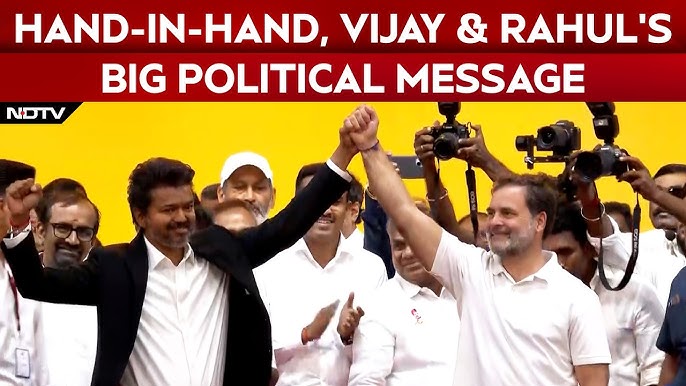
Today a photograph is being taken in Chennai. Rahul Gandhi stands next to Vijay at a swearing-in ceremony, projecting brotherhood and alliance. In the opposition benches of the Tamil Nadu assembly, DMK leaders are watching this on their phones.
This is Congress in 2026. Attending the celebrations of the politician who replaced their ally. Calling betrayal a pragmatic realignment. Governing four states and still unable to name a Chief Minister in the one they just won.
India deserves a strong opposition. Congress, in its current form, is not it.
Nishani writes on geopolitics, Indian politics, economics, and culture at nishani.in
Comments

Hi, I’m Nishanth Muraleedharan (also known as Nishani)—an IT engineer turned internet entrepreneur with 25+ years in the textile industry. As the Founder & CEO of "DMZ International Imports & Exports" and President & Chairperson of the "Save Handloom Foundation", I’m committed to reviving India’s handloom heritage by empowering artisans through sustainable practices and advanced technologies like Blockchain, AI, AR & VR. I write what I love to read—thought-provoking, purposeful, and rooted in impact. nishani.in is not just a blog — it's a mark, a sign, a symbol, an impression of the naked truth. Like what you read? Buy me a chai and keep the ideas brewing. ☕💭 For advertising on any of our platforms, WhatsApp me on : +91-91-0950-0950 or email me @ support@dmzinternational.com