
Part 2 – Life on Earth: Accident, Divine Design, or a Repeated Cosmic Experiment?

From the First Microbe to Modern Man… and the Next Possible Extinction
If Earth had a biography, the first chapter wouldn’t be “Once upon a time.”
It would be:
“A burning rock survived hell long enough to become alive.”
No trees. No birds. No oceans full of fish. No humans fighting on social media about who created what. Just a violent planet forming from cosmic debris around 4.5 billion years ago, getting smashed by meteors, boiling under volcanoes, and breathing toxic gases instead of oxygen.
And then something happened that should not have happened.
Dead matter… became alive.
Not with divine music. Not with lightning from heaven. Not with angels clapping.
But through chemistry.
And from that silent microscopic rebellion, Earth eventually produced everything—forests, dinosaurs, whales, civilizations, religion, science, war, poetry, love, plastic, and you reading this.
So the real question isn’t how humans evolved.
The real question is:
How did lifeless chemicals learn to copy themselves?
And why does Earth keep wiping life out like a cruel experiment resetting itself?
Because Earth didn’t build life like a loving parent.
Earth built life like a ruthless tester.
1. Before Life: Earth Was Not a Paradise. It Was a Furnace.
Earth’s early years were chaos.
- molten surface
- constant volcanic eruptions
- poisonous atmosphere
- meteor bombardments
- violent storms and lightning
- oceans forming, evaporating, reforming
- zero oxygen to breathe
- no plants
- no animals
- no peace
If you had visited Earth back then, you wouldn’t call it “Mother Earth.”
You’d call it:
A chemical war zone.
But Earth had two ingredients that matter more than anything:
✅ Water
✅ Energy
Heat. Lightning. Radiation. Volcanic vents.
The same forces that destroy… also create.
And they may have triggered the most mysterious event in the history of the universe:
the birth of life.
2. The Dawn of Life: When Chemistry Became Biology
Science does not claim a final answer yet.
But it has powerful theories.
The most accepted idea is:
Abiogenesis
Life formed from non-living chemicals through natural reactions.
Somewhere around 4.1 to 3.8 billion years ago, Earth’s oceans or pools likely contained organic molecules—amino acids and basic compounds—that gradually assembled into more complex structures.
In 1952, the famous Miller–Urey experiment shocked the world by showing that electric sparks in a simulated early atmosphere could create amino acids—the building blocks of proteins.
In simple terms:
Earth may have cooked life in its own laboratory.
And if that isn’t unsettling, consider another theory:
The RNA World Hypothesis
RNA may have been the first molecule capable of both storing information and triggering chemical reactions. Before DNA ruled biology, RNA may have been the original biological code.
So the first “life” might not have been a creature.
It may have been a chemical system that learned one supernatural trick:
Replication.
That’s what life is at its core.
Not intelligence.
Not emotion.
Not morality.
Just the ability to copy itself.
Life is matter that learned to duplicate.
That’s the real miracle—whether you call it divine or accidental.
3. Where Did Life Begin? Vents, Pools, Clay… or Something Else?
Scientists debate the birthplace of life. The main suspects are:
- deep-sea hydrothermal vents
- shallow tidal pools
- mineral-rich clay surfaces
- primordial oceans (“primordial soup”)
Nobody can say for sure.
But the timeline is disturbing:
Life emerged relatively quickly after Earth cooled.
Which raises a mind-bending thought:
If life could appear quickly here…
maybe life is not rare.
Maybe the universe is filled with planets where chemistry became biology.
Or maybe Earth is the one lucky exception.
Either way, we’re standing on a miracle—or a cosmic accident with very good marketing.
4. The First Visible Life: Stromatolites, Cyanobacteria, and Earth’s Oldest Fossils
The earliest life was microscopic, invisible to the naked eye.
But the first clear physical evidence of life comes from:
Stromatolites
Layered microbial structures formed by cyanobacteria.
Some stromatolite fossils date back 3.5 billion years, including examples found in regions like Western Australia’s Pilbara Craton.
These were not animals.
These were not fish.
These were not “advanced.”
They were microbial mats.
And yet, these tiny organisms did something that permanently transformed Earth.
They began producing oxygen.
5. The Great Oxygenation Event: When Life Poisoned the Planet to Upgrade It
Around 2.4 billion years ago, cyanobacteria filled Earth’s atmosphere with oxygen.
This is known as:
The Great Oxidation Event
Here’s the cruel twist:
Oxygen was toxic to many early life forms.
So when oxygen rose, countless organisms died.
Meaning the rise of breathable air was also one of Earth’s earliest mass biological disasters.
But oxygen enabled something bigger:
- complex metabolism
- bigger organisms
- multicellular life
- animals
- brains
- humans
So the truth is brutal:
Life nearly killed itself… to become more powerful.
Evolution doesn’t grow politely.
Evolution grows through violence.
6. The Greatest Merger in History: The Birth of Complex Cells
For nearly 3 billion years, Earth was ruled by single-celled organisms.
Then came the rise of eukaryotes—cells with nuclei—around 2.2 to 1.8 billion years ago.
And science believes this happened through one of the most insane biological events ever:
Endosymbiosis
One cell swallowed another cell.
But instead of digesting it, they partnered.
That swallowed organism became mitochondria—the energy factory inside your cells.
So yes:
Your body is built on an ancient microbial partnership deal.
You are literally a walking business merger.
7. The Cambrian Explosion: When Nature Went Completely Wild
Around 600 million years ago, multicellular life expanded.
Then around 541 million years ago, something dramatic happened:
The Cambrian Explosion
Suddenly the oceans filled with bizarre creatures, predators, armor, eyes, movement, competition.
If early life was a silent chemical experiment…
Cambrian life was Earth’s first blockbuster movie.
Nature said:
“Enough microbes. Let’s create monsters.”
8. Evolution: Not a Staircase, but a War Zone
Darwin’s concept of evolution by natural selection explains how life diversified:
- traits vary
- traits get inherited
- environments favor certain traits
- survival creates new species over time
But evolution is not “progress.”
It is not a ladder.
It is a battlefield where survival decides truth.
And the fossils prove it.
Over time:
- fish emerged (~500 million years ago)
- amphibians evolved (~370 million years ago)
- reptiles rose
- mammals followed
- primates evolved
- and eventually humans appeared
But Earth was never “planning humans.”
Humans are not the goal.
Humans are the result of survival.
9. When Worlds End: Earth’s Five Mass Extinctions
Earth doesn’t just evolve life.
Earth destroys life.
Repeatedly.
Scientists identify five major mass extinction events, each wiping out 75% or more of species.
1. Ordovician–Silurian Extinction (443–444 million years ago)
- glaciation and sea level fall
- ~85% marine life wiped out
2. Late Devonian Extinction (375–359 million years ago)
- multiple pulses
- climate instability
- ocean oxygen depletion (anoxia)
- ~75% species vanished
3. Permian–Triassic Extinction (252 million years ago)
The worst extinction ever.
Called:
“The Great Dying”
- ~96% marine species wiped out
- ~70% land vertebrates wiped out
- likely caused by Siberian Traps volcanic eruptions
- CO₂ spike, global warming, acid oceans, toxic seas
Earth almost became lifeless.
This wasn’t extinction.
This was biological apocalypse.
4. Triassic–Jurassic Extinction (201 million years ago)
- massive volcanism and climate chaos
- ~80% species wiped out
- cleared the stage for dinosaurs
5. Cretaceous–Paleogene Extinction (66 million years ago)
The famous dinosaur extinction.
- asteroid impact near Yucatán
- plus volcanic eruptions (Deccan Traps)
- dust clouds blocked sunlight
- wildfires, acid rain, food chain collapse
- ~75–76% life wiped out
Dinosaurs died.
Mammals rose.
And eventually humans appeared.
So the truth is hilarious and terrifying:
You exist because an asteroid destroyed the rulers of Earth.
Your existence is built on a cosmic accident.
10. Fossils: Earth Is a Cemetery of Forgotten Kingdoms
Every extinction buried worlds.
Trilobites. Ammonites. Ancient reefs. Forest ecosystems.
Their bodies got trapped under sediment and turned into fossils.
Meaning:
Earth is not a planet. It is a graveyard with a thin layer of life on top.
Dinosaurs ruled for 160 million years.
Humans have been here for only 300,000 years.
So if dinosaurs were a global empire…
humans are just a loud temporary tenant.
11. The Human Chapter: From Ape to Fire to Civilization
Science says humans evolved in Africa.
We diverged from chimpanzees around 6–7 million years ago.
Then came early hominins:
- Sahelanthropus
- Australopithecus
- Homo habilis (~2.8 million years ago)
- Homo erectus (~1.8 million years ago)
Homo erectus mastered fire, made tools, and migrated widely.
Then came the star of the modern story:
Homo sapiens emerged around 300,000 years ago
with fossil evidence including Jebel Irhoud.
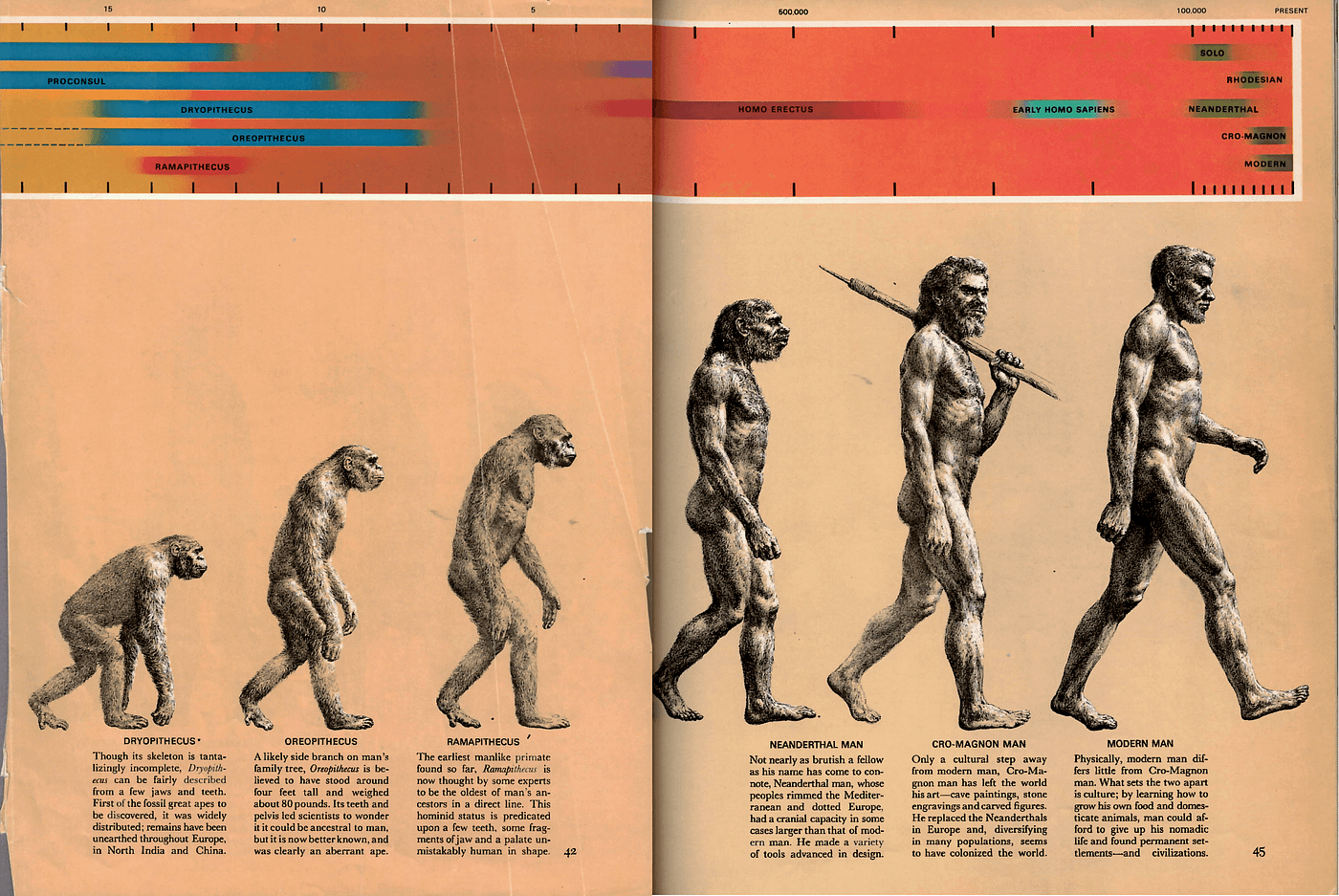
Humans migrated out of Africa around 70,000–100,000 years ago, spreading across the planet and interbreeding with Neanderthals.
We didn’t conquer Earth through strength.
We conquered Earth through:
- social cooperation
- language
- imagination
- strategy
- tools
- storytelling
12. What Were Early Humans Doing? Living Hard and Dying Fast.
Early humans weren’t writing holy books.
They were trying not to become lunch.
Their life was:
- hunting animals
- gathering berries and roots
- living in small bands
- migrating constantly
- sleeping in caves and shelters
- surviving disease and injury without medicine
- burying their dead
- forming rituals
- creating early art
By around 40,000 years ago, humans created cave paintings and symbolic culture.
Religion wasn’t born from stupidity.
Religion was born from fear, wonder, and the human need to explain death.
13. The Agricultural Revolution: The Real Beginning of Civilization
For most of human existence, we were hunter-gatherers.
Then around 10,000 years ago, agriculture began (notably in the Fertile Crescent).
Farming created:
- permanent settlements
- food surplus
- population growth
- cities
- kings
- wars
- slavery
- taxes
- organized religion
- civilization
Agriculture didn’t just feed humans.
It created human ego.
And that ego built empires.
14. What Religions Say: Divine Origins Across Faiths
Science explains mechanisms.
Religion explains meaning.
That’s why both survive.
Let’s look at the major creation narratives:
Abrahamic Religions (Judaism, Christianity, Islam)
These traditions share a strong theme:
- God creates the world intentionally
- creation happens in stages
- humans are created specially
- Adam is formed from earth/clay
- humans are placed in Eden (Genesis narrative)
- humans fall from grace through disobedience
These traditions emphasize humans being made in God’s image and assigned responsibility over creation.
Hinduism: Cosmic Cycles and Creation-Recreation
Hinduism is different.
It does not insist the universe began once.
It often describes time as cyclical:
- creation
- preservation
- destruction
- rebirth
Texts like the Rigveda speak poetically about cosmic origins, including the cosmic egg (Brahmanda) and creation emerging from cosmic consciousness.
The concept of Yugas reflects repeating ages.
Interestingly, Hindu cosmology contains time scales that feel closer to modern cosmology than many ancient traditions.
Coincidence? Symbolism? Forgotten knowledge? Debate continues.
Buddhism: No Creator Obsession, Only Cause and Condition
Buddhism doesn’t focus on “who created the universe.”
It focuses on dependent origination—everything arises due to causes and conditions.
It suggests no absolute beginning is necessary.
In Buddhism, obsessing over origin stories can distract from spiritual growth.
In short:
The universe exists. Now stop suffering.
Indigenous and Ancient Traditions Worldwide
From Native American emergence stories to African Yoruba myths to Aboriginal Dreamtime narratives, creation is often described as:
- humans shaped from earth
- life emerging from previous worlds
- celestial beings forming land and creatures
Different names, same message:
Humans are not random. Humans are accountable.
15. Science vs Religion: The Real Conflict Is Not Facts, It’s Ego
Science says:
You are a temporary accident of evolution.
Religion says:
You are intentionally created and meaningful.
Science gives truth without comfort.
Religion gives comfort with purpose.
The war between them is often childish.
Because they answer different questions:
- Science explains how
- Religion explains why
And sometimes the two overlap, making both sides uncomfortable.
16. The Bridge: Theistic Evolution and the Middle Ground
Many thinkers and religious leaders accept the idea that evolution is real, but guided through natural laws established by a creator.
This is called:
Theistic Evolution
God as the architect of laws, evolution as the method.
This idea annoys extremists on both sides.
But reality doesn’t care about extremists.
Reality cares about what works.
17. The Sixth Extinction: Are We Writing Earth’s Next Apocalypse?
Many scientists argue we are already entering the sixth mass extinction, driven not by asteroids but by human activity.
Causes include:
- habitat destruction
- deforestation
- climate change
- pollution
- overexploitation
- industrial agriculture
- plastic contamination
- ocean acidification
Species are disappearing at rates 100 to 1,000 times higher than natural background extinction rates, according to many scientific assessments.
Unlike the Big Five…
this extinction has a face.
And it is human.
This time the asteroid is not from space.
It is our lifestyle.
18. What Could Trigger the Next Collapse?
Earth can still destroy us the old-fashioned way:
- asteroid impact
- supervolcano eruption (like Yellowstone-scale)
- solar storms
- natural pandemics
But humans can also destroy themselves with:
- nuclear war
- engineered pandemics
- ecological collapse
- climate tipping points
- food and water wars
The timing is unpredictable.
But the danger is not imaginary.
We are the first species intelligent enough to predict extinction…
and arrogant enough to ignore it.
19. The Most Dangerous Delusion: Humans Think They Are the Final Form
Humans behave like we are the climax of evolution.
That is laughable.
Evolution never stops.
If humans survive long enough, we will evolve.
Or we may merge with machines.
Or we may collapse and vanish.
And Earth will continue.
Earth has no loyalty to Homo sapiens.
Earth has buried kings, empires, and dinosaurs.
It can bury us too.
20. The Greatest Irony: The First Life Still Rules the Planet
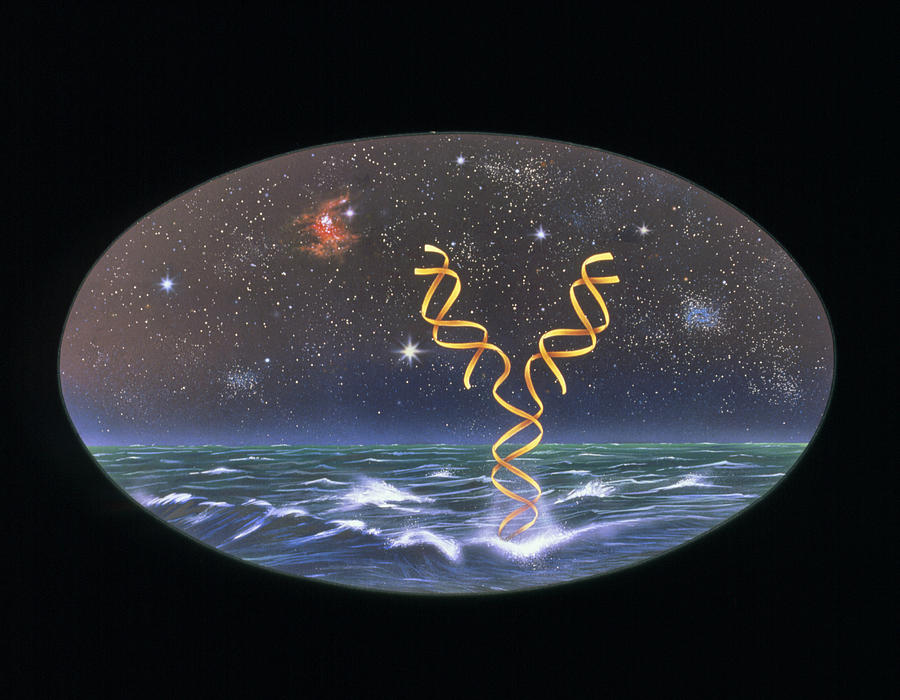
Bacteria were among the earliest life forms.
And bacteria are still here.
They survived:
- oxygenation disasters
- five mass extinctions
- meteors
- volcanic winters
- climate collapses
They don’t worship.
They don’t pray.
They don’t build civilizations.
They simply adapt.
So perhaps the most brutal truth of existence is this:
Survival belongs to those who adapt, not those who dominate.
Conclusion: Earth Has Restarted Life Before. It Can Restart Without Us.
Life began as microscopic chemistry.
Then came stromatolites, oxygen, complex cells, multicellular life, predators, dinosaurs, mammals, and finally humans.
Humans then invented religion to explain fear.
Humans invented science to explain reality.
Humans invented civilization to control nature.
Humans invented industry to multiply power.
And now humans stand at the edge of something terrifying:
We may be intelligent enough to reach Mars…
but not wise enough to protect Earth.
If the five extinctions buried trilobites, ammonites, and dinosaurs…
the sixth might bury:
- our cities
- our religions
- our pride
- our plastic-laced oceans
- our “advanced civilization”
And the fossils of the future might show a strange layer in Earth’s crust:
a thin band of plastic, metal, and radiation.
A signature of a species that called itself wise.
And the final punchline will be this:
Homo sapiens—the species that believed it was chosen—was not destroyed by a meteor… but by its own ego.
So whether you believe life began by divine intention or chemical accident, one conclusion is unavoidable:
Life is rare. Earth is fragile. And humanity is not permanent.
We are not the owners of this planet.
We are not even its main characters.
We are just the newest species lucky enough to hold consciousness for a moment.
And now the story of life is asking humanity a simple question:
Will you evolve into wisdom… or become just another fossil layer?
Because Earth doesn’t care about what we believe.
Earth only cares about what we do.
And if we fail…
Earth will do what it has done before.
It will wipe the board clean.
And start again.
Part 1 – THE SUN: Eternal God… or Just a Cosmic Coincidence That Accidentally Created You?
Comments

Hi, I’m Nishanth Muraleedharan (also known as Nishani)—an IT engineer turned internet entrepreneur with 25+ years in the textile industry. As the Founder & CEO of "DMZ International Imports & Exports" and President & Chairperson of the "Save Handloom Foundation", I’m committed to reviving India’s handloom heritage by empowering artisans through sustainable practices and advanced technologies like Blockchain, AI, AR & VR. I write what I love to read—thought-provoking, purposeful, and rooted in impact. nishani.in is not just a blog — it's a mark, a sign, a symbol, an impression of the naked truth. Like what you read? Buy me a chai and keep the ideas brewing. ☕💭 For advertising on any of our platforms, WhatsApp me on : +91-91-0950-0950 or email me @ support@dmzinternational.com


