
Linchpin — The Book That Will Make You Uncomfortable About the Life You Are Settling For
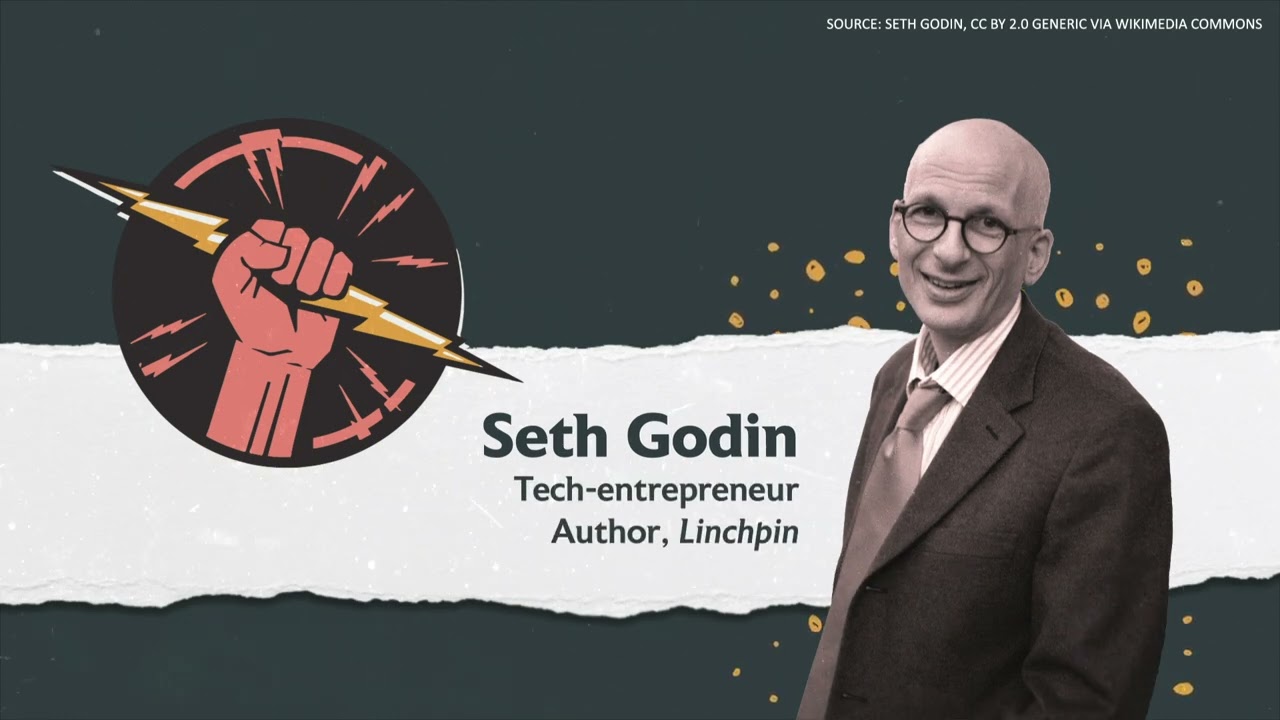
Seth Godin Wrote This Book About You. Specifically You.
Not about the market. Not about the economy. Not about the system that is broken or the industry that needs disruption or the government that is failing or the circumstances that are unfair.
About you. About the specific, daily, deliberate choice you make — usually without examining it as a choice — to do the predictable thing, follow the established script, stay inside the boundaries of what is expected, and call that safety when its actual name is surrender.
Linchpin, published in 2010, is Seth Godin’s most personal and most direct book. He has written about marketing, about tribes, about the practice of shipping creative work. This one is different. This one is about the internal architecture of the person who does the work — the beliefs, the fears, the resistance, the rationalizations that determine whether someone becomes genuinely indispensable or spends a career being efficiently replaceable.
It is not comfortable reading. It is not designed to be. Godin is one of the most cited business thinkers alive precisely because he has spent decades refusing to tell people what they want to hear and insisting on telling them what they need to examine. Linchpin is that refusal at its most concentrated and its most personal.
The World That Created the Linchpin Problem
To understand what Godin is arguing, you need to understand the system he is arguing against.
The industrial economy — the one that shaped the institutions, the schools, the corporations, and the cultural operating systems that most of us still inhabit — was built on a specific design principle: predictability at scale. The factory needed workers who would show up at the same time, perform the same tasks, follow the same instructions, and produce the same output day after day. Variation was waste. Creativity was disruption. The ideal worker was interchangeable — reliable, compliant, and replaceable without friction.
The education system was designed to produce this worker. Sit in rows. Follow instructions. Reproduce the correct answer on the test. Do not question the syllabus. Do not deviate from the curriculum. The goal was not to develop independent thinkers. The goal was to produce reliable components for an industrial machine that needed human parts that behaved like mechanical ones.
That machine worked. For a specific historical period, in a specific economic context, it produced enormous prosperity for a specific portion of the world’s population. And it installed, in the people it educated and employed, a set of beliefs about work, safety, and value that are now catastrophically misaligned with the economy those people are actually operating inside.
Godin’s argument is that the industrial model is over — not gradually declining but structurally finished as the primary source of value creation — and that the people who are still operating inside its logic are not being safe. They are being precisely as vulnerable as a factory worker in a plant that is about to be automated. The compliance that protected them inside the old system is the thing that is exposing them in the new one.
What Godin Actually Means by Linchpin
The word is specific and it matters to be precise about it.
A linchpin is the pin that holds a wheel to an axle. Remove it and the wheel comes off. Everything stops. The linchpin is not the largest component. It is not the most expensive. It is the one whose absence makes everything else irrelevant.
Godin uses this to describe a category of person — not a job title, not a credential, not a level on an organisational chart — but a way of showing up to work. The linchpin is the person in any organisation whose absence would be genuinely felt, whose contribution cannot be replicated by following the same manual they follow, whose value comes not from executing instructions but from bringing judgment, creativity, and genuine human connection to situations that instructions cannot fully anticipate.
This person exists in every organisation. They are not always the most senior. They are not always the most visibly talented. They are the person who figures out how to make the difficult client feel understood. The one who sees the problem before it is named. The one who connects people who needed to be connected and didn’t know it. The one who, when something falls between the formal responsibilities of two departments, picks it up anyway — not because it is in their job description but because they have defined their job as making things work rather than as executing a defined scope.
The opposite of the linchpin — which Godin does not celebrate but which he describes with uncomfortable accuracy — is the cog. The person who does what is asked, does it reliably, causes no disruption, raises no flags, and produces no surprises. In the industrial economy, this person was secure. In the connection economy — where value comes from ideas, from trust, from relationships, from the kind of human creativity that cannot be outsourced or automated — this person is the most vulnerable participant in the system.
The Resistance — The Most Important Concept in the Book
Godin borrows from Steven Pressfield’s War of Art the concept of Resistance — the internal force that prevents creative work from being done. But he extends and specifies it in ways that make it directly relevant to anyone operating in a professional context.
Resistance is not laziness. Resistance is not lack of talent. Resistance is not even fear in its simple form. It is a sophisticated, intelligent, adaptive internal mechanism that generates precisely the rationalisation most likely to prevent you from doing the work that matters.
It tells you that now is not the right time — that you will do the important work after the current crisis has passed, after the funding comes through, after the team is more stable, after the market is clearer. It tells you that your idea is not ready — that a little more preparation, a little more research, a little more refinement will produce something worth sharing. It tells you that the rules don’t allow what you are imagining — that the organisation, the industry, the client, the platform has constraints that make your contribution impossible before you have tested whether those constraints are real or assumed.
It is brilliant at its job. It has had your entire life to learn exactly which argument will work on you specifically. And it is entirely in service of one outcome: keeping you from shipping the work that would make you genuinely indispensable.
Godin’s diagnosis is that Resistance is not a personal failing. It is a feature of human psychology — one that was useful in evolutionary contexts where standing out from the group carried real physical risk and that is now catastrophically misapplied to professional and creative contexts where standing out is the only source of durable value. Understanding it as a mechanism rather than as a truth about your limitations is the beginning of working differently.
The Gift — What Linchpins Actually Do
One of the book’s most important and most misunderstood concepts is the idea of giving a gift.
Godin argues that linchpins approach their work as an act of giving — not in the sense of self-abnegation or working without compensation, but in the sense of bringing something to their work that exceeds what was contracted for, that is not required by the job description, that comes from genuine care about the outcome rather than compliance with the specification.
The customer service person who solves the problem the customer didn’t know how to ask about. The designer who delivers not just the brief but the insight that makes the brief better. The salesperson who tells the prospect the truth about a limitation in the product because the relationship matters more than the individual transaction. The employee who stays late not because they are asked to but because the thing is not done and it matters to them that it gets done.
This is not martyrdom. It is not working for free. It is a specific orientation toward work — one that defines the job as making a genuine difference rather than completing a defined scope — that produces the kind of output that cannot be replicated by following a manual because it comes from caring rather than complying.
The commercial logic underneath this is real and Godin is explicit about it: the person who consistently gives gifts — who consistently brings more than was asked, who makes the people around them feel seen and served and genuinely helped — builds a form of social and professional capital that compounds in ways that compliant execution never can. They become the person everyone wants on their project, in their corner, at their table. That is not soft. That is the most durable competitive advantage available in a connection economy.
The Art — Why Godin Calls This Work Art
The most philosophically interesting and most practically misunderstood move in the book is Godin’s insistence on calling linchpin work art.
He is not talking about painting. He is not talking about creative industries in the conventional sense. He is using art to mean something specific: work that comes from a human being’s genuine engagement with a problem — work that could not have been produced by following a manual, that carries the maker’s judgment and care and perspective, that is in some sense an act of expression as well as an act of production.
By this definition, the customer service interaction that genuinely resolves a difficult situation is art. The product decision that requires holding multiple competing user needs in tension and making a judgment call is art. The conversation that turns a hostile client into an advocate is art. The meeting that was going nowhere until someone reframed the problem in a way that unlocked the room is art.
What makes it art is not the medium. It is the presence of genuine human judgment, creativity, and care — the things that cannot be reduced to a process or a checklist, that require a person who is actually paying attention and actually invested in the outcome.
This framing matters because it changes the relationship to the work. Art is not something you execute. It is something you make — with everything you have, under conditions of uncertainty, without a guarantee of success. The linchpin who understands their work as art approaches problems differently than the cog who understands their work as task completion. The questions they ask are different. The solutions they find are different. The relationships they build through their work are different.
The Scenarios That Make This Book Essential
The talented employee who has been waiting for permission.
You have been in the organisation long enough to see clearly what is broken and to have a specific idea about how to fix it. You have not shared the idea — not because you don’t believe in it, but because you are waiting. For the right moment. For the right relationship with the person who could implement it. For enough seniority to be taken seriously. For someone else to notice the problem and ask for solutions.
Godin’s analysis is direct: the waiting is Resistance wearing the costume of strategy. The permission you are waiting for is not coming — not because the organisation is malicious but because permission to do genuinely new things almost never comes from above. It is taken, carefully and thoughtfully, by the person who does the work and demonstrates the value before asking for the endorsement. The linchpin does not wait to be asked. They ship something small that proves the idea — and let the results make the argument.
The founder who has commoditised themselves.
You started with genuine differentiation — a specific insight, a specific approach, a specific way of serving customers that nobody else was doing. And gradually, in the process of scaling and systematising and making the business operationally efficient, you have removed the thing that made it different. The systems that enable consistency have also enabled blandness. The processes that reduce error have also reduced surprise. The business is efficient and indistinct and wondering why growth has plateaued.
Linchpin’s diagnosis: the systematisation that was necessary for scale also systematised out the human judgment, the creative risk-taking, the genuine gift-giving that was the original source of value. The recovery is not to dismantle the systems. It is to reintroduce, deliberately and structurally, the space for linchpin behaviour — the customer interaction that is not scripted, the product decision that comes from genuine curiosity rather than A/B testing, the team member who is explicitly given permission and responsibility to do the unexpected thing when the unexpected thing is right.
The professional who is excellent and invisible.
You are genuinely good at what you do. The work is solid. The output is reliable. The clients are satisfied. And your career is moving at the pace of the calendar rather than the pace of your contribution. The promotions are regular and modest. The opportunities are predictable and incremental. The recognition is polite and forgettable.
Godin’s framework explains this with uncomfortable precision: excellent execution of a defined scope is valuable and replaceable simultaneously. The market pays for it fairly and does not pay for it extraordinarily — because extraordinary payment is reserved for the contribution that could not have come from following the same instructions. The person who is excellent and invisible has confused quality of execution with indispensability. They are not the same. Indispensability requires bringing something to the work that the work description did not ask for and could not have anticipated. That is a different skill from excellence. And it is learnable.
The entrepreneur who keeps asking for validation before shipping.
The product is almost ready. The content is almost right. The pitch is almost polished. The business plan is almost complete. Almost — which is a word that in entrepreneurial contexts almost always means the Resistance has found the exact threshold of preparation that feels close enough to done to be a credible excuse for not shipping.
Godin’s instruction is blunt: ship. Not because imperfect work is good, but because the learning that comes from real-world contact with real people is more valuable than the additional preparation that happens in the absence of that contact. The linchpin is not the person who ships carelessly. They are the person who ships — who overcomes the internal resistance to putting real work into the real world, who accepts the vulnerability of being evaluated, who iterates from contact with reality rather than from an increasingly refined internal model of it.
Where the Book Has Limits
Godin writes with conviction and velocity. The prose moves fast and the argument is consistent and the emotional resonance is genuine. And in several places, the speed comes at the cost of precision.
The linchpin concept is inspiring as a direction and underdeveloped as a practice. Godin tells you compellingly that you should bring your whole self to work, that you should make art, that you should give gifts, that you should overcome Resistance. What he gives you less of is the granular, operational description of how to do these things inside specific constraints — a bureaucratic organisation, a difficult market, a resource-constrained startup, a family situation that makes risk-taking genuinely dangerous rather than merely uncomfortable.
The book also has a privilege blindness that is real and worth naming. The instruction to ignore the rules, to take initiative, to make yourself indispensable through unsanctioned contribution — this advice carries different risk profiles for different people in different contexts. The young professional from a dominant community in a supportive organisation who ships an unsanctioned project and is celebrated for initiative is living a different story than the person from a marginalised community in a less forgiving environment who does the same thing and is disciplined for overstepping. Godin’s framework does not see this. The reader must supply the awareness themselves.
The Resistance analysis, while genuinely useful, occasionally slides into a mode where every form of hesitation is pathologised as fear. Some hesitation is legitimate risk assessment. Some waiting is genuine strategic patience. Some rules are worth following because breaking them has real costs that the book’s language of creative liberation does not adequately account for. The wisdom is in distinguishing between Resistance and prudence — and that distinction requires judgment the book does not always help you develop.
For Indian Entrepreneurs and Professionals: Why This Book Hits Differently Here
India’s professional culture has a specific and complicated relationship with the linchpin concept — because it contains, simultaneously, everything that enables linchpin behaviour and everything that suppresses it.
On the enabling side: India has produced an extraordinary density of people who have found genuine creative solutions to problems that the established playbook said were unsolvable. Jugaad — the Indian tradition of frugal innovation, of finding the workaround, of making things work with what is available — is linchpin thinking under resource constraint. The Indian entrepreneur who built distribution in a market where no distribution existed, who found the customer acquisition channel that no textbook described, who built trust in a low-trust environment through personal relationship rather than institutional credibility — these are linchpin stories. They just aren’t always recognised as such.
On the suppressing side: India’s educational system is among the most compliance-oriented in the world. The pressure to conform — to get the marks, follow the syllabus, not question the teacher, not deviate from the expected path — is installed early and reinforced constantly. The professional culture that follows rewards predictability, punishes public failure, and treats unsanctioned initiative with suspicion. The family pressure to take the safe option is not background noise. It is a constant, specific, often loving force that operates in direct opposition to the linchpin imperative.
The specific gift India’s linchpins need to give — and the specific Resistance they need to overcome — is the permission to be publicly, visibly, irreversibly themselves in professional contexts. Not the performed version. Not the version that has been modulated and filtered and made acceptable to every authority in the room. The actual version — with the actual ideas, the actual judgment, the actual creative contribution that is available when the person stops managing how they are perceived and starts managing what they actually make.
That is where the value lives. It has always been there. The book is not delivering new capability. It is arguing, with some urgency, for the courage to use the one you already have.
Verdict: Should Entrepreneurs Read It?
Yes. But read it as a mirror, not a manual.
Linchpin will not give you a framework. It will not give you a process. It will not give you a checklist of linchpin behaviours to implement by the end of the quarter. What it will give you — if you read it honestly, if you let it ask its questions rather than skimming it for its answers — is a precise and uncomfortable portrait of the gap between the contribution you are currently making and the contribution you are capable of making.
That gap is the most important business problem you have. Not the market problem. Not the product problem. Not the funding problem. The gap between who you are performing at work and who you actually are — the judgment you are not bringing, the ideas you are not shipping, the gifts you are not giving because the Resistance has convinced you that now is not the right time and the idea is not ready and the rules don’t allow it.
Read it. Let it make you uncomfortable. And then — this is the part most people skip — do the specific thing it made you realise you have been avoiding.
That is the whole book. That is the whole practice. It is simpler than you want it to be and harder than you are ready for.
Final Line
Godin spent two hundred and fifty pages building to one instruction: stop waiting to be chosen and start doing the work that makes you impossible to ignore. Everything else in the book is just the argument for why you keep waiting — and why that waiting is costing you more than you have calculated.
Comments

Hi, I’m Nishanth Muraleedharan (also known as Nishani)—an IT engineer turned internet entrepreneur with 25+ years in the textile industry. As the Founder & CEO of "DMZ International Imports & Exports" and President & Chairperson of the "Save Handloom Foundation", I’m committed to reviving India’s handloom heritage by empowering artisans through sustainable practices and advanced technologies like Blockchain, AI, AR & VR. I write what I love to read—thought-provoking, purposeful, and rooted in impact. nishani.in is not just a blog — it's a mark, a sign, a symbol, an impression of the naked truth. Like what you read? Buy me a chai and keep the ideas brewing. ☕💭 For advertising on any of our platforms, WhatsApp me on : +91-91-0950-0950 or email me @ support@dmzinternational.com