
Nana Patekar Left Rs 50–80 Crore. He Lived in a Flat Smaller Than Most Offices.
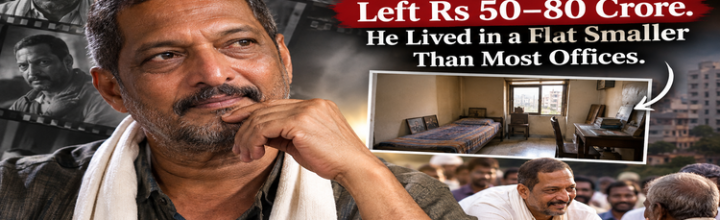
When news broke on 8 October that Nana Patekar had died at 75, many Indians searched for one thing: how much money he left behind. The estimates range from Rs 50 crore to Rs 80 crore. These are media guesses, not audited numbers. But the way he held that money is the real story.
A Boy Who Started at 13
He was born Vishwanath Patekar on 1 January 1951 in Murud-Janjira, Maharashtra. His father’s business collapsed when he was about 13. School did not stop, but work started. He painted film posters for Rs 35 a month and one meal. He later said he turned 30 very early in life.
At 28, he lost his father. Soon after, his first son, Durvasa, died at about two and a half years old. Few people reach fame after losses like these.
The Flat That Never Changed
His film fee reached Rs 2–3 crore. Yet he spent most of his life in a 750 sq ft one-bedroom flat in Andheri, Mumbai. He bought it decades ago for about Rs 1.1 lakh. Today it is worth nearly Rs 3 crore.
He lived there with his mother. After she passed away, he stayed on alone. Most stars in his position would have moved to a sea-facing bungalow. He did not.
Land, Not Luxury
His largest asset was a 27-acre farmhouse at Khadakwasla near Pune, with seven rooms and plain interiors. He also had a home in Goa and a property on Law College Road in Pune. For a man with his income, this was a small list.
His state funeral reportedly took place at the Khadakwasla farmhouse. It was a quiet end in the place he loved most.
Where the Money Went
In 2015, Maharashtra faced a severe drought, and farmer suicides rose. Patekar and actor Makarand Anaspure started the Naam Foundation in Pune. The first help was a cheque of Rs 15,000 for the family of each farmer who had died. Later, the foundation gave larger amounts to thousands of families.
The work then grew. Naam built houses, a residential school in Beed district, and gave ambulances and medical equipment. When a fire destroyed 16 homes near Khadakwasla dam, the foundation rebuilt all 16 in two months.
Reports say he gave award money and part of his film earnings to this cause, often without publicity. This is likely why his net worth stayed lower than his fame suggested.
The Work That Remains
His acting career began in 1978 with Gaman and lasted almost five decades. Parinda, Krantiveer, Prahaar, Apaharan and Welcome showed his range, from rage to comedy. He won three National Film Awards and received the Padma Shri in 2013. His last film role was a police officer in O’Romeo. Days before he died, he spoke at a theatre event in Goa about keeping the performing arts alive.
The Last Night
Early on Thursday, he sent a message to a friend saying he felt unwell. The friend rushed over and found him unconscious. He was taken to Manipal Hospital in Dona Paula. Doctors tried to revive him for 45 minutes, but he could not be saved. He is survived by his son, Malhar, and his wife, Neelkanti.
What He Leaves Behind
Net worth is a number on a list. His life shows what that number was for. A boy who once worked for one meal a day became rich, then chose a small flat, a farm, and a foundation for farmers.
India will remember his dialogues and his anger on screen. But the better lesson is simpler. He knew what money could not buy, and he spent the rest of it on people who needed help.
Comments

Hi, I’m Nishanth Muraleedharan (also known as Nishani)—an IT engineer turned internet entrepreneur with 25+ years in the textile industry. As the Founder & CEO of "DMZ International Imports & Exports" and President & Chairperson of the "Save Handloom Foundation", I’m committed to reviving India’s handloom heritage by empowering artisans through sustainable practices and advanced technologies like Blockchain, AI, AR & VR. I write what I love to read—thought-provoking, purposeful, and rooted in impact. nishani.in is not just a blog — it's a mark, a sign, a symbol, an impression of the naked truth. Like what you read? Buy me a chai and keep the ideas brewing. ☕💭 For advertising on any of our platforms, WhatsApp me on : +91-91-0950-0950 or email me @ support@dmzinternational.com