
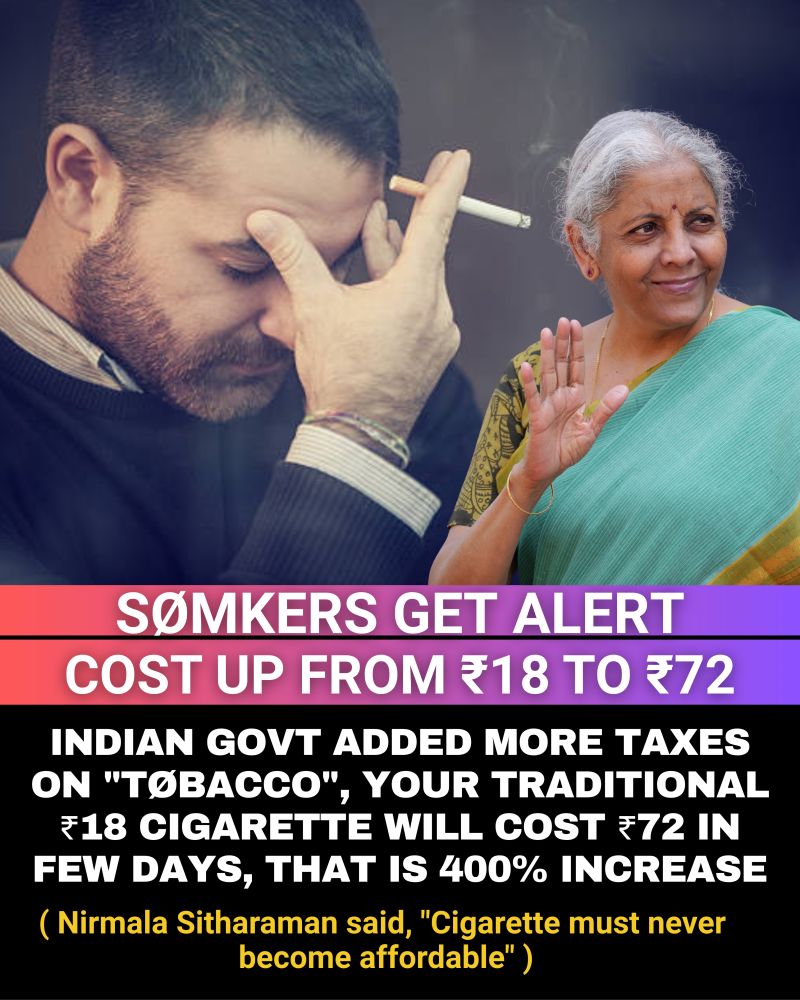
Smoking in India Is About to Get Shockingly Expensive — And This Time, It’s No Accident
For decades, India was the “cheap heaven” for smokers. While Europe, the UK, Australia, and Canada were burning wallets with sky-high cigarette prices, India stayed comfortably in the “affordable addiction” zone.
But that era?
Over. Finished. Buried.
The government has now taken the one step smokers were praying would never happen — rewriting the entire tobacco taxation system so that every single cigarette becomes dramatically more expensive.
And the timing, the scale, and the design of this move shows one thing clearly:
This was always the plan.
India is now joining the “high-price club” of countries that make smoking nearly unaffordable.
Let’s break down the truth without sugarcoating it.
What Exactly Changed?
Parliament passed the Central Excise (Amendment) Bill, 2025. It replaces the old tax system with a brand-new, permanent, brutal one.
Here’s the killer punch:
Old excise duty on cigarettes:
₹200 to ₹735 per 1,000 sticks
That’s basically 20 paise to 73 paise per cigarette.
Cheap enough to not hurt anyone’s business.
New excise duty on cigarettes:
₹2,700 to ₹11,000 per 1,000 sticks
That’s ₹2.70 to ₹11.00 per cigarette in tax alone.
Read that again.
A jump of 10X to 40X.
This is not a “price correction.”
This is not “inflation adjustment.”
This is design.
The message is loud: India doesn’t want cigarettes to be affordable anymore.
So What Will Packs Actually Cost?
Smokers want the real numbers, not government speeches.
Here are the realistic projections:
Gold Flake Kings (20 sticks)
Current market average: around ₹330–₹350
After the new excise:
- Low increase scenario → +₹54 per pack
- High increase scenario → +₹220 per pack
Expected future price: ₹390 to ₹560 per pack
Yes — half a thousand rupees for Gold Flake Kings.
Let that sink in.
Gold Flake Small / 10-pack
Current price: ₹100–₹170
After excise:
- Low scenario → +₹27
- High scenario → +₹110
Expected future price: ₹130 to ₹280
Your “small pack” will no longer feel small.
Why Is India Doing This?
Government reasons (official and political):
- Reduce tobacco consumption
- Improve public health
- Make smoking unaffordable
- Align India with global anti-tobacco tax models
- Replace the now-expiring compensation cess system
- Keep government revenue high without raising GST
But reading between the lines:
India is pushing smoking into the luxury category.
You may smoke — but you’ll pay for it.
How Cigarette Companies Will React
This is the fun part.
The tobacco giants — ITC, Godfrey Phillips, VST — have only one real option:
Increase prices. Immediately. Aggressively.
No company will absorb even 10% of this tax hike.
Margins are sacred. Smokers will pay, or quit.
Expect:
- Across-the-board MRP updates
- Premium brands increasing first
- Smaller brands trying to look “affordable” for a few weeks
- 10-stick packs becoming the new battlefield
- Retailers struggling with stock confusion
Whenever ITC raises prices, the whole industry follows within days.
This will be no different.
How Smokers Will React (Brace for Reality)
1. Stockpiling
Whenever smokers smell a big hike, they buy cartons like the apocalypse is tomorrow. Expect that again — fast.
2. Switching to smaller packs
Even if per-stick price is higher, small packs “feel” cheaper.
3. Downshifting brands
From premium → mid-range → cheap → beedis.
4. Smuggling and illicit cigarettes booming
Whenever prices jump this sharply, the black market celebrates.
5. More people wanting to quit
Wanting… but actually quitting is a different story.
What Will Beedis Cost?
Here’s the plot twist:
Beedis are barely touched by the tax hike.
Why?
Because the beedi industry employs millions and sits on a political volcano.
So while cigarette smokers suffer, beedi users escape.
This creates a strange reality:
- King-size cigarettes may cost ₹500 a pack
- But beedis remain dirt cheap
Guess where the poor and lower middle class will shift?
Is India About to Match Foreign Prices?
Not fully — but closer than ever.
Countries like the UK or Australia charge insane prices (₹2,000–₹3,000 per pack equivalents). India won’t go that far yet.
But this new tax structure puts India firmly on the path where:
- Smoking becomes a premium habit
- Low-income smokers are priced out
- Youth find it too expensive to get hooked
- The government earns massive revenue while claiming public health benefits
The strategy is clear:
Slowly but surely kill cigarette affordability.
The Hidden Truth No One Is Saying Out Loud
This is not a one-time shock.
This is Phase 1.
Once you redesign the tax framework, raising taxes becomes easy — just tweak a number.
Expect follow-up hikes every year.
India may soon reach:
- ₹400–₹600 for Gold Flake Kings
- ₹500–₹700 for Classic/Dunhill
- ₹200+ for small packs
- ₹50–₹100 per stick in premium lounges
Yes, a cigarette could become more expensive than a chai + samosa.
So, Is This Good or Bad?
Depends on who you ask.
For the government:
Great — more revenue, more control, better public-health optics.
For public health:
Higher taxes = fewer new smokers. Good.
For cigarette companies:
Short-term chaos, long-term stability (they pass the cost anyway).
For smokers:
A direct attack on the wallet.
Smoking will soon be a luxury addiction, not a common habit.
For illegal sellers:
Golden days ahead — demand for cheap “no-tax” cigarettes will explode.
Final Take:
India has fired its biggest shot yet in the war against affordable smoking.
And unlike earlier tax increases, this one is structural. Permanent. Deliberate.
Cigarette prices are no longer just increasing —
they’re being redesigned to hurt.
If you’re a smoker, this is the financial storm you never wanted to see.
If you’re trying to quit, this might be your best push ever.
If you’re a policymaker, this is your victory lap.
If you’re a seller, brace for chaos.
One thing is absolutely certain:
Smoking in India will never be the same again.
Comments

Hi, I’m Nishanth Muraleedharan (also known as Nishani)—an IT engineer turned internet entrepreneur with 25+ years in the textile industry. As the Founder & CEO of "DMZ International Imports & Exports" and President & Chairperson of the "Save Handloom Foundation", I’m committed to reviving India’s handloom heritage by empowering artisans through sustainable practices and advanced technologies like Blockchain, AI, AR & VR. I write what I love to read—thought-provoking, purposeful, and rooted in impact. nishani.in is not just a blog — it's a mark, a sign, a symbol, an impression of the naked truth. Like what you read? Buy me a chai and keep the ideas brewing. ☕💭 For advertising on any of our platforms, WhatsApp me on : +91-91-0950-0950 or email me @ support@dmzinternational.com