From PayPal to a $1.77 Trillion Rocket: Is Elon Musk Quietly Building an Empire Over the Universe?
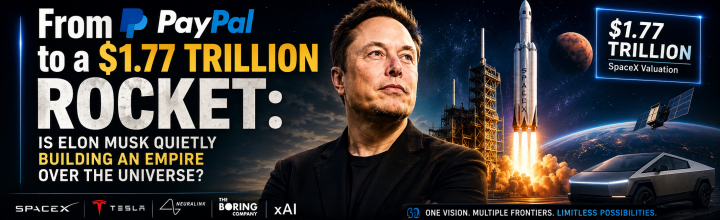
This week, SpaceX went public. The shares were priced at $135 each, the company was valued at around $1.77 trillion, and the offering raised roughly $75 billion. It is the largest stock market debut in history. That single sentence is bigger than the entire IPO that made Saudi Aramco famous in 2019.
But the number is not the real story. The real story is the man, and a pattern that has been running for more than twenty years.
He always works a decade ahead
Go back to October 2002. eBay bought PayPal for $1.5 billion in stock. Elon Musk was the largest single shareholder, holding about 11.7% of the company. His share came to roughly $165 to $175 million before tax. He was barely past thirty years old. For most people, that is the finish line. You take the money, you buy a house, you relax, and you tell the story for the rest of your life.
Musk did the opposite. He took that cash and pushed almost all of it back into two ideas that sounded mad at the time. He founded SpaceX in 2002, the same year PayPal was sold. Soon after he put money into Tesla and took control of it. Two new bets, both in industries known for burning founders to ash: rockets and cars.
There is a famous detail from those early years. During the hardest stretches of building Tesla and SpaceX, Musk has said he slept on the factory floor. Not for a photo. Because he had no time to go home, and because both companies were close to running out of money. He nearly went broke in 2008, holding two companies that the smart money said would both fail.
This is the first part of the pattern. He does not protect his winnings. He converts them into the next, bigger risk.
The risk-taking never stopped
That habit never left him. Every win became fuel for a larger gamble, right up to this week.
Look at Tesla. People laughed at it for years. Electric cars were treated as a rich man’s toy. Self-driving was called a fantasy. Today Tesla is worth around $1.6 trillion, it sells in markets across the world, and its self-driving software keeps improving. Even the batteries became a second business. The same battery technology that runs the cars now runs Tesla’s Megapack systems, the giant batteries used to store power for the electricity grid. One bet quietly grew into two.
That is the second part of the pattern. Nothing he builds stays single-purpose. A car company becomes an energy company. A rocket company becomes an internet company through Starlink. Each piece feeds the next.
The Twitter deal looked like a mistake
Then came the part many people called his big blunder. In 2022, Musk bought Twitter for about $44 billion. He clearly overpaid, and the deal loaded the company with roughly $12 billion in debt. Advertisers left. The value fell hard. At one point a major investor had marked its stake down by nearly 80%. By every normal measure, it was a loss.
Here is where the pattern showed its teeth again.
In March 2025, Musk merged Twitter, by then renamed X, into his AI company xAI. The deal was all-stock. It valued xAI at $80 billion and X at $33 billion, which is $45 billion minus that $12 billion of debt. In simple words: he sold the troubled social media company to himself, by folding it inside his AI startup.
This was not just an accounting trick, though it was partly that. X gave xAI something money cannot easily buy: a live stream of real-time human conversation from hundreds of millions of users, perfect for training an AI model. He turned a falling asset into raw material for the next bet. One private company swallowing another to cover and convert the damage. That is exactly the move he has made his whole career.
Grok is the weak link, but even here he found an edge
Be honest about where it has not worked. xAI’s chatbot, Grok, is not winning. OpenAI, Google, and Anthropic do not really treat it as a top rival. In the race for the best AI model, Grok is behind.
But even in a weaker position, Musk found a structural advantage. He builds his own data centers and stitches his companies together to supply each other. xAI buys Tesla Megapacks to power and stabilize its data centers. Tesla sold hundreds of millions of dollars of those batteries to xAI. So even where the product is losing, the system around it is undercutting rivals on the one thing that decides the AI race: the cost of compute and power. When everyone else is renting, owning the whole chain is a real weapon.
Google and Anthropic collectively pay Elon Musk‘s SpaceX/xAI over $2.17 billion per month for access to massive AI data center compute capacity. Google contributes $920 million monthly for 110,000 Nvidia GPUs, while Anthropic pays $1.25 billion monthly to utilize the Colossus 1 data center. These substantial monthly rental agreements underscore the high demand for infrastructure to power advanced AI models.
And now, space itself
Which brings us to this week’s IPO. In February 2026, Musk merged SpaceX and xAI into one entity, valued at around $1.25 trillion at the time. The company that just listed is that combined machine: rockets, satellites, and AI under one roof.
And the vision he is selling investors is pure Musk, ten years ahead again. He talks about putting data centers in space, powered directly by the sun with no clouds and no night, and cooled by the natural cold of space instead of huge cooling plants on Earth. He talks about mining metals from asteroids. He talks about a city on Mars. To most CEOs this would sound like science fiction. From him, after rockets that land themselves and a global satellite internet, investors are no longer laughing. The IPO was heavily oversubscribed and crossed a $1.7 trillion valuation.
Now join the dots
Here is where it gets uncomfortable. Take each venture as a single dot, then draw the line between them.
PayPal gave him money. Tesla gave him batteries and self-driving software. X gave him real-time human data. xAI gave him the brain. SpaceX gave him rockets, satellites, and now a path off the planet. Starlink wraps the Earth in his own internet. Each one looks like a separate business. But every dot connects to the next, and money, data, power, and parts flow between them in a closed loop he alone controls.
Look at the line that forms once the dots are filled in. Energy on Earth. Communication around the Earth. Intelligence to run it all. Transport to leave the Earth. Mining beyond the Earth. A city on another planet at the far end. This is not a portfolio of companies. It is a single supply chain that starts in a factory in Texas and points straight out into space.
So ask the honest question. Once the dots are joined, does it not look like one man is positioning himself to dominate not just markets, but the next frontier of the universe itself?
Maybe that is too dramatic. Maybe it is just a restless engineer chasing the next hard problem. But consider the facts plainly. He controls the rockets, the satellites, the cars, the grid batteries, the social network, and the AI, all wired together, all pointed at the same far horizon. No government, no other company, holds that full stack. He does.
The man who slept on a factory floor in 2008 just rang the largest IPO bell in history. The risk-taking that started with a $165 million cheque in 2002 has not cooled by even one degree. And the target is no longer a richer company or a bigger market. The target is space.
We should watch this carefully. Patterns this consistent are never an accident. And when one person quietly assembles every piece needed to live and work beyond Earth, the right question is no longer whether he can dominate a market. It is whether anyone is positioned to share the universe with him.
SpaceX is being built one dot at a time, a rocket here, a satellite there, slowly assembling into something the size of a small universe. But a universe this big invites hard questions, and three of them matter most. How can a company that posted a loss still be worth $1.75 trillion? What is the surprisingly small number that quietly holds the whole structure up? And what are the real cracks, not the imagined ones, that could bring it down?
Why does a company with a $4.9 billion loss still command a $1.75 trillion valuation?
The loss is real but misunderstood.
SpaceX did report a $4.9 billion net loss in 2025, yet in the same year it turned cash-flow positive and produced about $6.6 billion in adjusted earnings. The gap is the whole story: the loss is not money vanishing into a failing business, it is money poured back into Starship development and the newly acquired xAI, which counts against profit on paper but builds the next stage of the empire in practice. The valuation rests on one engine doing the heavy lifting, Starlink, which alone brought in $11.4 billion in revenue and $4.4 billion in operating profit. Investors are not paying $1.75 trillion for a loss-making rocket firm. They are paying it for a global broadband network already serving over 10 million customers across 160 countries, and betting it keeps compounding for a decade. The loss is a choice, not a wound.
What is the small monthly number that holds up this entire trillion-dollar structure?
It is not a share price. It is $81.
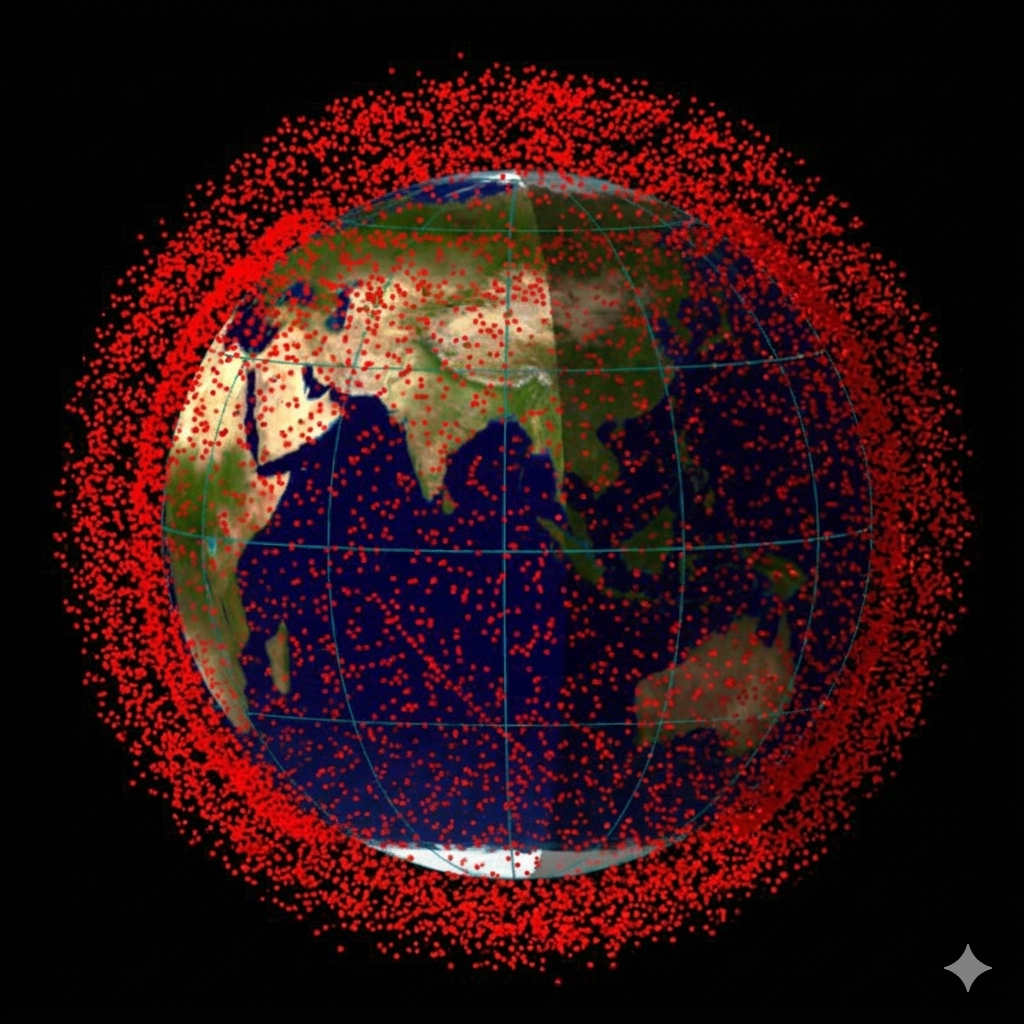
The red dots here are currently orbiting Starlink satellites.
That is the average monthly bill a Starlink subscriber pays, and almost the entire valuation traces back to it; multiply roughly $81 across more than 10 million paying customers, month after month, and you get the recurring river of cash that funds every grand vision attached to this company. The tension is that this number did not rise between 2023 and 2025, it fell 18 percent, as SpaceX traded price for volume to grab customers fast across the globe, which means the empire was leaning on a figure that shrank per user even as the user count exploded. In May 2026 the company reversed course and raised prices by up to $10 a month, a bet that customers will accept higher bills rather than leave, and that bet has not yet been tested at scale. A trillion-dollar empire resting on an $81 monthly invoice is not absurd, but it is fragile in a very specific way: the foundation is real, and also thin.
What are the genuine red flags that could turn this into the most expensive disappointment of the decade?
Three cracks sit underneath the story.
The first is concentration: this is not a diversified space empire but a satellite broadband company with a rocket cost advantage attached, since Starlink is 61 percent of revenue and effectively all of the profit, while the launch business grew only 8 percent in 2025 with nearly three-quarters of flights used internally for Starlink rather than paying customers, so if Starlink stumbles there is nothing big enough to catch the fall.
The second is the xAI acquisition, a cash-burning hole bolted on right before the listing, having burned about $9.5 billion in three quarters of 2025 against just $210 million in revenue.
The third is the price itself paired with competition closing in: the company is valued at well over 150 times earnings, a multiple that only works if Starlink compounds for years with almost no missteps, even as Amazon’s Kuiper, Blue Origin, and Eutelsat’s OneWeb deploy rival constellations and the next-generation Starship still has to prove it works.
None of this makes SpaceX a fraud. It means the price already assumes near-flawless execution in a business where perfection is rare.
So the universe SpaceX is building is real, and so is the money underneath it. But it stands on a narrow base: one broadband business, one small monthly bill, and a price that already assumes a decade of near-perfect execution. That is not a reason to dismiss it, and it is not the biggest bubble ever sold. It is a reminder that even the most dazzling empires rest on a few ordinary numbers, and those numbers are worth watching closely before you decide what the whole thing is truly worth.
Comments

Hi, I’m Nishanth Muraleedharan (also known as Nishani)—an IT engineer turned internet entrepreneur with 25+ years in the textile industry. As the Founder & CEO of "DMZ International Imports & Exports" and President & Chairperson of the "Save Handloom Foundation", I’m committed to reviving India’s handloom heritage by empowering artisans through sustainable practices and advanced technologies like Blockchain, AI, AR & VR. I write what I love to read—thought-provoking, purposeful, and rooted in impact. nishani.in is not just a blog — it's a mark, a sign, a symbol, an impression of the naked truth. Like what you read? Buy me a chai and keep the ideas brewing. ☕💭 For advertising on any of our platforms, WhatsApp me on : +91-91-0950-0950 or email me @ support@dmzinternational.com