
Your Brain Has Never Had a Fitness Tracker. Until Now?
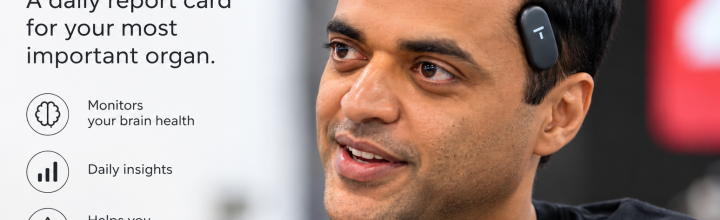
Your watch counts your steps. Your ring watches your sleep. But the most important organ in your body has had no daily report card.
Deepinder Goyal, the man behind Zomato, wants to change that. His new company, Temple, is about to open pre-orders for a small wearable that sits on the side of your head.
What is it?
Temple is a tiny sensor, about the size of a bean, worn near your temple. That is where the name comes from. It shines harmless infrared light through the skin and reads how light is absorbed. This gives a signal linked to blood flow and oxygen in the brain.
Temple calls its main reading BrainFlow. It is important to understand that BrainFlow is a stand-in for brain blood flow. It is not a direct measurement.
What does it do for a common person?
Think of it like a petrol gauge for your brain. A good night’s sleep, a hard workout, a stressful day or a calm meditation can each change how blood moves in your head. Temple wants to show you those changes as they happen. You could learn which habits help your brain and which do not.
It does not diagnose disease. It does not tell you that you have a brain problem. It shows trends, not verdicts.
Does the science hold up?
There is early evidence. In one study, 23 healthy adults cycled and changed posture. Temple’s readings matched an ultrasound method called transcranial Doppler with a correlation of about 0.8. In a second study, 44 healthy young men were tested against a stronger optical method. The match with brain blood volume was between 0.84 and 0.91, and it was weaker for scalp blood.
That last point matters. A device on the head can easily read the skin instead of the brain. Temple’s data suggests it mostly reads the brain.
Now the honest part. Both studies are preprints, which means other scientists have not yet reviewed them. The company shared them. All the participants were young men between 20 and 32. We do not know how it works for women, older people or people with illness. And a high match in a short test does not prove that the device can improve your health.
What will it cost?
Nothing is official. Media reports suggest ₹75,000 to ₹80,000, and some say up to ₹1 lakh. That is the price of a good laptop, for a device that tells you things you cannot yet act on. Temple has also reportedly said the price would include lifetime access to its software.
Who is it for?
At first, not for most of us. The company has described it as a wearable for elite athletes. The wider pitch is for people who like to measure and improve their health, such as busy professionals and fitness lovers. For a family earning an average Indian salary, this is a curiosity today.
How is it launching?
It is a limited launch edition in six colours. Goyal has said pre-orders may open soon and that devices will ship before the end of 2026. Plans for other countries have not been announced.
Is it the first of its kind?
No, and anyone who says so is wrong. Muse already sells a headband that combines brainwave sensing with light sensing for blood oxygen. Neurable and others sell brain-sensing products too. Kernel in the United States makes a full-head optical helmet, but it costs about $99,000 and is built for researchers.
So Temple is not the first brain wearable. Its claim is that it is much smaller and focused on blood flow. Whether that is better is for independent testing to prove.
The real question
India has a huge number of people with stress, poor sleep and rising lifestyle disease. Data about the brain could be valuable here. But data is useful only when it leads to action. If Temple tells you that your brain flow dropped, what do you do? Sleep more? Walk more? Without clear answers, it is an expensive mirror.
Still, someone has to try. Every great health device began as an odd idea that people doubted. The heart rate monitor did too.
Temple’s job now is not to excite us. It is to prove itself, in the hands of women and men, young and old, with results that other scientists can check.
Until then, enjoy the idea, but keep your wallet closed.
Because a device can show you your brain. Only you can decide what to do with what it shows.
Comments

Hi, I’m Nishanth Muraleedharan (also known as Nishani)—an IT engineer turned internet entrepreneur with 25+ years in the textile industry. As the Founder & CEO of "DMZ International Imports & Exports" and President & Chairperson of the "Save Handloom Foundation", I’m committed to reviving India’s handloom heritage by empowering artisans through sustainable practices and advanced technologies like Blockchain, AI, AR & VR. I write what I love to read—thought-provoking, purposeful, and rooted in impact. nishani.in is not just a blog — it's a mark, a sign, a symbol, an impression of the naked truth. Like what you read? Buy me a chai and keep the ideas brewing. ☕💭 For advertising on any of our platforms, WhatsApp me on : +91-91-0950-0950 or email me @ support@dmzinternational.com