
The Quiet Empire: How Kerala Built Half of Everyday Life in the Gulf
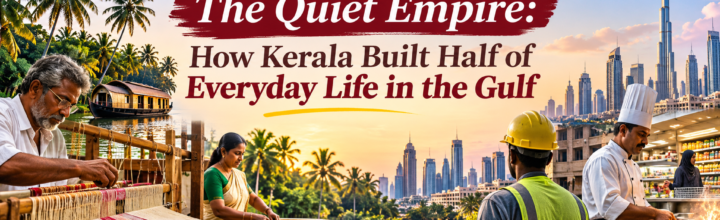
A family from Hyderabad lands in Dubai for a five-day holiday. They sleep in a tower built by a Kerala-born developer. Their daughter joins a day camp at a school brand started by a Kerala family. A stomach problem takes them to a hospital chain founded by a doctor from Malappuram. On the last evening, they buy a gold chain from a jeweller with roots in Thrissur.
They believe they spent money in Dubai. In truth, a large part of it began a long journey to a small green state on India’s south-west coast.
A Trade Older Than Oil
Malayalis did not discover the Gulf when oil was found. Kerala’s coast has traded with Arabia for more than two thousand years. Pepper sailed west, and Arab ships sailed east. When oil money arrived in the 1960s and 1970s, Kerala already had what the Gulf needed: people who knew the sea, the market and the language of trade.
Many early workers crossed the Arabian Sea in small wooden boats, often without proper papers. Some were never heard from again. Others became owners of whole industries.
The Names Behind the Signboards
Look at who owns the everyday Gulf.
M. A. Yusuff Ali, from Nattika in Thrissur, reached Abu Dhabi in 1973 and built Lulu Group, one of the biggest retail chains in the region. He is a Forbes-listed billionaire.
Ravi Pillai, from Kollam, built RP Group across construction, hotels and real estate in several Gulf countries. He is also on Forbes lists.
Joy Alukkas turned a Dubai jewellery store into a global brand with showrooms in many countries.
M. P. Ahammed started Malabar Gold in Kozhikode in 1993. It now has more than 400 showrooms across about 13 countries.
Dr. Azad Moopen began Aster with one clinic in Dubai in 1987. It is now a major healthcare group in the Gulf and India.
Dr. Shamsheer Vayalil built VPS Healthcare and Burjeel Holdings, which is listed on the Abu Dhabi stock exchange. He too is a Forbes-listed billionaire.
Sunny Varkey of GEMS Education grew a school started by his Kerala family in Dubai in 1959 into one of the world’s largest private school networks.
P. N. C. Menon founded Sobha, whose luxury towers now shape the Dubai skyline.
P. Mohamed Ali built Galfar, a major construction company in Oman, and received the Padma Shri from India.
Now think about it. Groceries, gold, hospitals, schools, homes and roads. One state of about 35 million people sits behind all of them.
What Most People Miss
The surprising part is not that they got rich. It is how they started. Many arrived with little money and no family name. They began as clerks, shop assistants, drivers and labourers. Their advantage was trust. In the Gulf, a Malayali was known for honest accounts and hard work. Trust turned small shops into chains.
The Money That Came Home
Kerala has less than 3 out of every 100 Indians. Yet in the RBI’s latest remittance survey, it received nearly one-fifth of all money sent home to India. Only Maharashtra received more.
About 2.2 million Keralites live abroad, most of them in the Gulf. A state migration survey estimated their yearly remittances at more than Rs 2 lakh crore. That is a very large share of the state’s own economy.
You can see this money on the ground. In the 2011 census, Kerala had over a million houses locked and empty. Many belong to families whose earners are working abroad. Each one is a story of a man who missed weddings, funerals and Onam, so that a roof could stand back home.
This is also why Kerala’s hospitals, schools and small-town banks look different from those in many richer-looking states. Gulf wages paid for fees, surgeries and education, one generation at a time.
A Different Idea of Being Rich
India often measures wealth by display: the biggest car, the tallest tower, the loudest wedding. The Kerala model works the other way. The most valuable asset is not the thing you show. It is the thing you own quietly, and the family you lift.
That is why a Malayali billionaire can walk through his own mall without anyone knowing who he is. His real pride is not in Dubai. It is in a village home, a school fee paid on time, and a cousin who got a job.
The Lesson for the Rest of India
For decades, India’s talent was told to leave and not come back. Kerala did something smarter. It sent its people out, taught them to build there, and made the money return home.
The next time you walk into a mall in Dubai, Abu Dhabi or Muscat, do not just look at the brands. Look at who stands behind them.
Wealth you show can be copied. Wealth you build, and send home, becomes a legacy.
Comments

Hi, I’m Nishanth Muraleedharan (Nishani)—an IT engineer turned internet entrepreneur with 25+ years of experience in the textile industry. As the Founder of "DMZ International Imports & Exports Pvt ltd" ( Handlooom.com) and President & Chairperson of the "Save Handloom Foundation" (DesiFusions.com), I’m committed to reviving India’s handloom heritage by empowering artisans through sustainable practices and advanced technologies like Blockchain, AI, AR & VR. I write what I love to read—thought-provoking, purposeful, and rooted in impact. nishani.in is not just a blog — it's a mark, a sign, a symbol, an impression of the naked truth. Like what you read? Buy me a chai and keep the ideas brewing. ☕💭 For advertising on any of our platforms, WhatsApp me on : +91-91-0950-0950 or email me @ nishani@nishani.in