
Behaviour Is a Costume. Character Is the Body Under It
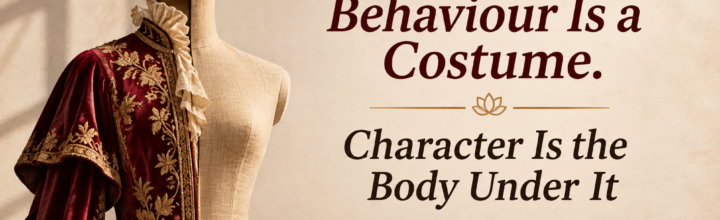
Every person you meet shows you one version of themselves. Very few show you the real one. To know a person, you must look at three different things: behaviour, character and moral. Most people use these words as if they mean the same. They do not. The gap between them explains why some smiling people hurt us, and why some rude people help us when nobody else will.
Behaviour: The Part You Can Perform
Behaviour is what you show when someone is watching. It can be learned in a few weeks. Speak softly, say thank you, smile at the right time. Many training centres in India earn their money by teaching only this.
That is why behaviour is temporary. A newly married person is patient, helpful and gentle. Almost everyone behaves well when a relationship is new, or when they want something. The real test comes in the second year and the fifth year, when the effort feels heavy. A person who was kind only because kindness was needed will slowly show a different face. That face was always there. It was only waiting.
Character: What Remains When the Performance Ends
Character is what you do again and again, without an audience, even when it costs you. Time is its only honest examiner. Money, power, tiredness, anger and fear take off the costume. Nobody can fake character under all five for long.
Here is a fact that surprises many people: a person can have excellent behaviour and weak character at the same time. In 2009, Ramalinga Raju, founder of Satyam Computer Services, confessed that the company’s accounts were inflated by about ₹7,000 crore. For years he was praised as a polite, well-spoken leader. His manners were never questioned. His character was.
The opposite is also true. Think of an auto driver who speaks bluntly and has no patience for small talk, yet returns a forgotten bag with all the cash inside. Such stories appear in Indian newspapers every month. They teach one lesson: rough speech does not prove a bad person, and soft speech does not prove a good one.
Moral: The Line You Do Not Cross
Moral is your inner belief about right and wrong, and it holds even when no rule forces it. Law stops you when a policeman is near. Moral stops you when nobody is near.
That is why moral cannot be bought. A rich person can buy a lawyer, a tutor, a house and even a good reputation. He cannot buy a conscience. Either you carry it or you do not.
In 1956, after a series of railway accidents, Lal Bahadur Shastri, then India’s Railway Minister, offered to resign and finally did so, taking responsibility for events he had not caused with his own hands. No law forced him. His moral did.
The most dangerous person is not the one with bad behaviour. It is the one with no inner line. For such a person, a rule is only a wall to walk around, and a human being is only a tool. These people are often charming, because charm is also a tool.
When Success Hides the Gap
In November 2026, the world watched Jensen Huang, one of the most admired technology leaders, step down as Nvidia’s CEO after reports of extramarital relationships, some involving company employees. Reports say he apologised to his wife and children and admitted to one affair. The other allegations are unproven, and later reports say he returned to his role.
Whatever the final facts are, the pattern is worth learning. Skill, wealth and public praise do not answer the question of private character. Many employees reportedly wanted him back, because people often confuse a leader’s results with a leader’s character. A skill is not a value.
Two Views, One Test
From a man’s view, power and praise slowly teach a person that rules are for others. Each small secret feels harmless. Then the secret becomes a habit. A man’s character is tested most when he is most admired.
From a woman’s view, she is often the one who pays. The wife may learn the truth in public. A colleague may be in a relationship where she cannot freely say no, because the other person controls her career. A relationship between unequal people is never fully free.
Character has no gender, and men and women both fail and pass this test. The question is the same for everyone: what did you do with the trust you were given?
How to Identify the Real Person
- Watch how they treat people who cannot help them: the waiter, the driver, the house helper.
- Listen to how they speak about people who are absent.
- See how they react when they lose, or when they are corrected.
- Check whether small promises are kept. Big promises are easy.
- Give it time. Behaviour fades, and character repeats.
Behaviour only: polite to the powerful and rude to the weak, charming but secretive, blames others, apologises with words but not with change.
Real character: the same person in public and in private, admits mistakes without being forced, accepts a loss for doing right.
No moral: says “everybody does it”, feels no discomfort after a wrong act, applies rules to others but never to themselves.
The Question for Tonight
Ask yourself three things. Do I treat my spouse, parents and staff as well in the fifth year as in the first? Do I do the right thing when it costs me money? If nobody ever found out, would my choice be the same?
Behaviour makes people like you. Character makes people trust you. Moral decides whether you deserve both.
Comments

Hi, I’m Nishanth Muraleedharan (Nishani)—an IT engineer turned internet entrepreneur with 25+ years of experience in the textile industry. As the Founder of "DMZ International Imports & Exports Pvt ltd" ( Handlooom.com) and President & Chairperson of the "Save Handloom Foundation" (DesiFusions.com), I’m committed to reviving India’s handloom heritage by empowering artisans through sustainable practices and advanced technologies like Blockchain, AI, AR & VR. I write what I love to read—thought-provoking, purposeful, and rooted in impact. nishani.in is not just a blog — it's a mark, a sign, a symbol, an impression of the naked truth. Like what you read? Buy me a chai and keep the ideas brewing. ☕💭 For advertising on any of our platforms, WhatsApp me on : +91-91-0950-0950 or email me @ nishani@nishani.in