
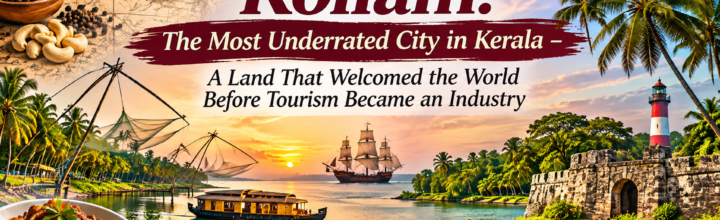
Kollam: The Most Underrated City in Kerala – A Land That Welcomed the World Before Tourism Became an Industry
But mention Kollam, and how many people immediately recognise what this extraordinary place has to offer?
That is perhaps the greatest irony of Kerala tourism. Kollam, arguably one of the most geographically diverse, historically significant and culturally fascinating destinations in the state, remains surprisingly underrated.
And the question is not whether Kollam has enough attractions. The real question is: How did a place that once attracted the world become a place that Kerala itself rarely promotes enough?
A city that traded with the world centuries ago
Long before international airports, luxury resorts and tourism campaigns existed, Kollam was already welcoming foreigners through its natural harbour at Neendakara.
Known historically as Quilon and Desinganadu, Kollam had commercial connections with ancient Roman and Phoenician traders. Chinese, Arab and European merchants subsequently frequented its shores.
Travellers such as Marco Polo and Ibn Battuta recorded references to this remarkable trading centre. Spices, pepper, cinnamon, ginger, coconut products and other commodities travelled from its shores to distant markets.
Between the 9th and 12th centuries, Kollam was also the capital of the Venad kingdom.
Here is another fascinating historical fact: the Malayalam calendar, Kollavarsham, began in 825 CE, with its origin associated with a royal decision taken at Kollam.
Think about that. A city that helped shape Kerala’s commercial history also gave the state its calendar tradition.
The city that put Indian cashews on the global map
If there is one industry that deserves to be inseparably associated with Kollam, it is cashew.
Kollam earned the reputation of being the Cashew Capital of the World. Its commercial cashew processing industry developed during the early twentieth century, and the first recorded Indian cashew export shipment from Kollam went to the United States in 1920.
From there, Kollam’s cashew kernels found markets across the USA, UK, Netherlands, UAE, France, Canada, Italy, Saudi Arabia, Singapore and Japan.
Behind this global industry were thousands of workers, particularly women, whose hands peeled, graded and processed cashews for international markets.
But there is a painful side to this achievement. The industry has suffered a considerable decline because of international competition, reduced local cultivation and structural challenges. Kollam deserves an industrial revival that protects the livelihoods and legacy of its workers.
Geography gave Kollam almost everything
What makes Kollam extraordinary is its diversity of landscapes.
It has the Arabian Sea, beautiful beaches, extensive backwaters, freshwater lakes, rivers, islands, forests, mountains and waterfalls.
Consider what visitors can experience:
- Ashtamudi Lake: One of Kerala’s most beautiful backwater destinations, famous for its eight-armed waterway system and houseboat experiences.
- Munroe Island: A breathtaking network of islands, narrow canals, coconut groves, village life and canoe journeys.
- Thenmala: India’s first planned eco-tourism destination, offering forest trails, adventure activities, butterfly parks and reservoir experiences.
- Palaruvi Waterfalls: A spectacular waterfall surrounded by lush greenery.
- Kumbhavurutty Waterfalls: Another beautiful natural attraction in the forest landscape.
- Shenduruny Wildlife Sanctuary: A treasure for wildlife enthusiasts and nature lovers.
- Sasthamcotta Lake: Kerala’s largest freshwater lake.
- Paravur Lake: A beautiful combination of lake, waterways and coastal landscapes.
- Thirumullavaram Beach: A peaceful coastal destination.
- Thangassery: Historic lighthouse, colonial architecture and remnants of Portuguese and Dutch influence.
- Jatayu Earth’s Centre, Chadayamangalam: A remarkable destination combining mythology, adventure, architecture and tourism.
- Punalur Suspension Bridge: A fascinating nineteenth-century engineering landmark.
- Krishnapuram Palace: A beautiful heritage destination known for its architecture and traditional murals.
Where else in Kerala can someone experience the sea, backwaters, freshwater lakes, waterfalls, wildlife, mountains and centuries-old heritage within one district?
Kollam is practically a miniature version of Kerala.
Jatayu: When mythology meets modern tourism
The recent release of Ramayana: Part 1 has brought renewed attention to Jatayupara in Chadayamangalam.
According to local tradition, this is where Jatayu fell after fighting Ravana while attempting to rescue Sita.
The Jatayu sculpture, conceptualised and created by Rajiv Anchal, is an extraordinary monument perched on a massive rock formation.
Beyond its mythology, the destination offers a museum, adventure activities, trekking and spectacular views.
The renewed interest following the film is an opportunity for Kollam. But Jatayu should not be promoted as an isolated attraction. It should become the gateway to a larger Kollam tourism experience.
And then comes Kollam’s food!
Kollam has a culinary identity that deserves far greater recognition.
It is particularly known among food lovers for its mutton preparations. Its mutton curry, mutton roast, pepper-rich meat dishes and traditional preparations have a loyal following. Seafood is another major attraction, with fresh fish, prawns and other coastal delicacies.
And then there is Kerala Sadya.
The traditional Kerala Sadya, with its extraordinary variety of curries, pickles, vegetables, payasams and accompaniments, represents one of the state’s greatest culinary traditions. Elaborate Sadyas can feature dozens of preparations, even appearing in luxury hotel dining experiences.
Imagine promoting Kollam as a destination where visitors can experience traditional Sadya, distinctive mutton dishes, coastal seafood and authentic village food.
Tourism is not only about seeing beautiful places. It is also about tasting the identity of a place.
So, why is Kollam still underrated?
There are several reasons.
1. Lack of a powerful tourism identity: Munnar is marketed as a hill destination, Alleppey as a houseboat destination and Wayanad as an adventure destination. Kollam has everything, but its identity is not communicated through one compelling tourism story.
2. Insufficient national promotion: Kollam’s attractions rarely receive the same sustained national marketing attention as Kerala’s better-known destinations.
3. Attractions are marketed separately: Munroe Island, Thenmala, Jatayu, Ashtamudi and Palaruvi are often treated as individual destinations rather than parts of one integrated tourism circuit.
4. Underdeveloped tourism experiences: More quality accommodation, guided experiences, waterfront restaurants, heritage walks, transport connections and professionally managed tourism packages could make a significant difference.
5. Its industrial identity overshadows its tourism potential: People associate Kollam with cashews, fishing, coir and trade. They often overlook its extraordinary natural and cultural wealth.
Kollam deserves more than a passing mention
Kerala often proudly calls itself God’s Own Country. But perhaps we should ask whether we have given every part of God’s Own Country the attention it deserves.
Kollam has history that goes back centuries, a maritime legacy that connected continents, an internationally recognised cashew heritage, breathtaking water bodies, forests, waterfalls, beaches, mythology, architecture and an extraordinary food culture.
It does not need to become another Alleppey or another Munnar.
It needs to become Kollam.
Imagine a properly planned three-to-five-day Kollam tourism circuit combining heritage, backwaters, islands, waterfalls, wildlife, beaches, Jatayu and local cuisine. It could become one of Kerala’s most compelling domestic tourism products.
Perhaps the biggest tragedy is that foreign merchants discovered Kollam centuries ago, but millions of Indian travellers are yet to discover it properly.
A place that once welcomed the world through its harbour should not have to wait for the world to rediscover it.
Kollam is not short of beauty, history or experiences. It is short of the recognition, storytelling and tourism vision it deserves.
And perhaps it is time Kerala gave its most underrated treasure the attention it has earned over a thousand years.
Comments

Hi, I’m Nishanth Muraleedharan (Nishani)—an IT engineer turned internet entrepreneur with 25+ years of experience in the textile industry. As the Founder of "DMZ International Imports & Exports Pvt ltd" ( Handlooom.com) and President & Chairperson of the "Save Handloom Foundation" (DesiFusions.com), I’m committed to reviving India’s handloom heritage by empowering artisans through sustainable practices and advanced technologies like Blockchain, AI, AR & VR. I write what I love to read—thought-provoking, purposeful, and rooted in impact. nishani.in is not just a blog — it's a mark, a sign, a symbol, an impression of the naked truth. Like what you read? Buy me a chai and keep the ideas brewing. ☕💭 For advertising on any of our platforms, WhatsApp me on : +91-91-0950-0950 or email me @ nishani@nishani.in