A Poor Man’s Peace Comes With a Price. A Rich Man Can Afford to Cry in Comfort.
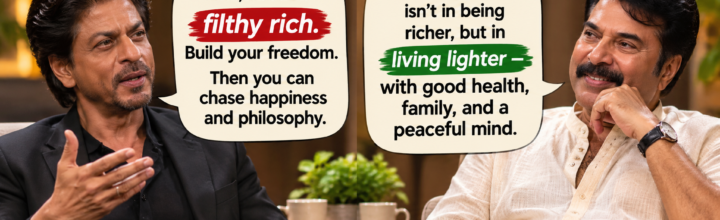
There is a sentence that sounds philosophical but becomes rather uncomfortable when examined closely: Money cannot buy happiness.
It is repeated at dinner tables, in motivational speeches, in spiritual gatherings and across social media. But there is one question that rarely follows it.
Have the people repeating this sentence ever experienced what it means to have no money when money is desperately needed?
Consider two people experiencing the same miserable day.
One is cycling home through torrential rain. His clothes are soaked, his groceries are getting wet, his bicycle has a puncture, and he has no money left for an auto-rickshaw. He is worried about tomorrow’s electricity bill and wondering how to pay his child’s school fees.
A few metres away, another person is sitting inside a Rolls-Royce, watching the same rain through insulated glass. He has just suffered a business loss worth several crores. He is equally unhappy.
Both are crying about life.
But whose suffering would most people prefer?
The billionaire’s, perhaps?
At least he is crying in a climate-controlled cabin, with a driver, financial reserves and the ability to make tomorrow considerably easier.
If life insists on giving someone problems, having money to face those problems is infinitely better than facing them empty-handed.
Poverty has a hidden tax that wealthy people rarely pay
Poverty is not simply the absence of money. It is the additional cost of almost everything.
A wealthy family can purchase health insurance, seek treatment early, afford nutritious food and arrange emergency transport. A financially struggling family may postpone a medical consultation because even the consultation fee is a problem.
A person with savings can leave an unhealthy workplace. Someone living from salary to salary may tolerate humiliation because losing that salary could mean losing the roof over the family’s head.
A wealthy parent can arrange educational opportunities for a child. A struggling parent might have to choose between paying school fees and purchasing medicines for an elderly parent.
Both parents love their children equally. Their financial circumstances, however, give them very different choices.
And that is the cruelty of poverty: It does not merely take away luxuries. Sometimes it takes away options.
India: Where a medical emergency can become a financial emergency
India offers a particularly striking example.
According to World Bank data using the WHO’s Universal Health Coverage dataset, 22.3% of India’s population faced impoverishing out-of-pocket healthcare expenditure in 2022, under the relevant international measure.
Think about what that means. A medical emergency can do more than threaten someone’s health. It can threaten the family’s entire financial existence.
There has been progress. India’s National Health Accounts for 2023–24 reported that household out-of-pocket spending fell from 64.2% of total health expenditure in 2013–14 to 42.7%.
But the remaining burden is substantial.
For a family without savings, even a hospital bill that appears manageable to someone earning well can become a financial catastrophe.
The difference between having money and not having it can sometimes be the difference between treating an illness immediately and watching it become worse.
Kerala: Education, migration and the uncomfortable economics of survival
Kerala presents another fascinating contradiction.
It has impressive achievements in education, healthcare and social development. Yet financial security remains an important concern for many households.
A 2026 Kerala fiscal status report highlights that more than 2.2 million Keralites live and work abroad. It also estimates remittances at around 23.2% of the state’s Net State Domestic Product.
Why do so many people travel thousands of kilometres away from their families?
Not necessarily because they dislike Kerala. Many leave because better-paying employment and financial opportunities are available elsewhere.
A person may have an engineering degree, a postgraduate qualification and considerable professional ability, yet struggle to find suitable employment locally.
Education gives knowledge. Employment gives income. Income creates independence.
And independence gives people the ability to make decisions without constantly asking whether they can afford them.
This is why the romantic idea that contentment alone is sufficient deserves questioning.
A beautiful home state is wonderful. But when someone has to leave their parents, spouse and children to earn a living, the economics of survival becomes more powerful than the comfort of belonging.
Is the world any different?
Interestingly, international research does not support the simplistic argument that money is irrelevant to happiness.
A landmark study by Nobel Prize-winning economist Daniel Kahneman and Angus Deaton, published in 2010, found that income was strongly associated with people’s evaluation of their lives. It also found that low income intensified the emotional pain associated with misfortune.
Subsequent research published in PNAS Nexus in 2022 found that the relationship between income and happiness can become stronger in societies with greater income inequality.
In other words, money can matter even more when the difference between what people possess is enormous.
There is, however, an important distinction.
Money can purchase better healthcare, safer housing, comfortable travel, quality education, domestic help, leisure and financial independence.
It cannot guarantee a loving marriage, genuine friendships, good health, loyal children or freedom from grief.
A billionaire can be lonely. A millionaire can be depressed. A person with a modest income can have a beautiful family life.
But there is a difference between having problems and having no resources to deal with them.
The 95% question: What can money actually solve?
It would be dishonest to claim that money solves 95% of life’s problems. No credible universal statistic establishes that.
But consider how many everyday worries are connected to financial insecurity:
- Rent, food and electricity bills.
- Children’s education and career opportunities.
- Medical treatment and emergencies.
- Retirement and old-age security.
- Transport, housing and personal safety.
- Dependence on others for basic necessities.
Money cannot solve every one of these perfectly, but it can significantly reduce the pressure associated with most of them.
It buys time when someone is ill. It buys alternatives when a job becomes unbearable. It buys protection when circumstances suddenly change.
Most importantly, it gives a person the power to say NO.
And sometimes, the most expensive luxury in the world is the ability to say no without being afraid of what happens next.
Stop preaching poverty as a philosophy
There is nothing noble about being financially helpless. There is nothing shameful about wanting to become wealthy.
People should not be made to feel guilty for wanting a bigger home, a better vehicle, comfortable holidays, savings or a financially secure retirement.
Of course, earning money should not come at the cost of health, family, integrity or humanity.
But neither should people be encouraged to romanticise financial struggle.
The world does not distribute opportunities equally. Some inherit wealth, some inherit debt, some inherit property, and some inherit responsibilities before they are old enough to understand them.
Therefore, the sensible approach is not to worship money or reject it. It is to understand its power and use it wisely.
Work towards earning more than yesterday. Develop skills. Build assets. Save consistently. Avoid unnecessary debt. Create financial independence.
There will always be people ready to offer philosophical advice about how little money is needed to live happily.
But before accepting that advice, ask one question:
If money is so unimportant, why does almost everyone work so hard to earn it?
Perhaps the greatest form of peace is not having a life without problems.
It is having enough financial strength that when problems arrive, the entire world does not collapse around them.
A poor person may learn to smile despite having nothing. But that does not make having nothing a virtue.
And if two people must cry on a rainy evening, one inside a Rolls-Royce and the other on a broken bicycle, there is absolutely no reason to pretend that their circumstances are equally comfortable.
Comments

Hi, I’m Nishanth Muraleedharan (Nishani)—an IT engineer turned internet entrepreneur with 25+ years of experience in the textile industry. As the Founder of "DMZ International Imports & Exports Pvt ltd" ( Handlooom.com) and President & Chairperson of the "Save Handloom Foundation" (DesiFusions.com), I’m committed to reviving India’s handloom heritage by empowering artisans through sustainable practices and advanced technologies like Blockchain, AI, AR & VR. I write what I love to read—thought-provoking, purposeful, and rooted in impact. nishani.in is not just a blog — it's a mark, a sign, a symbol, an impression of the naked truth. Like what you read? Buy me a chai and keep the ideas brewing. ☕💭 For advertising on any of our platforms, WhatsApp me on : +91-91-0950-0950 or email me @ nishani@nishani.in