Why Smoke Rises Outside India’s IT Parks
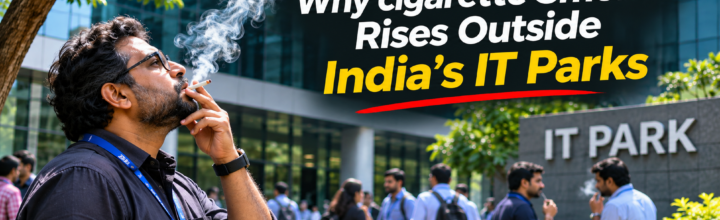
Walk past any big IT park in Bengaluru, Hyderabad, Chennai, Pune or Gurugram at anytime. Small groups stand near the tea stalls and gates with cigarettes in hand. Some parks even have a shop inside the campus selling cigarettes. Is this legal? And why is it so common here?
What the law says
India’s main law is the Cigarettes and Other Tobacco Products Act, 2003 (COTPA).
- Smoking in public places is banned. This includes offices, which count as workplaces. The fine is around ₹1000, and it is rarely enforced.
- Smoking rooms inside offices are not allowed. The law permits designated smoking areas only in airports, hotels with 30 or more rooms, and restaurants with 30 or more seats. Offices are not on this list. So an indoor smoking zone in an IT office is against the law.
- Open-air spaces are a grey area. The Act’s definition of a public place excludes open space. This is why many companies set up a smoking corner in a open campus area, near a gate or parking, and the practice continues.
- Selling cigarettes is not banned in an IT park. The rules ban sales to anyone under 18 and within 100 yards of schools and colleges. Shops must also display the health warning board. A licensed shop selling to adults inside a private campus is not clearly illegal.
Enforcement is the real problem. Local bodies and park managers rarely check, and companies prefer not to confront employees.
Why so many smokers in IT?
No national study compares smoking across sectors, but several reasons are widely discussed.
1. Stress and deadlines. IT work means tight delivery dates, client calls at odd hours and constant pressure. A cigarette break becomes a short escape.
2. Young earners with money. Many IT workers are in their 20s and 30s, live away from family, and have a good salary. Nobody at home is watching.
3. Smoking as a social habit. The smoking corner becomes a place to meet people from other teams, talk about the manager, and share news. Many people say they go for the chat, not the cigarette.
4. Distance inside big parks. Some campuses are very large. Walking to the main gate and back can take 15 minutes. A shop or a corner near the building saves time for the employee and for the company. The company also benefits, because a 5-minute break is better than a 20-minute one.
5. Night shifts and global hours. Working for US and UK clients means long hours and broken sleep. Both are linked to higher tobacco use in health research.
What happens in Silicon Valley
California is much stricter. Smoking inside workplaces has been banned by state law since 1995, and in bars since 1998. Large tech campuses are mostly tobacco-free by policy, and the few smokers usually stand at the edge of the property. California’s adult smoking rate is about 6-7%, among the lowest in the United States. India’s adult smoking rate is about 10%, and the rate for men is much higher.
Tech companies there also treat health as part of the workplace. They offer gyms, counselling and quit-smoking help as part of benefits. The cultural message is that smoking is a personal health failure. In India, the message is often that it is simply how people cope with work.
Japan offers a different example. Offices there were long tolerant of smoking, but rules have tightened, with indoor smoking rooms now strictly controlled. That shows change is possible even in a smoking-friendly work culture.
What India’s IT companies should do
- Stop treating a campus cigarette shop as a service. It sends the wrong signal.
- Offer quit-smoking programmes through the health insurance and wellness team, not just posters.
- Fix the cause: long hours, unrealistic deadlines and no real breaks.
- Enforce the law on indoor smoking zones.
The bottom line
A smoking corner in an IT park is not proof that the law is weak. It is proof that stress has found a quiet exit. Until companies treat the pressure, the smoke will keep rising outside their glass buildings.
Comments

Hi, I’m Nishanth Muraleedharan (Nishani)—an IT engineer turned internet entrepreneur with 25+ years of experience in the textile industry. As the Founder of "DMZ International Imports & Exports Pvt ltd" ( Handlooom.com) and President & Chairperson of the "Save Handloom Foundation" (DesiFusions.com), I’m committed to reviving India’s handloom heritage by empowering artisans through sustainable practices and advanced technologies like Blockchain, AI, AR & VR. I write what I love to read—thought-provoking, purposeful, and rooted in impact. nishani.in is not just a blog — it's a mark, a sign, a symbol, an impression of the naked truth. Like what you read? Buy me a chai and keep the ideas brewing. ☕💭 For advertising on any of our platforms, WhatsApp me on : +91-91-0950-0950 or email me @ nishani@nishani.in