
China’s AI Domination: Alibaba’s Qwen-2.5 and the Rise of Open-Source Supremacy
For years, the AI race was thought to be a competition dominated by American giants like OpenAI, Google, and Anthropic. But China, with its relentless technological advancements, is turning the tide at an unprecedented pace.
The latest disruptor? Alibaba’s Qwen-2.5.
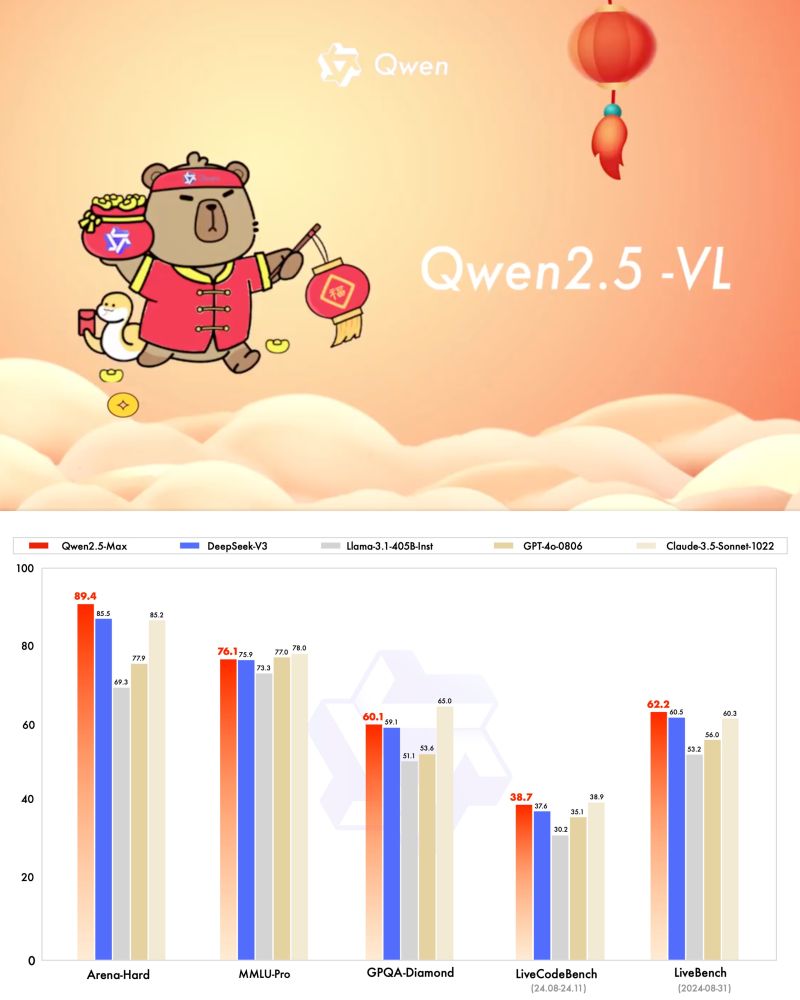
Forget DeepSeek. Forget waiting for the next OpenAI or Google release. Alibaba has just introduced Qwen-2.5, a proprietary AI model that not only competes with but almost beats industry heavyweights like Claude Sonnet 3.5, Gemini-2 Flash, and GPT-4o. And the most astonishing part?
It’s fully open-source.
Qwen-2.5: The Game-Changer in AI
Alibaba’s Qwen-2.5 isn’t just another language model; it’s a multi-modal powerhouse capable of:
- Coding, writing, and web searching – similar to GPT-4o and Gemini-2 Flash.
- Generating images – comparable to OpenAI’s DALL·E.
- Generating videos – rivaling Google’s Veo 2 and OpenAI’s yet-to-be-released Sora.
- Building AI Agents – Qwen-2.5 VL (Vision and Language) enables users to create their own OpenAI Operator-like agent for computers and mobile devices—at zero cost.
In simple terms, Alibaba is providing a model with capabilities that would typically cost $200/month on OpenAI, for free. This is a paradigm shift in the AI industry.
The Open-Source Revolution and China’s Strategic Play

While US-based AI firms continue to push for proprietary, subscription-based models, China has adopted a radically different approach—open-source AI dominance.
- OpenAI, Anthropic, and Google continue to charge for API access and enterprise services.
- Chinese companies like Alibaba, DeepSeek, and Baidu are releasing state-of-the-art models for free, often with open-source code.
This approach has serious implications. Open-source AI means:
- Faster global adoption: Anyone, anywhere, can integrate these models into applications without hefty licensing fees.
- Lower barriers to entry: Small businesses and individual developers now have access to cutting-edge AI without financial constraints.
- Wider innovation potential: Open-source AI fosters community-driven improvements, potentially surpassing closed-source models in innovation.
The Implications: Will US AI Giants Adapt or Struggle?
China’s AI strategy is clear: dominate by democratizing access.
The West’s major AI firms, particularly OpenAI, are increasingly moving towards a closed ecosystem, focusing on profit-driven models that require high subscription fees for premium access. But with China releasing free, open-source alternatives, can they continue to justify these costs?
Consider these scenarios:
- Businesses opting for free Chinese AI tools over paid Western alternatives.
- Developers choosing open-source AI for greater flexibility and customization.
- Governments and research institutions relying on Chinese AI due to lower costs and unrestricted access.
With each new AI release, China is making it harder for companies like OpenAI, Google, and Anthropic to sustain their current business models. If OpenAI were to release GPT-5 as a paid-only model while Alibaba continues open-sourcing models of similar quality, what would businesses choose?
What’s Next? The Inevitable AI Cold War

China’s dominance in AI isn’t just a technological triumph—it’s a geopolitical statement.
With every new open-source AI model, China gains an upper hand in global influence. The accessibility of these tools ensures that startups, enterprises, and even governments around the world integrate Chinese AI into their operations, further extending Beijing’s technological footprint.
Will OpenAI, Google, and other Western AI firms fight back by adapting to this open-source trend? Or will they double down on their subscription-based models, risking market share loss to China’s rapidly advancing AI industry?
One thing is certain—the AI war has just begun, and China isn’t just participating; they’re leading.
Comments

Hi, I’m Nishanth Muraleedharan (also known as Nishani)—an IT engineer turned internet entrepreneur with 25+ years in the textile industry. As the Founder & CEO of "DMZ International Imports & Exports" and President & Chairperson of the "Save Handloom Foundation", I’m committed to reviving India’s handloom heritage by empowering artisans through sustainable practices and advanced technologies like Blockchain, AI, AR & VR. I write what I love to read—thought-provoking, purposeful, and rooted in impact. nishani.in is not just a blog — it's a mark, a sign, a symbol, an impression of the naked truth. Like what you read? Buy me a chai and keep the ideas brewing. ☕💭 For advertising on any of our platforms, WhatsApp me on : +91-91-0950-0950 or email me @ support@dmzinternational.com