
India is a migration superpower
India has a long history of migration. More than a century ago, large numbers of Indian migrants – many of them involuntary ones – moved to Africa, the Caribbean and within the Indian subcontinent itself. Some of the top destinations of Indian migrants in more recent decades include Persian Gulf countries, North America and Europe.
India is the top source of international migrants, with one-in-twenty migrants worldwide born in India.
As of 2015, 15.6 million people born in India were living in other countries. India has been among the world’s top origin countries of migrants since the United Nations started tracking migrant origins in 1990. The number of international Indian migrants has more than doubled over the past 25 years, growing about twice as fast as the world’s total migrant population.
Nearly half of India’s migrants are in just three countries: the United Arab Emirates, Pakistan and the United States. About 3.5 million Indians live in the UAE, the top destination country for Indian migrants. Over the past two decades, millions of Indians have migrated there to find employment as laborers. Pakistan has the second-largest number of migrants, with 2 million.
Almost 2 million more live in the U.S., making up the country’s third-largest immigrant group. Among Indian Americans, nearly nine-in-ten were born in India. As a whole, Indian Americans are among the highest educated and have some of the highest income among racial and ethnic groups in the U.S.
India receives more remittances from migrants than any other country.
About $69 billion was sent by Indian migrants to family and friends in India in 2015, amounting to roughly 3% of the country’s gross domestic product, according to the World Bank estimates. Most of the money comes from Indians living in Persian Gulf countries as well as the U.S., the UK and Canada. India has been the world’s top recipient of migrant remittances since 2008, when it overtook China on this measure.
India’s religious minorities have been more likely to migrate internationally.
Religious minorities make up a larger share of India’s international migrant population than they do among the nation’s domestic population, according to 2010 Pew Research Center estimates. For example, about 19% of the Indian international migrant population was Christian, compared with only 3% of the population in India. Similarly, an estimated 27% of the Indian international migrant population was Muslim, compared with 14% of the population in India. The reverse is true for Hindus: Only 45% of India’s international migrant population was Hindu, compared with 80% of the population in India.
What is the main reason immigrants came to America?
In the late 1800s, people in many parts of the world decided to leave their homes and immigrate to the United States. Fleeing crop failure, land and job shortages, rising taxes, and famine, many came to the U. S. because it was perceived as the land of economic opportunity.
Work has always been the great magnet attracting migrants to the United States. Historically, immigrants tackled jobs that native-born Americans avoided, such as digging canals, building railroads, or working in steel mills and garment factories.
The earliest recorded Indian emigrant to the United States was from Madras, who traveled to Massachusetts in 1790. A number of Indians were brought to the United States by seafaring Captains who worked for the East India Company to serve in their households as servants.
Three reasons immigrants came to America before 1880 were for freedom of religion, to escape the laws of their country, and to earn money because most were very poor.
By the 1500s, the first Europeans, led by the Spanish and French, had begun establishing settlements in what would become the United States. In 1607, the English founded their first permanent settlement in present-day America at Jamestown in the Virginia Colony.
According to the United Nations, in 2019, the United States, Germany, and Saudi Arabia had the largest number of immigrants of any country
From 1980 to 2019, the Indian immigrant population in the United States increased 13-fold (see below graph).
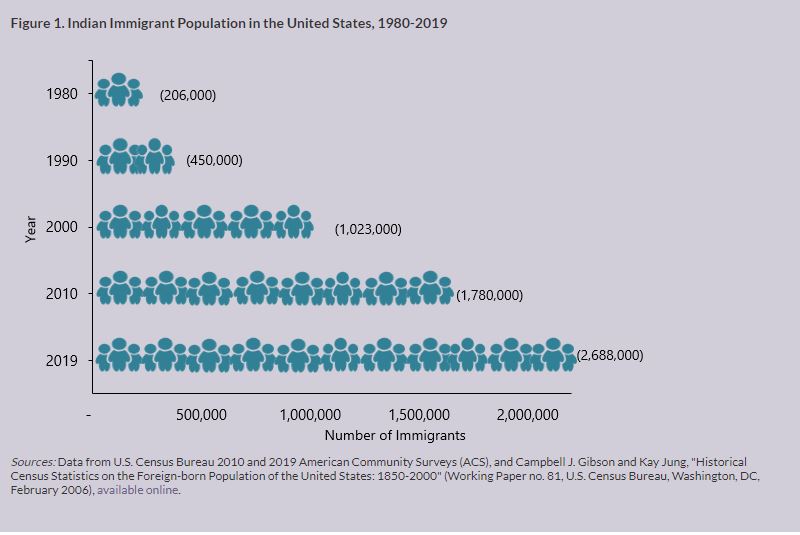
Indian immigrants are notable not only for their large numbers. Compared with both the overall U.S.- and foreign-born populations, Indian immigrants are more likely to be highly educated, to work in management positions, and to have higher incomes. They also have lower poverty rates and are less likely to be uninsured. Today, most Indians in the United States who obtain lawful permanent residence (LPR status, also known as getting a green card) do so through family reunification channels, either as immediate relatives of U.S. citizens or through other family-sponsored channels, although a sizeable share gain status through employment preferences.
In the 2014-18 period, immigrants from India were highly concentrated in California (20 percent), followed by Texas and New Jersey (each with 10 percent). The next three most populous states—New York, Illinois, and Georgia—were home to an additional 17 percent of the Indian population collectively. The top four counties by Indian concentration were Santa Clara County in California, Middlesex County in New Jersey, Alameda County in California, and Cook County in Illinois. Together four these counties were home to 15 percent of Indian immigrants in the United States.
As of 2014-18, the U.S. cities with the largest number of Indians were the greater New York, Chicago, San Francisco, and San Jose metropolitan areas. These four metro areas accounted for about 30 percent of Indians in the United States.
Indians have much higher education rates than both the U.S.- and overall foreign-born populations. In 2019, 79 percent of Indian immigrants ages 25 and older reported having at least a bachelor’s degree, compared to 33 percent of both U.S.-born and all immigrant adults.
Indians participate in the labor force at a slightly higher rate than all immigrants and the U.S.-born population. About 72 percent of Indian immigrants ages 16 and older were in the civilian labor force in 2019, compared to 67 percent of the foreign born and 62 percent of the native born. Indians were much more likely to be employed in management, business, science, and arts occupations than the overall U.S.- and foreign-born populations
Income and Poverty
Indians overall have much higher incomes than the total foreign- and native-born populations. In 2019, households headed by an Indian immigrant had a median income of $132,000, compared to $64,000 and $66,000 for all immigrant and U.S.-born households, respectively.
In 2019, Indian immigrants were less likely to be in poverty (5 percent) than immigrants overall (14 percent) or the U.S. born (12 percent).
Immigration Pathways and Naturalization
Indians are less likely to be naturalized U.S. citizens than immigrants overall. In 2019, 47 percent of Indians were naturalized citizens, compared to 52 percent of all immigrants.
Compared to all immigrants, Indians are much less likely to have arrived before 2000. The largest share of Indians, approximately 41 percent, arrived in 2010 or later, as compared to just 25 percent of the overall foreign-born population
In fiscal year (FY) 2018, India was the fourth-largest country of origin for new permanent residents after Mexico, Cuba, and mainland China. Close to 60,000 of the 1.1 million new LPRs were from India. Most Indians who obtain green cards do so through family reunification channels. In FY 2018, 59 percent of the 59,821 Indians who received a green card did so as either immediate relatives or other family members of U.S. citizens, while 38 percent received a green card through employment-based channels, at a rate almost three times higher than for all new LPRs
Health Coverage
Indians have high health insurance coverage rates compared to both the overall immigrant and native-born populations. In 2019, just 5 percent of immigrants from India were uninsured, compared to 8 percent of the native born and 20 percent of the total foreign born. Indian immigrants were also more likely to be covered by private health insurance than the overall foreign- and U.S.-born populations.
The Three Waves
The 3 million individuals of Indian origin who currently reside in the United States (roughly 1 percent of the total population) arrived in three distinct periods.
The “early movers” came in the wake of the Immigration and Nationality Act of 1965, which replaced a national-origins quota system that governed immigration in the United States with a preference based on skills and family relationships. The 12,000 or so India-born immigrants a year arriving in this group were unusually well educated, with numbers favoring doctors, engineers and scientists.
Phase two of Indian immigration, dating from the early 1980s, was the “family” cohort, when some 30,000 relatives a year of those who had settled in the States came in.
About two-thirds of India-born Americans have arrived in the ongoing third wave. “the IT generation.” The influx of as many as 100,000 computer specialists a year from India began with concerns over Y2K in the mid 1990s, as American companies sought to revamp their systems to avoid “millennial meltdown” when computers programmed with a two-digit date code would have to cope with the dates of the 21st century. Approximately one out of every three visas issued to India-born immigrants goes to residents of the high-tech Hyderabad area, far more than to individuals from Bombay or Delhi, for example.
A central thesis of the book argues that how immigrants come to the United States matters in determining their eventual success. Most recent Indian immigrants arrived on the so-called H-1B visa program, granted to specialized new hires who have already secured jobs and hold a minimum of a bachelor’s degree. The visa, which can be extended for up to six years, indicates that the holder will graduate to immigrant status. From 1997 to 2013, fully half of the 125,000 H-1B visas issued went to Indians. “The rest of the world got the other half.”
Arriving with jobs and steady sources of income, Indians skipped the “ghetto stage” common to most immigrant stories, when newcomers settle in urban enclaves with other home-country refugees. Instead, the India-influx located close to their jobs, living in middle-class or pricier neighborhoods in techy communities, such as the New York-New-Jersey area, Chicago and Washington, D.C. suburbs, and the outskirts of San Francisco and Dallas. Almost without exception, they started families and primed their children to receive similar levels of educational achievement.
In the third selection, this pre-ordained pool naturally rose to the top of a US system that favored immigrants with IT skills. Forget the ladder to success, “These guys stepped into an elevator.”
On a lighter note,
India has nothing to show until our talented brains are drained willfully by US, UK, Canada, Australia or any other similar countries and remains unable to know the difference between a slave of olden times and today’s tech-geeks. This doesn’t mean that India doesn’t have anyone with brains now.
Initially greed takes us all to these countries after graduating from India. It can also be political or religious reasons also. Also may be getting a dream job with dream salary. So we follow them for 25-30 years and completely get destroyed as a family. Starting may look great but end will be tragic for vast majority.
Also in India, we have been conditioned to think that only politicians can solve our problems like better infrastructure, Good job opportunities matching our qualifications. But at some point, maybe we will wakeup and recognize that it was politicians who created our problems in India from the very beginning of getting freedom itself. So that will be also be a reason forcing Indians to move abroad thinking of leading a better life in a better society with proper infrastructure and good job opportunities for educated people with dream salary.
But, Old NRI’s will be able to tell that they are not far from truth. the first generation migrants are able to sustain their family and cultural values but the 2nd and 3rd wave generation are becoming rootless. This gives rise to identity crisis as well.
Comments

Hi, I’m Nishanth Muraleedharan (also known as Nishani)—an IT engineer turned internet entrepreneur with 25+ years in the textile industry. As the Founder & CEO of "DMZ International Imports & Exports" and President & Chairperson of the "Save Handloom Foundation", I’m committed to reviving India’s handloom heritage by empowering artisans through sustainable practices and advanced technologies like Blockchain, AI, AR & VR. I write what I love to read—thought-provoking, purposeful, and rooted in impact. nishani.in is not just a blog — it's a mark, a sign, a symbol, an impression of the naked truth. Like what you read? Buy me a chai and keep the ideas brewing. ☕💭 For advertising on any of our platforms, WhatsApp me on : +91-91-0950-0950 or email me @ support@dmzinternational.com