India vs. China: A Tale of Two Startup Worlds
At first glance, India and China are often seen as economic rivals — two densely populated nations racing toward global dominance. Their geopolitical tensions are well-documented, with border disputes and diplomatic standoffs shaping public perception. But step beyond the headlines, and you’ll find a fascinating and stark contrast in how each country is shaping the future — especially in the startup world.
Despite icy diplomatic relations, there’s a lot India can learn from China. The recent global disruption caused by Chinese innovations in electric vehicles and artificial intelligence is a wake-up call to the rest of the world — particularly to the West, and yes, to India too.
China’s Silent Revolution: Outpacing the West
In 2025, BYD (Build Your Dreams), a Chinese electric vehicle manufacturer, surpassed Tesla in global EV sales — selling over 526,000 EVs in Q4 2023 compared to Tesla’s 484,000. While headlines focused on Elon Musk’s reaction, the real story was how China silently built an entire ecosystem of EVs, batteries, and smart tech to take the lead. BYD Has Evolved From Joke to “Tesla Killer” and Is Now Cementing Its Dominance
Even more disruptive was the launch of DeepSeek-V2, an AI tool developed in China. What shocked the tech world was its ability to rival GPT-4 performance — without relying on NVIDIA GPUs, instead using locally built, cost-efficient hardware. This move reportedly triggered a historical $500 billion market cap loss for NVIDIA in a single day — highlighting the fragility of Western tech dominance.
Couple that with innovations like Alibaba’s AI models and China’s surge in quantum computing and robotics, and it’s clear: China isn’t just competing — it’s building an alternate tech future.
India’s Startup Boom: Hype or Hope?
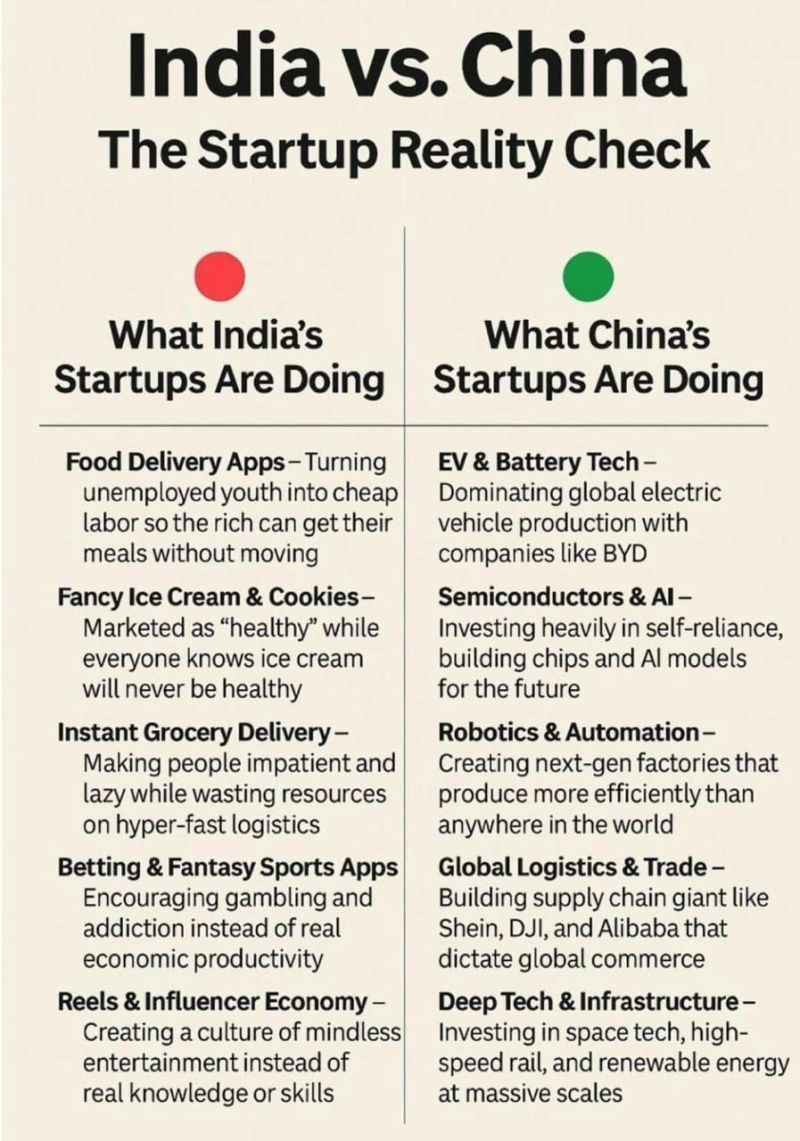
India is the world’s third-largest startup ecosystem, with over 100 unicorns and thousands of recognized startups. But while China builds EVs, chips, and AI tools, many of India’s top-funded startups are focused on:
- Food delivery apps
- Instant grocery services
- Fantasy sports & online betting
- Viral content creation (influencer & reel economy)
- D2C brands for ice creams, proteins, and cafes
There’s nothing wrong with convenience economy innovations. But the concern is this: Are we solving real, long-term problems — or just feeding consumer impulses?
Sector Comparison: Where Each Nation Stands
| Sector | India | China |
|---|---|---|
| EV & Battery Tech | Nascent (Ola Electric, Ather) | Global Leader (BYD, CATL) |
| AI & Deep Tech | Early stage (Saarthi AI, Sarvam AI) | Advanced (DeepSeek, Alibaba AI, Baidu) |
| Robotics & Automation | Limited (industrial use only) | Widespread use in factories, logistics |
| Semiconductors | Just beginning (ISMC fab plans) | Advanced chip design & fabs (SMIC) |
| E-commerce & Payments | Mature (Flipkart, PhonePe, UPI) | Dominant (Alibaba, WeChat Pay) |
| Digital Infrastructure | Improving (Jio, 5G rollout) | State-backed, integrated nationwide |
The Elephant and the Dragon: Philosophies That Shape Innovation
China’s Model: State-Driven Deep Tech
- The Chinese government plays an aggressive role in funding, incubating, and protecting its startups.
- Military-civil fusion ensures dual-use technologies (like AI and robotics) get fast-tracked.
- Data access is centralised, giving companies like Baidu and Tencent massive leverage to train AI.
India’s Model: Market-Driven Innovation
- India’s strength lies in digital inclusion and democratic access, with tools like UPI revolutionizing fintech.
- Startups are mostly consumer-focused, trying to capitalize on India’s booming middle class.
- There’s less government support for deep-tech innovations, and limited venture capital for hardware startups.
A Cultural Contrast in Innovation
- In China, engineering is king, and top students often go into AI, robotics, and manufacturing.
- In India, most IIT grads still prefer finance, consulting, or working abroad. The mindset toward innovation in hardware and deep-tech remains lukewarm.
The Wake-Up Call: What Should India Do Now?
- Focus on Deep-Tech Education: We need to build hardware and AI research hubs on par with global standards.
- Govt-Led Infrastructure for Startups: Create zones with tax benefits, funding, and infrastructure like fab labs.
- Invest in Strategic Sectors: EVs, semiconductors, quantum computing, and AI should receive the same hype as food delivery.
- Public-Private Collaboration: India should emulate ISRO’s success model — efficient, mission-driven innovation backed by policy support.
- Incentivize Long-Term Projects: Shift VC funding toward impact startups in agritech, healthtech, and cleantech.
Final Thought: Silent Giants vs. Loud Unicorns
While India celebrates its unicorns loudly, China builds silently — and often strikes hard. BYD overtaking Tesla was not just a market milestone — it was a strategic blow to American dominance in EVs. DeepSeek-V2 wasn’t just an AI model — it was a declaration of technological independence.
India has the brainpower, the demographic edge, and the global goodwill to lead the world. But we need to move from convenience tech to consequential tech — from short-term user engagement to long-term human progress.
If India is to compete with China — or surpass it — it’s time to think big, act deep, and invest in the future beyond the screen.
Comments

Hi, I’m Nishanth Muraleedharan (also known as Nishani)—an IT engineer turned internet entrepreneur with 25+ years in the textile industry. As the Founder & CEO of "DMZ International Imports & Exports" and President & Chairperson of the "Save Handloom Foundation", I’m committed to reviving India’s handloom heritage by empowering artisans through sustainable practices and advanced technologies like Blockchain, AI, AR & VR. I write what I love to read—thought-provoking, purposeful, and rooted in impact. nishani.in is not just a blog — it's a mark, a sign, a symbol, an impression of the naked truth. Like what you read? Buy me a chai and keep the ideas brewing. ☕💭 For advertising on any of our platforms, WhatsApp me on : +91-91-0950-0950 or email me @ support@dmzinternational.com