
More about Mahabharata, Ramayana, Bhagavad Gita, Bible and Quran
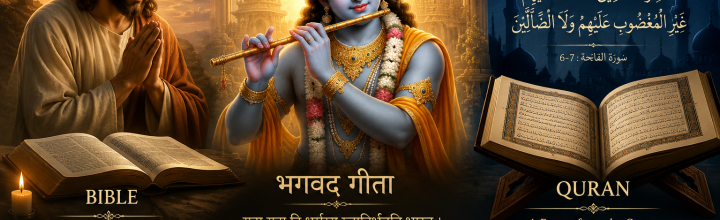
We often speak about the Mahabharata, Ramayana, Bhagavad Gita, Bible and Quran as though each appeared one day, fully written by a single person. History tells a much more complicated—and far more fascinating—story.
The first thing we must separate is faith from history. Faith asks what believers hold sacred or divinely revealed. History asks: When did this text emerge? Who transmitted it? What evidence survives? How did it change?
So, who wrote the Mahabharata?
Tradition attributes the Mahabharata to Vyasa. But historians and textual scholars generally see the epic as a work that developed over centuries through oral transmission, additions and compilation, rather than something written in one sitting by one identifiable author. Its major layers are generally placed somewhere between the last centuries BCE and the early centuries CE.
The Ramayana is traditionally attributed to Valmiki. Scholars likewise recognise layers and later additions in the text, although its core appears to have a stronger connection with an individual poetic tradition than the enormous Mahabharata.
And the Bhagavad Gita? It is a section of the Mahabharata, traditionally attributed to Vyasa, but scholars disagree about precisely when its present form emerged. Estimates commonly place its composition somewhere in the late centuries BCE, with some scholars arguing for earlier or later dates.
That uncertainty is important. We don’t know the exact historical date of composition, and pretending otherwise would be bad history.
But were these merely “stories”?
Not necessarily.
Ancient societies did not have newspapers, universities, television, constitutional law books or psychology textbooks. Epic literature was one way societies preserved memory, morality, political ideas, philosophy and social values.
The Mahabharata discusses power, family, war, loyalty, justice, revenge and moral ambiguity.
The Ramayana explores duty, kingship, sacrifice, relationships and the consequences of choices.
The Gita asks perhaps the most uncomfortable question of all: What should a human being do when every available choice carries a moral cost?
That is why these works survived.
Their continuing relevance does not require every episode to be historically verifiable. A fictional courtroom drama can teach us something about justice even if the courtroom never existed.
And what about the Bible?
The Bible is not one book written by one person.
It is a library of texts produced by different authors and communities over many centuries. The Hebrew Bible/Old Testament contains writings from different periods, while the New Testament emerged in the first century CE.
The four canonical Gospels are traditionally associated with Matthew, Mark, Luke and John, but historians study them as ancient texts whose authorship and precise dates are subjects of scholarly debate.
Christianity itself emerged in the first century CE from the Jewish world of Roman-era Palestine, centred on the life and teachings of Jesus and the movement that formed around him.
So saying “the Bible was written by X” misses the entire historical process.
And the Quran?
Islam has a different textual history.
Muslim tradition holds that Muhammad received revelations from God through the angel Gabriel beginning around 610 CE, continuing until Muhammad’s death in 632 CE. These revelations were recited and memorised, and the Quran was subsequently collected and standardised in the early Muslim community.
Historically, therefore, the Quran is connected directly to Muhammad’s prophetic career, while the physical compilation and standardisation of the text occurred through the early Muslim community.
And here again, religious belief and historical methodology describe the same tradition differently. Believers speak of divine revelation; historians examine manuscripts, transmission, language and chronology.
So when did “Hinduism”, Christianity and Islam actually begin?
This is where modern labels can mislead us.
There was no moment when somebody announced: “Today, Hinduism has officially started.”
The religious traditions that we now call Hinduism developed gradually from several ancient Indian traditions, including Vedic traditions, philosophical schools, devotional movements and epic literature.
Christianity developed from the Jewish religious environment of the first century.
Islam emerged in seventh-century Arabia around Muhammad and the Quran.
In other words, religions are also historical processes—communities, ideas, rituals, institutions and identities developing across generations.
And what were humans doing when all this happened?
This is perhaps the most astonishing part.
Homo sapiens has existed for roughly 300,000 years.
Humans were already hunting, gathering, making tools, creating symbols and maintaining social networks long before the great scriptures appeared. Archaeological evidence shows surprisingly sophisticated exchange networks hundreds of thousands of years ago.
And we were not alone. Neanderthals lived alongside Homo sapiens and even interbred with ancestors of many people living outside Africa today.
Think about that timeline.
300,000 years of Homo sapiens.
Then agriculture.
Then cities.
Then kingdoms.
Then writing.
Then epics.
Then organised religions.
And yet enormous portions of human history remain unknown.
We don’t know the names of countless ancient storytellers. We don’t know exactly how many oral traditions disappeared before being written down. We don’t know precisely how particular myths evolved from generation to generation. Archaeology gives us fragments; texts give us memories; science gives us increasingly powerful clues.
Perhaps that is the greatest lesson.
Human beings have always tried to answer the same terrifying questions: Where did we come from? Why are we here? What is right and wrong? What happens after death? How should power be used? And what makes a life meaningful?
The answers became epics, philosophies and religions.
Thousands of years later, we are still arguing about them.
Maybe that is not evidence that humanity has failed to find answers.
Maybe it is evidence that we are still asking the right questions.
Comments

Hi, I’m Nishanth Muraleedharan (also known as Nishani)—an IT engineer turned internet entrepreneur with 25+ years in the textile industry. As the Founder & CEO of "DMZ International Imports & Exports" and President & Chairperson of the "Save Handloom Foundation", I’m committed to reviving India’s handloom heritage by empowering artisans through sustainable practices and advanced technologies like Blockchain, AI, AR & VR. I write what I love to read—thought-provoking, purposeful, and rooted in impact. nishani.in is not just a blog — it's a mark, a sign, a symbol, an impression of the naked truth. Like what you read? Buy me a chai and keep the ideas brewing. ☕💭 For advertising on any of our platforms, WhatsApp me on : +91-91-0950-0950 or email me @ support@dmzinternational.com