The Ceasefire That Died in 72 Hours: Iran, America, and the Mystery of the F-35 Hangars
Three days. That is all it took for a two-month ceasefire to fall apart.
On the morning of June 10, 2026, today, air raid sirens screamed across three countries at once. Missiles flew toward Jordan. Drones headed for Bahrain. Kuwait’s defences fired into the dark sky. And somewhere in the middle of it all sits one unanswered question: did Iran really destroy America’s most advanced fighter jets on the ground?
Let us rewind the tape.
How the Fire Restarted
The war between the US, Israel, and Iran began on February 28, 2026. It opened with American and Israeli airstrikes on Iranian military targets, and Iran answered by choking the Strait of Hormuz — the narrow waterway that carries a quarter of the world’s seaborne oil. On April 8, both sides agreed to a ceasefire, with Trump demanding the Strait be reopened. For two months, the truce held — barely.
Then came the weekend that broke it. Hezbollah bombed northern Israel. Israel struck Beirut on Sunday. Iran then fired a missile at northern Israel — the first direct Iran-Israel exchange since the truce began.
The next domino fell over water. On Monday, a US Army Apache helicopter went down near the Strait of Hormuz. Trump announced on Truth Social that Iran had shot it down, said both pilots were safe, and declared that America “must respond”. The US military believes an Iranian Shahed drone brought the helicopter down just off the coast of Oman.
Strike and Counter-Strike
America moved first. On Tuesday night, US forces struck Iranian air defences, ground control stations, and radar sites near the Strait of Hormuz, calling it a “proportional response to unjustified Iranian aggression”. Explosions were heard at Qeshm Island, Bandar Abbas, Sirik, Minab, and Jask — all strategic points guarding the Strait.
Iran’s answer came before dawn on Wednesday, and it was bigger. The IRGC launched drone attacks on the US Fifth Fleet headquarters in Bahrain and the Ali Al Salem airbase in Kuwait, plus a long-range missile strike on the Azraq airbase in Jordan. It claimed it attacked 21 US targets and destroyed four, including an F-35 fighter jet hangar in Jordan.
The F-35 Mystery
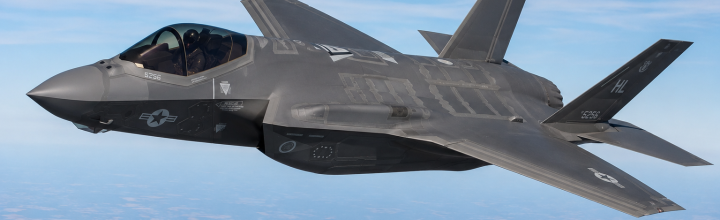
Now the question everyone is asking. Were the F-35s hit?
Here is what we actually know. Iran’s Revolutionary Guards said they targeted the base at Al Azraq with long-range solid-fuel missiles and destroyed hangars housing F-35 jets. But no photographic evidence has been provided to back up the claim. The US had deployed at least 18 F-35 stealth fighters to Muwaffaq Salti Air Base, near Al Azraq, in February.
Jordan tells a completely different story. The Jordanian military said it intercepted and shot down all five missiles fired toward Azraq, with only shrapnel falling and no injuries or material damage. Early US assessments say nearly all Iranian missiles and drones were intercepted.
So as of today, there is no official confirmation that any F-35 was damaged on the ground. One side claims total destruction. The other claims total interception. Both cannot be true. Until satellite images or independent evidence appear, treat the hangar claim as war propaganda — from either side.
The Map of Iranian Strikes
One correction people keep getting wrong: Jordan is not a GCC country. The Gulf Cooperation Council has six members — Saudi Arabia, UAE, Qatar, Kuwait, Bahrain, and Oman. Across this war, Iran has struck five of them. Earlier waves of Iranian ballistic missiles targeted American bases in Qatar, Kuwait, and the UAE, and hit the US Fifth Fleet headquarters in Bahrain, while explosions were also reported in Riyadh. Civilian targets have suffered too — fuel tanks at Kuwait’s airport were hit by drones, and Bahrain accused Iran of damaging a water desalination plant. Iran’s stated reason is simple: these countries host the American bases attacking Iranian soil. Only Oman has stayed untouched — which is exactly why it remains a diplomatic backchannel.
Iran’s Warning to the Gulf: Stay Out or Pay the Price
Iran is not hiding its message to its neighbours. On Wednesday, Iran’s foreign ministry strongly condemned the US strikes and warned regional countries not to allow their territory or facilities to be used by the United States or Israel for operations against Tehran. The ministry said countries in the region, especially those on the southern shores of the Persian Gulf, had a “legal and moral responsibility” to prevent any use of their land for planning, carrying out, or supporting attacks on Iran. President Masoud Pezeshkian had earlier said Iran “will be forced to respond” against its neighbours if their territory was used to attack it — though he had also apologised to countries hosting US bases for strikes on their soil. The Gulf states insist their land has not been used against Iran. Iran clearly does not believe them. That gap between claim and belief is what keeps Bahrain, Kuwait, and the rest in the firing line.
What Trump and Netanyahu Are Doing Now
This is where the story turns strange. Even while missiles fly, Trump keeps saying a deal is close, claiming there is “a good chance” of signing one in two or three days. More remarkably, Trump warned Netanyahu that Israel could find itself “on your own very soon” if it carried out further strikes on Iran. Reports say Netanyahu called off a major strike on Iran with fighter jets already on the runway, then told his nation attacks were halted “for now” — but Israel would strike again if attacked.
Ceasefire or Full War?
Pakistan-led mediators have been pushing for weeks to close a permanent deal. Iran wants access to billions in frozen oil revenue, sanctions waivers, and the lifting of the US naval blockade. The pieces of a deal exist. But after this week, trust does not.
The pattern of this war is now clear: ceasefire, incident, retaliation, escalation, then back to talks. Neither side wants full war. Neither side can stop hitting back. The Strait of Hormuz remains the trigger — and India’s fuel bill remains the hostage.
The F-35s may or may not be burning in Jordan. But the ceasefire definitely is.
Comments

Hi, I’m Nishanth Muraleedharan (also known as Nishani)—an IT engineer turned internet entrepreneur with 25+ years in the textile industry. As the Founder & CEO of "DMZ International Imports & Exports" and President & Chairperson of the "Save Handloom Foundation", I’m committed to reviving India’s handloom heritage by empowering artisans through sustainable practices and advanced technologies like Blockchain, AI, AR & VR. I write what I love to read—thought-provoking, purposeful, and rooted in impact. nishani.in is not just a blog — it's a mark, a sign, a symbol, an impression of the naked truth. Like what you read? Buy me a chai and keep the ideas brewing. ☕💭 For advertising on any of our platforms, WhatsApp me on : +91-91-0950-0950 or email me @ support@dmzinternational.com