
Three Indian Sailors Are Dead, Hormuz Is Shut, and Everyone Is Waiting for Someone Else to Blink
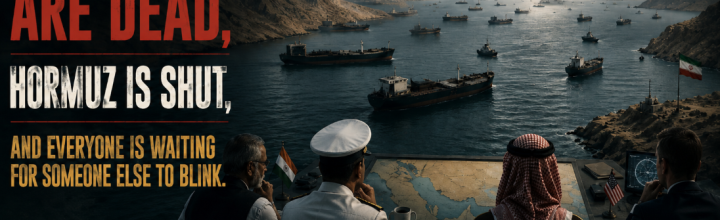
On the night of June 9, an American aircraft fired precision munitions into the engine room of a commercial tanker in the Gulf of Oman. The ship, the Settebello, carried 24 Indian crew members. Three of them are now confirmed dead. The United States says the ship violated its naval blockade of Iran and ignored instructions. So it shot at a civilian vessel full of Indian workers.
This was not a one-off mistake. On June 8, US forces attacked another tanker, the Marivex, with 24 Indians on board. All were rescued. On June 11, a third tanker with 20 Indian crew, the Jalveer, was hit. Three attacks on ships carrying Indians, in four days, by the military of a country we call a strategic partner.
Ask yourself a simple question. If Iranian forces had killed three Indian sailors this week, what would our evenings look like? Television studios would be on fire. Hashtags would trend by morning. Politicians from every party would compete to look the angriest. We know this because it happened — when attacks linked to the Iranian side killed Indian crew members in March, the anger was loud and immediate. This week the shooter is American, and the anger is a press release. India summoned a US diplomat and condemned the attack. That is correct procedure. But patriotism that checks the flag of the shooter before deciding how angry to feel is not patriotism. It is theatre. A sailor’s life cannot be worth less because of the flag on the missile that killed him.
Now step back and see the war these men died in. Today, June 11, 2026, the conflict between Iran, the United States, and Israel completed 104 days. It began on February 28, when US and Israeli strikes killed Iran’s Supreme Leader in his own capital. It has become the biggest shock to global energy and shipping in fifty years.
This week the spiral turned faster. America struck Iranian ports and islands along the Strait of Hormuz. Iran answered by attacking 21 American military targets, including the US Fifth Fleet base in Bahrain and airbases in Kuwait and Jordan. Iran shot down an American helicopter. America launched fresh strikes. And this morning, Iran’s Revolutionary Guard declared the Strait of Hormuz fully closed to every vessel, warning that any ship attempting passage will be fired upon. The American military insists the strait remains open. Both sides are now shooting at merchant ships to prove their version true.
Into this chaos walked President Trump with a remarkable claim: a secret US operation has quietly moved over 100 million barrels of oil and 200 ships through the strait. His own energy secretary looked surprised. Some oil is certainly slipping through on tankers with their trackers switched off. But 20 million barrels passed through Hormuz every single day before the war. The boast is bigger than the proof.
Look inside the three minds driving this war. Iran is thinking about survival. Its Supreme Leader is dead, its economy strangled, its ports mined. The strait is the only powerful card Tehran has left, and the new leadership must prove its legitimacy through resistance, because surrender could mean the end of the regime itself. Iran’s bet is that every week of 100-dollar oil increases the world’s pressure on Washington, not Tehran.
America is thinking about a deal it can call a victory. Trump bombs and negotiates in alternating weeks. Talks failed in April; an escort mission was announced and paused in May. But Washington has its own clock — inflation past four percent, oil above 100 dollars, and a public that did not sign up for a long Gulf war. America can punish Iran endlessly, but it cannot occupy it, and punishment alone has produced no surrender in 104 days.
Israel is thinking long term. It achieved the decapitation it always wanted and has the least reason to stop. Its interest is to keep going until Iran’s capabilities are permanently broken, and it is content to fight to the last drop of American patience.
The most interesting minds belong to the Gulf rulers. More than four thousand Iranian missiles and drones have been fired at GCC countries. Qatar halted its gas exports. Kuwait’s airport shut down. Sirens sound over Bahrain. The Emir of Kuwait said something remarkable: his country was attacked by a Muslim neighbour it considers a friend, even though Kuwait never allowed its territory to be used against Iran. The Gulf states hosted American bases for protection, and the bases made them targets instead. Many Gulf officials quietly believe America defended Israel’s skies more eagerly than theirs, so they are now buying air defence help from Britain, France, and even Ukraine. The lesson they are learning will outlast the war: American protection is conditional, and the gleaming diversified economies they built can be held hostage by a war they never chose. Nobody wants this over more than the GCC, and they will fund and host any peace deal that appears.
What happens next? Three paths. The most likely, eventually, is a negotiated reopening — Iran needs its economy back, Trump needs oil prices down, and Qatar, Oman, and Pakistan are all available as channels. Even then, clearing the mines from the strait could take six months. The second path is a long grind of blockade, dark tankers, and slow global recession. The third is the nightmare — another strike on Iran’s leadership, or an Iranian hit on Saudi or Emirati oil facilities, pushing the world economy off a cliff.
For India, the task is clear: protect our sailors, demand accountability for the dead with equal force no matter who fired, and push loudly for a ceasefire. We are one of the few countries on speaking terms with every capital involved.
Three Indian families are arranging funerals this week. They did not lose their sons to an enemy. They lost them to a friend. One hundred and four days in, nobody is winning this war. The only competition left is over who can afford to lose the slowest.
Comments

Hi, I’m Nishanth Muraleedharan (also known as Nishani)—an IT engineer turned internet entrepreneur with 25+ years in the textile industry. As the Founder & CEO of "DMZ International Imports & Exports" and President & Chairperson of the "Save Handloom Foundation", I’m committed to reviving India’s handloom heritage by empowering artisans through sustainable practices and advanced technologies like Blockchain, AI, AR & VR. I write what I love to read—thought-provoking, purposeful, and rooted in impact. nishani.in is not just a blog — it's a mark, a sign, a symbol, an impression of the naked truth. Like what you read? Buy me a chai and keep the ideas brewing. ☕💭 For advertising on any of our platforms, WhatsApp me on : +91-91-0950-0950 or email me @ support@dmzinternational.com