
Why Would Someone Spend ₹50 Lakh on a Bike… When a Car Can Protect Them Better?
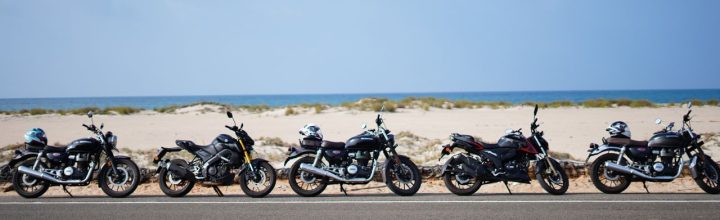
The strange, beautiful psychology of the long-distance biker
A sensible person would ask a very simple question.
“Why?”
Why would someone spend ₹15 lakhs, ₹20 lakhs, ₹25 lakhs, 50 lakhs—or even more—on a motorcycle?
For that money, they could buy a perfectly comfortable car. In many cases, they could buy an SUV.
A car gives you a roof.
Air-conditioning.
Protection from rain.
Protection from dust.
More luggage space.
A comfortable seat.
Music.
Safety features.
The ability to travel with family.
And when the weather becomes terrible, you simply turn on the wipers.
So why does someone willingly choose to sit exposed on two wheels, carry their life in a few panniers, face freezing winds in Ladakh, get soaked in unexpected rain, inhale dust, deal with punctures in remote places, and come home with a sore back?
The answer is simple.
Because a biker is not merely travelling to a destination. A biker is travelling through an experience.
And that changes everything.
A car protects you from the journey. A motorcycle makes you part of it.
Imagine driving through Ladakh in an SUV.
You are comfortable.
Warm.
Protected.
You can watch the mountains through a windshield.
Now imagine riding through the same mountains on a motorcycle.
You don’t merely see the cold.
You feel it.
You don’t merely see the wind moving across the valley.
You ride through it.
You don’t merely look at the smell of rain on the road.
You experience it.
You don’t merely observe the mountains.
For a few hours, you become part of the landscape.
That is the difference.
A car creates a boundary between you and the world.
A motorcycle removes much of that boundary.
And perhaps that is what serious riders are paying for.
Not the motorcycle. The absence of distance between themselves and life.
Motorcycle travellers often describe the road as offering a more intimate connection with landscapes and local people, while experienced riders also repeatedly describe the attraction as freedom, presence and discovery rather than simply reaching a destination.
The ₹50 Lakh Question
Let us be honest.
A ₹50 lakh motorcycle is not a financially logical purchase if your only objective is transportation.
For transportation, even a much cheaper vehicle can take you from Bengaluru to Leh.
For comfort, a good SUV wins.
For luggage, a car wins.
For rain protection, a car wins.
For family travel, a car wins.
For safety in many situations, four wheels generally offer more protection.
So why spend that much money on two wheels?
Because logic and passion do not always live in the same house.
Nobody asks a person who spends ₹5 lakh on a luxury watch why they don’t simply use their phone to check the time.
Nobody asks a musician why they own five guitars.
Nobody asks a photographer why they spend lakhs on cameras when a smartphone can take photographs.
The object is not the point.
The relationship with the object is the point.
For a serious biker, the motorcycle is not merely a machine.
It becomes an extension of personality.
Some people look at a mountain road and see a difficult route.
A biker sees an invitation.
Some people see rain and think, “Let’s cancel the plan.”
A biker thinks, “Let’s see how bad it gets.”
That does not always mean bikers are reckless.
In fact, many experienced riders are deeply aware of risk.
They simply have a different relationship with discomfort.
The biker’s brain is not searching for comfort. It is searching for intensity.
Modern life has become incredibly comfortable.
Air-conditioned homes.
Air-conditioned offices.
Food delivered to the door.
Entertainment delivered to the screen.
Navigation systems telling us exactly where to turn.
Online shopping preventing us from even stepping outside.
Everything is becoming easier.
And strangely, many people are becoming mentally exhausted.
Why?
Because the human mind does not live only on comfort.
It also needs challenge.
Uncertainty.
Novelty.
A little difficulty.
A reason to become alert.
On a motorcycle, particularly on a long ride, you cannot completely switch off.
You have to watch the road.
Understand the weather.
Read the terrain.
Listen to the motorcycle.
Plan fuel stops.
Judge your own energy.
Decide when to slow down.
Solve unexpected problems.
Your brain becomes present.
There is very little space to simultaneously worry about office politics, WhatsApp arguments, social media drama and unnecessary opinions.
The road demands your attention.
And that attention can become deeply refreshing.
Some riders and travel writers describe long motorcycle journeys as a mental reset—not because problems magically disappear, but because changing environments and sustained attention interrupt familiar routines and thought patterns.
The real addiction is not speed. It is freedom.
Many people misunderstand bikers.
They assume motorcycles are about speed.
Sometimes they are.
But long-distance touring is often about something completely different.
Freedom.
The freedom to stop anywhere.
The freedom to change the plan.
The freedom to take the smaller road.
The freedom to turn around.
The freedom to sit at a roadside tea shop because the rain suddenly became beautiful.
The freedom to follow curiosity instead of a schedule.
A person travelling in a car often thinks:
“We need to reach the hotel by 7 PM.”
A biker may think:
“That road looks interesting. Let’s see where it goes.”
That difference in thinking is important.
A biker is often less attached to the destination.
The destination gives the journey a direction.
But the journey itself is the real purpose.
A biker wants stories. A traveller in a car often wants convenience.
This is not criticism of car travellers.
A car traveller has perfectly valid reasons.
Families need comfort.
Older parents need protection from the weather.
Children need space.
Long journeys require luggage.
Safety matters.
There is nothing inferior about travelling by car.
But there is a psychological difference.
A car traveller often tries to reduce uncertainty.
A biker often accepts it.
Sometimes even welcomes it.
A puncture in the middle of nowhere.
A road blocked by a landslide.
A mechanical problem.
Unexpected rain.
No network.
No hotel.
No proper food.
To an ordinary traveller, these are problems.
To a seasoned biker, these eventually become stories.
And human beings remember stories more than comfortable hotel rooms.
Nobody returns from Ladakh and excitedly says:
“The seat cushioning was excellent.”
But they may spend twenty years telling people about the night they got stuck in the rain, found a tiny roadside shop, drank tea with strangers and somehow reached the next town at midnight.
The difficulty becomes part of the memory.
The motorcycle creates a very different relationship with strangers.
There is another interesting difference.
When you arrive somewhere in a large SUV, you often remain inside your own world.
You arrive.
Park.
Lock the vehicle.
Enter the hotel.
On a motorcycle, you are far more exposed.
People ask questions.
“Where are you coming from?”
“Where are you going?”
“How much does this bike cost?”
“Did you come alone?”
“Have you been to Ladakh?”
A conversation begins.
Someone suggests a better route.
Someone tells you where to eat.
Someone offers help.
Someone helps repair your motorcycle.
The motorcycle becomes a social bridge.
Riders themselves frequently describe these journeys as opportunities to interact more easily with locals and form strong connections with fellow travellers.
There is also an ego involved. Let us not pretend otherwise.
Now let us be completely honest.
Not every person riding a ₹50 lakhs motorcycle is searching for spiritual enlightenment.
Sometimes, yes, the expensive motorcycle is also about status.
It can be about identity.
It can be about achievement.
It can be about saying:
“I worked hard. I can finally afford this.”
And there is nothing automatically wrong with that.
People display success in different ways.
Some buy luxury cars.
Some buy houses.
Some collect watches.
Some buy art.
Some buy motorcycles.
But the interesting thing about an expensive touring motorcycle is this:
The person still has to ride it.
Money can buy the machine.
Money cannot ride it through rain.
Money cannot build endurance.
Money cannot give courage.
Money cannot repair a puncture in the middle of nowhere.
Money cannot automatically create the experience.
The owner still has to show up.
That may be one reason motorcycles feel more personal than many luxury purchases.
You cannot simply own the adventure.
You must participate in it.
The biker’s mentality: “I want to test myself.”
Many long-distance riders have something in common.
They are curious about their own limits.
Can I ride 500 kilometres today?
Can I handle this mountain road?
Can I manage when the weather changes?
Can I travel alone?
Can I solve a problem without immediately calling someone?
Can I survive outside my carefully designed routine?
A long motorcycle journey becomes a small laboratory of self-reliance.
And perhaps that is one of its greatest attractions.
Modern life allows us to outsource almost everything.
Need food? Order it.
Need transport? Book it.
Need information? Search it.
Need help? Call someone.
But somewhere inside, many people still want to know:
“If everything became difficult for a few days, could I handle myself?”
A motorcycle trip gives them an answer.
Sometimes the answer is:
“No, I was not prepared.”
And that is also valuable.
Because then you learn.
Car travellers seek control. Bikers learn to negotiate with reality.
A car gives you more control over your environment.
You control the temperature.
You close the windows.
You reduce noise.
You carry more equipment.
You protect yourself from the weather.
A motorcycle gives you less control.
And that is precisely what attracts certain people.
You cannot negotiate with a Himalayan storm by increasing the air-conditioning.
You cannot press a button and make a mountain road smoother.
You cannot tell the rain to wait.
You adapt.
You slow down.
You stop.
You wait.
You change your plan.
Motorcycling teaches something powerful:
You are not always in control, but you can always choose how you respond.
That is not just a lesson for the road.
That is a lesson for life.
But let us not romanticise everything.
Motorcycling is not automatically noble.
It is not automatically brave.
It is not automatically better than travelling in a car.
And it certainly does not make someone superior.
A reckless rider is not an adventurer.
A rider without proper safety gear is not “free.”
A rider speeding dangerously through mountain roads is not courageous.
They are simply taking unnecessary risks.
The real long-distance rider understands something important.
Adventure is not the absence of caution.
The best riders respect the road.
They understand weather.
They understand fatigue.
They understand altitude.
They understand that mountains do not care how expensive the motorcycle is.
A ₹50 lakh bike can still get stuck.
A ₹50 lakh bike can still puncture.
And a mountain road has absolutely no respect for your Instagram followers.
So who enjoys the journey more: the biker or the car traveller?
The honest answer is:
Neither. They enjoy different things.
The car traveller may enjoy:
Comfort.
Family.
Conversation.
Music.
Safety.
Convenience.
Carrying everything they need.
Reaching more places with less physical exhaustion.
The biker may enjoy:
Freedom.
Solitude.
Physical involvement.
The wind.
The smell of the landscape.
The difficulty.
The unexpected.
The mechanical relationship with the machine.
The feeling of earning every kilometre.
One person says:
“I want to see Ladakh comfortably.”
Another says:
“I want to experience Ladakh completely.”
Neither is wrong.
But they are not looking for the same thing.
A recent discussion among Indian riders captured the contrast rather neatly: many participants associated cars with peace and comfort, while motorcycles were associated with happiness, freedom and a more immersive journey—though they also acknowledged the greater fatigue and risk involved.
The biggest difference is this: car travellers often remember where they went. Bikers remember how they got there.
That may be the entire story.
Ask a car traveller about the trip.
They may tell you about:
The destination.
The hotel.
The restaurant.
The tourist attractions.
Ask a biker.
They may tell you about the road.
The unexpected rain.
The chai stall.
The person who helped them.
The dangerous turn.
The sunrise.
The breakdown.
The cold.
The silence.
The road itself becomes part of the destination.
And perhaps that explains the ₹50 lakhs motorcycle.
The buyer is not paying ₹50 lakhs merely to move from Point A to Point B.
They are paying for a machine that makes the distance between Point A and Point B feel alive.
Perhaps that is why bikers keep riding.
Because somewhere between Bengaluru and Ladakh…
Between a puncture and a repair…
Between fear and confidence…
Between exhaustion and another sunrise…
A person stops being just a tourist.
They become a traveller.
And there is a difference.
A tourist asks:
“What can I see here?”
A traveller asks:
“What can this journey teach me?”
And a biker?
A biker simply starts the engine.
Looks at the road.
And smiles.
Because sometimes the greatest luxury in life is not a comfortable seat, a powerful engine, or a ₹50 lakhs motorcycle.
Sometimes the greatest luxury is having nowhere else you need to be.
And that is something no SUV—however comfortable—can automatically give you.
Four wheels can take you far.
But sometimes, only two wheels can take you somewhere inside yourself.
Comments

Hi, I’m Nishanth Muraleedharan (also known as Nishani)—an IT engineer turned internet entrepreneur with 25+ years in the textile industry. As the Founder & CEO of "DMZ International Imports & Exports" and President & Chairperson of the "Save Handloom Foundation", I’m committed to reviving India’s handloom heritage by empowering artisans through sustainable practices and advanced technologies like Blockchain, AI, AR & VR. I write what I love to read—thought-provoking, purposeful, and rooted in impact. nishani.in is not just a blog — it's a mark, a sign, a symbol, an impression of the naked truth. Like what you read? Buy me a chai and keep the ideas brewing. ☕💭 For advertising on any of our platforms, WhatsApp me on : +91-91-0950-0950 or email me @ support@dmzinternational.com