Yogi or Shah: The Real Math Behind India’s Next PM Guessing Game
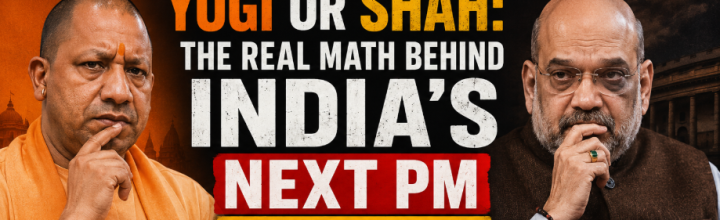
Every few months, a new theory appears about who will lead India after Narendra Modi. Right now, two names dominate the talk: Yogi Adityanath and Amit Shah. Add to this the loud claim that India is turning into a “Hindu Rashtra,” and you have a topic that gets clicks but rarely gets clear thinking. Let’s separate what is actually happening from what is guesswork.
Why this talk keeps coming back
Modi turned 75 in September 2025. In 2014, his own party set an informal rule: leaders past 75 step back from top posts. That rule sent two BJP giants, L.K. Advani and Murli Manohar Joshi, into retirement. So the question is fair: does the rule apply to Modi too?
So far, the answer from the party is no. Amit Shah himself has said Modi will complete his term. There is no sign of an early exit. This matters, because most of the succession talk assumes a vacancy that has not opened yet. Speculating about a job before it is vacant is not analysis. It is guesswork dressed up as news.
The case for Amit Shah
Shah runs the party machine. He has been Home Minister since 2019, and before that, he built the BJP’s election-winning system as party president. He has Modi’s trust and years of experience managing coalition politics, state elections, and internal party discipline. If loyalty and organisational control decide the next PM, Shah has the edge.
The case for Yogi Adityanath
Adityanath runs India’s biggest state, Uttar Pradesh, with 25 crore people. He has a mass base of his own, built through religious identity and a strongman image on law and order. Unlike Shah, he does not need Modi’s shadow to draw a crowd. That independence is his strength, and also his risk. A leader who does not owe his rise to the top brass is harder for that brass to control.
Why a clean 50-50 bet does not hold
Framing this as a coin toss between two men ignores how the BJP actually works. The party is not run by public opinion alone. The RSS, the ideological parent of the BJP, has enormous influence over who rises to the top. Analysts who track this closely note that whoever secures the RSS’s backing has the real advantage, not whoever looks more popular on television.
There is also a third possibility that most headlines skip: neither Shah nor Adityanath, but a less towering figure. Some observers argue Modi may prefer a successor who manages the party well but never threatens his own legacy. Names like Nitin Gadkari, Rajnath Singh, or newer state leaders such as Himanta Biswa Sarma are part of this quieter conversation. A dramatic two-man race makes for a better headline than a cautious committee decision, but Indian politics has favoured caution before.
The Hindu Rashtra question
This is where the reasoning needs the most care. “Hindu Rashtra” is not a legal position in India. The Constitution defines India as a secular republic, and that has not changed. What has changed is the space Hindu identity now occupies in public life and political messaging. The BJP’s rise, the Ram Mandir consecration, and years of majoritarian rhetoric have shifted the tone of national conversation.
But shifting tone is different from changing the Constitution. To formally declare a Hindu Rashtra, the BJP would need to amend the basic structure of the Constitution, something the Supreme Court has ruled cannot be touched even by Parliament. No party, however dominant, has tried to cross that line yet. So predicting an actual Hindu Rashtra as a near-certain outcome is not reality. It is a talking point used by both sides: supporters who want it, and critics who fear it, both benefit from repeating it loudly.
Where the freebie debate fits in
Both possible successors face the same trap Modi built his image against: welfare handouts, or “freebies,” used to win elections. Whoever takes over will inherit a country where free electricity, cash transfers, and subsidies have become standard campaign tools across every major party, BJP included. Cutting them back is politically risky. Continuing them strains state finances. This is a bigger, less discussed challenge than who sits in the PM’s chair.
What to actually expect
Modi stays until he chooses to leave, not until a headline forces the question. When succession does happen, RSS backing will matter more than public charisma. Shah has the trust, Adityanath has the base, and a quieter compromise candidate is not off the table. As for a formal Hindu Rashtra, the legal and constitutional barriers remain real, even as the cultural and political mood keeps shifting rightward.
The honest position is this: read the succession stories for entertainment, not prediction. Indian politics rewards patience over prophecy, and the next PM will be decided by internal party math, not by which name trends first on social media.
Comments

Hi, I’m Nishanth Muraleedharan (also known as Nishani)—an IT engineer turned internet entrepreneur with 25+ years in the textile industry. As the Founder & CEO of "DMZ International Imports & Exports" and President & Chairperson of the "Save Handloom Foundation", I’m committed to reviving India’s handloom heritage by empowering artisans through sustainable practices and advanced technologies like Blockchain, AI, AR & VR. I write what I love to read—thought-provoking, purposeful, and rooted in impact. nishani.in is not just a blog — it's a mark, a sign, a symbol, an impression of the naked truth. Like what you read? Buy me a chai and keep the ideas brewing. ☕💭 For advertising on any of our platforms, WhatsApp me on : +91-91-0950-0950 or email me @ support@dmzinternational.com