
Raids Before Takeovers? The Uncomfortable Questions India Must Ask About Adani, Corporate Power and Investigative Agencies

India proudly calls itself the world’s largest democracy. But democracy is not measured merely by elections, economic growth or the number of billionaires a country produces. It is also measured by whether institutions remain independent, businesses compete fairly, and the law treats everyone equally.
A troubling question has repeatedly surfaced in Indian public debate: Why have some companies or competing bidders faced investigative action before valuable assets eventually came under the control of the Adani Group?
The timing of these events deserves scrutiny. However, a raid followed by an acquisition does not, by itself, prove that the investigation was politically motivated or intended to benefit Adani. The real question is whether the facts, decisions and outcomes withstand independent examination.
1. Mumbai International Airport: The GVK Episode
In 2020, the CBI registered a case involving alleged financial irregularities connected with Mumbai International Airport. The Enforcement Directorate subsequently searched premises linked to GVK and associated entities. GVK disputed the allegations.
In 2021, Adani Airport Holdings took control of Mumbai International Airport.
The sequence raises legitimate questions. Did the investigation affect the circumstances in which control changed hands? Were the allegations investigated independently? Was the acquisition process fair to all parties?
The investigation and takeover are established events, but they do not establish that the raid was intended to facilitate the acquisition. Transparency is essential to distinguish evidence from suspicion.
2. NDTV: Corporate Ownership and Media Independence
In 2017, the CBI searched premises associated with NDTV founders Prannoy and Radhika Roy in connection with a loan-related case. The founders disputed the allegations. In 2022, Adani acquired control of NDTV through transactions involving Vishvapradhan Commercial Private Limited and associated shareholding arrangements.
These events should not automatically be treated as a coordinated operation. Nevertheless, the change in ownership raises a wider democratic concern.
When major news organisations become part of powerful corporate groups, can journalists freely investigate their owners’ commercial interests? Can they question government policies without fear of commercial or political consequences?
A free press is not simply another business asset. It is one of democracy’s essential safeguards.
3. Sanghi Industries: A Controversial Acquisition Timeline
The Sanghi Industries episode attracted particular attention because of the sequence of events.
According to a chronology publicised by the Congress party in 2023, Shree Cement was exploring an acquisition of Sanghi Industries. The Income Tax Department searched Shree Cement locations on June 21, 2023. Shree Cement subsequently withdrew from the acquisition race, and Adani-owned Ambuja Cements announced its acquisition of Sanghi Industries on August 3, 2023.
Congress alleged that investigative action against a competitor helped Adani secure the asset. However, the chronology alone does not prove that the searches were politically motivated or caused Shree Cement’s withdrawal.
Still, an important question remains: when a potential bidder faces an investigation and then exits a major acquisition contest, who independently examines whether competition was fair?
If the investigation was justified, the authorities should be able to defend it through lawful procedures. If any improper interference occurred, it should be investigated.
4. Jaiprakash Associates: The Insolvency Question
Jaiprakash Associates, with interests in infrastructure, cement and real estate, entered insolvency proceedings. The ED searched premises linked to the group and associated individuals in May 2025.
Adani Enterprises subsequently won the insolvency bid. The National Company Law Tribunal approved its resolution plan in March 2026, and the decision became the subject of further legal proceedings involving competing bidder Vedanta.
The approval of an insolvency resolution does not establish an improper takeover. However, when valuable assets change hands through insolvency, the process must be transparent and competitive. Creditors, employees and competing bidders deserve confidence that the outcome reflects the merits of the bids rather than any outside influence.
5. GVK Energy: A Separate Acquisition, a Wider Question
In 2026, the Competition Commission of India approved Adani Power’s acquisition of GVK Energy through insolvency proceedings.
The earlier investigation involving GVK Group and Mumbai International Airport makes this a case worth examining in a broader corporate chronology. But the airport investigation and the later energy acquisition are separate matters. There is no basis to assume that one caused the other.
The relevant questions concern the fairness of the insolvency process, the competing bids and the transparency of the final decision.
6. Gopalpur Port and Karaikal Port: Who Benefits From Infrastructure Consolidation?
Adani Ports announced its acquisition of Gopalpur Port in Odisha in March 2024 at an enterprise value of approximately ₹3,080 crore. The transaction involved sellers associated with the Shapoorji Pallonji Group and Orissa Stevedores Limited.
Adani Ports had earlier acquired Karaikal Port in Puducherry in 2023 for approximately ₹1,485 crore through the insolvency process.
Public debate has also connected investigative action involving interests associated with some of these businesses to the broader pattern of acquisitions. However, the precise targets, dates and legal outcomes must be established before claiming that a raid directly facilitated either transaction.
The larger concern is the concentration of infrastructure assets. Ports influence trade, logistics, industrial development and national connectivity. Their ownership deserves close scrutiny from competition authorities and regulators, regardless of which company acquires them.
7. Krishnapatnam Port: The Expansion of Port Power
Adani Ports acquired a controlling stake in Krishnapatnam Port in 2020. Critics have also raised questions about investigative action involving interests associated with the former owners, the Navayuga Group.
A direct causal connection between a particular raid and this acquisition should not be asserted without documentary evidence.
Nevertheless, the transaction belongs in a broader examination of India’s port sector. When a single corporate group controls an expanding network of strategically important ports, regulators must assess competition, market access and the consequences for businesses that depend on these facilities.
Corporate growth is legitimate. Unchecked concentration of strategic infrastructure is a separate question.
8. Quintillion Business Media: Expansion Into Financial Journalism
Adani acquired a 49% stake in Quintillion Business Media in 2022, expanding its presence in digital financial journalism.
This transaction deserves attention alongside the group’s acquisition of NDTV, not because it proves misconduct, but because ownership concentration in the media sector has implications for editorial independence.
When large corporate groups own businesses that operate in sectors they may also report on, transparency and strong editorial safeguards become particularly important.
The public must be able to distinguish independent journalism from corporate messaging.
9. Cement: ACC, Ambuja, Sanghi and Orient Cement
The Adani Group has significantly expanded its cement business.
In 2022, it acquired Holcim’s Indian cement operations, including ACC and Ambuja Cements. In 2023, Ambuja Cements acquired Sanghi Industries. In October 2024, Ambuja announced an agreement to acquire a 46.8% stake in Orient Cement at an equity value of approximately ₹8,100 crore.
These acquisitions demonstrate the group’s strategy of building a major cement business alongside its infrastructure interests.
The ACC and Ambuja businesses had previously faced regulatory scrutiny in the cement sector, including Competition Commission of India search operations in 2020. But those searches should not be portrayed as evidence that the later acquisition was engineered or coerced.
The real issue is whether the growing concentration of cement production affects competition, pricing and smaller manufacturers. Regulators must examine these questions using market data rather than political assumptions.
10. Coastal Energen and Other Distressed Assets
Coastal Energen, a thermal power company, was eventually acquired by Adani Power and Dickey Alternative Investment Trust through insolvency proceedings.
The case has appeared in wider discussions about investigative action and subsequent acquisitions. Yet the precise chronology and connection between any earlier search and the final transaction require careful verification.
The same caution applies to references involving Radius Estates and HDIL-linked projects. Investigative action involving a promoter, associate or related company is not equivalent to a raid on an entire business, and a transaction involving a particular project does not necessarily amount to a takeover of the whole company.
These cases should be included in a serious investigation only when the relevant ownership records, agency documents and transaction details can be established.
11. The Global Empire: Australia, Israel and Sri Lanka
Adani’s expansion extends far beyond India. Its international investments demonstrate the growing reach of the group across ports, energy and resource exports.
In Australia, the group acquired the Abbot Point coal export terminal under a 99-year lease in 2011 and developed interests in the Galilee Basin coal project. It also completed the acquisition of North Queensland Export Terminal in December 2025, strengthening its international port network.
In Israel, Adani Ports and Israel’s Gadot Group acquired Haifa Port in 2023 for approximately US$1.2 billion. Adani holds a 70% stake.
In Sri Lanka, Adani Ports developed Colombo West International Terminal through a joint venture with John Keells Holdings and the Sri Lanka Ports Authority under a 35-year build-operate-transfer concession.
The group also has port-related interests in Tanzania.
These investments are not established examples of raids forcing acquisitions. They illustrate a different point: Adani’s growing influence over strategic infrastructure extends across national borders.
The appropriate questions concern transparency, competition, environmental consequences, public accountability and the terms under which strategic assets are operated.
12. Kenya: When Proposed Deals Face Public Opposition
In 2024, proposed Adani-linked arrangements involving Jomo Kenyatta International Airport in Kenya triggered substantial public opposition. Kenya’s president subsequently announced the cancellation of the airport deal. A separate electricity-transmission arrangement was also cancelled amid controversy.
These were proposed deals that faced cancellation, not completed acquisitions. They illustrate that governments and citizens can scrutinise major infrastructure agreements and demand accountability before transactions proceed.
Public opposition does not automatically prove wrongdoing. Equally, a proposed investment should not be immune from scrutiny merely because it promises jobs, capital or infrastructure.
13. The Real Issue: Who Investigates the Investigators?
The cases above do not establish that every raid was politically directed or that every Adani acquisition was improper. But the public should be able to examine recurring patterns without being dismissed as anti-business or anti-national.
Investigative agencies must pursue genuine tax evasion, fraud and corruption. They must also be protected from political interference. Their credibility depends on consistent standards, transparent procedures and outcomes that withstand independent scrutiny.
The same principle applies to corporations. No business group should be presumed guilty because it succeeds. But no business group should be beyond scrutiny because it is powerful.
Parliament, courts, regulators, journalists and opposition parties all have a responsibility to demand answers. That responsibility must be exercised through documents, timelines, financial disclosures, competition assessments and judicial findings—not merely political slogans.
The opposition, too, must do more than hold press conferences. It should present documentary evidence, pursue parliamentary scrutiny, challenge questionable decisions through appropriate legal channels and explain how its proposed reforms would protect institutional independence.
Conclusion: Growth Without Accountability Is Not Progress
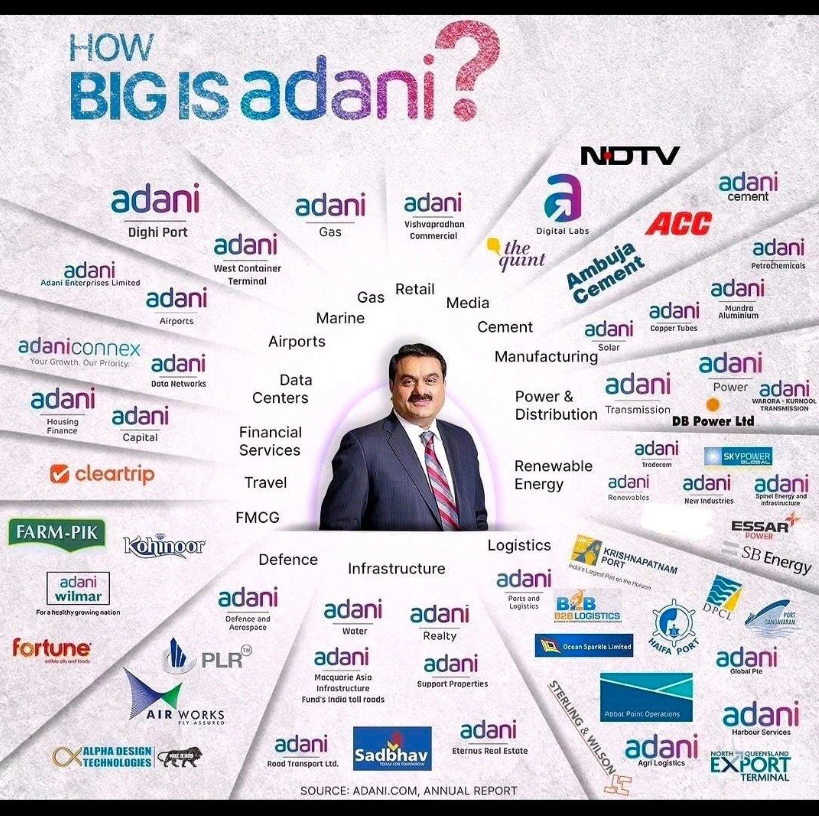
India needs ambitious businesses, strong infrastructure and global competitiveness. But economic development cannot become an excuse for weakening institutional independence or allowing market concentration to go unquestioned.
The central question is not whether Adani should acquire companies. It is whether every competitor receives a fair opportunity, every investigation follows the law, and every acquisition withstands independent examination.
If the process is fair, transparency will strengthen confidence in the outcome. If the process is not fair, transparency is the first step towards accountability.
A democracy must never ask its citizens to choose between economic growth and institutional integrity. It needs both. And when powerful businesses expand amid controversies over investigative action, asking difficult questions is not anti-business or anti-national. It is a democratic responsibility.
Comments

Hi, I’m Nishanth Muraleedharan (also known as Nishani)—an IT engineer turned internet entrepreneur with 25+ years in the textile industry. As the Founder & CEO of "DMZ International Imports & Exports" and President & Chairperson of the "Save Handloom Foundation", I’m committed to reviving India’s handloom heritage by empowering artisans through sustainable practices and advanced technologies like Blockchain, AI, AR & VR. I write what I love to read—thought-provoking, purposeful, and rooted in impact. nishani.in is not just a blog — it's a mark, a sign, a symbol, an impression of the naked truth. Like what you read? Buy me a chai and keep the ideas brewing. ☕💭 For advertising on any of our platforms, WhatsApp me on : +91-91-0950-0950 or email me @ support@dmzinternational.com